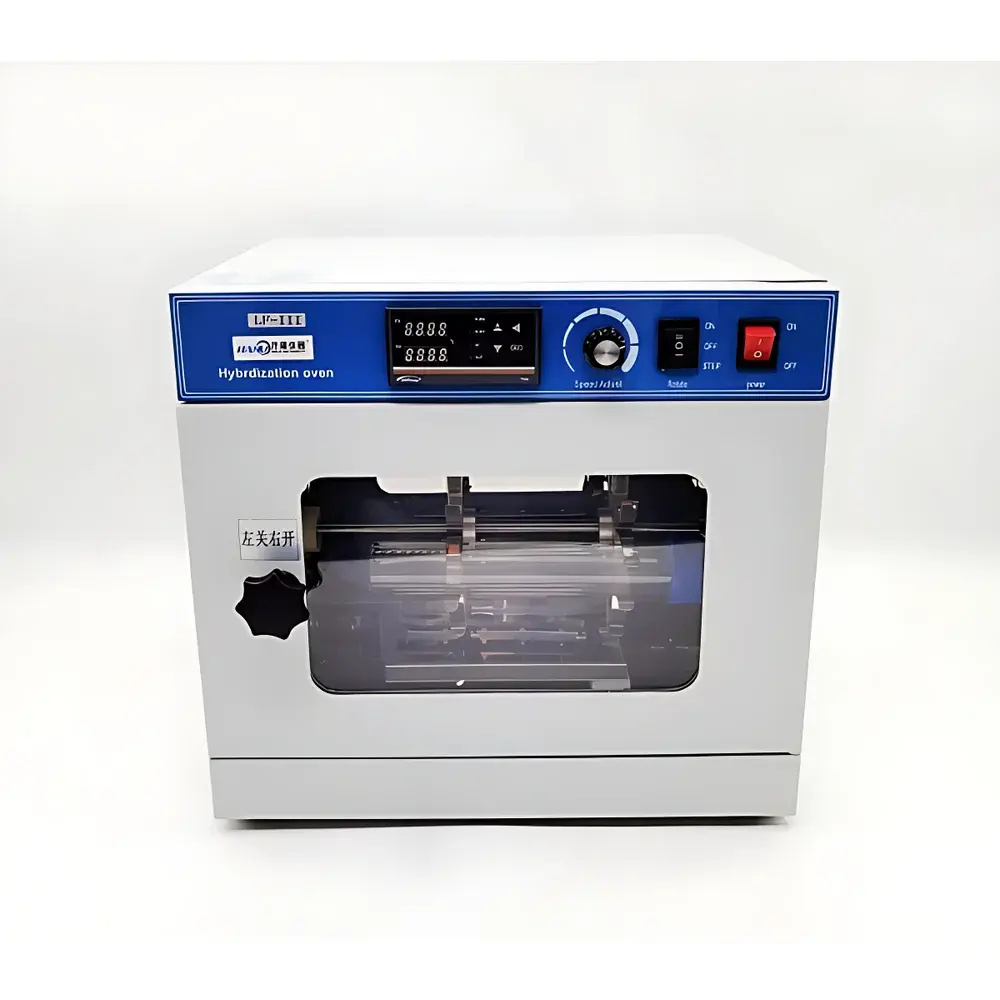
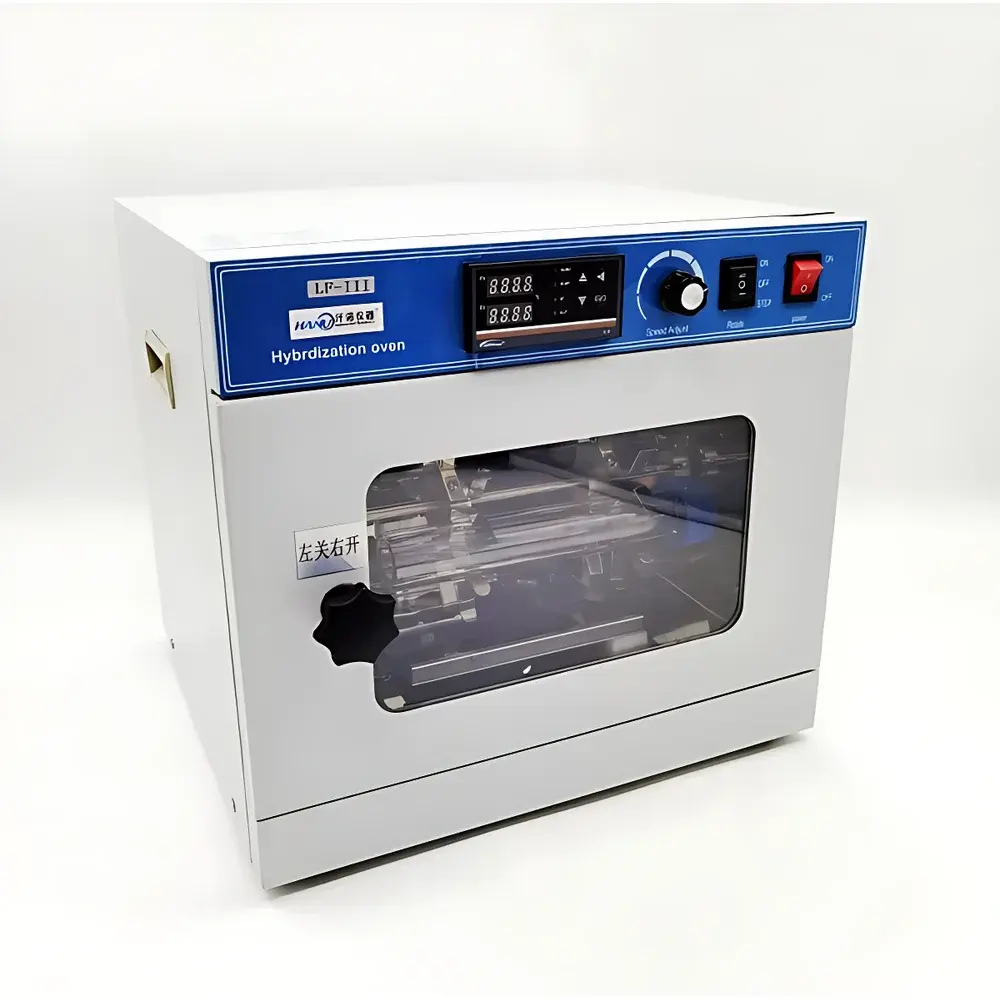
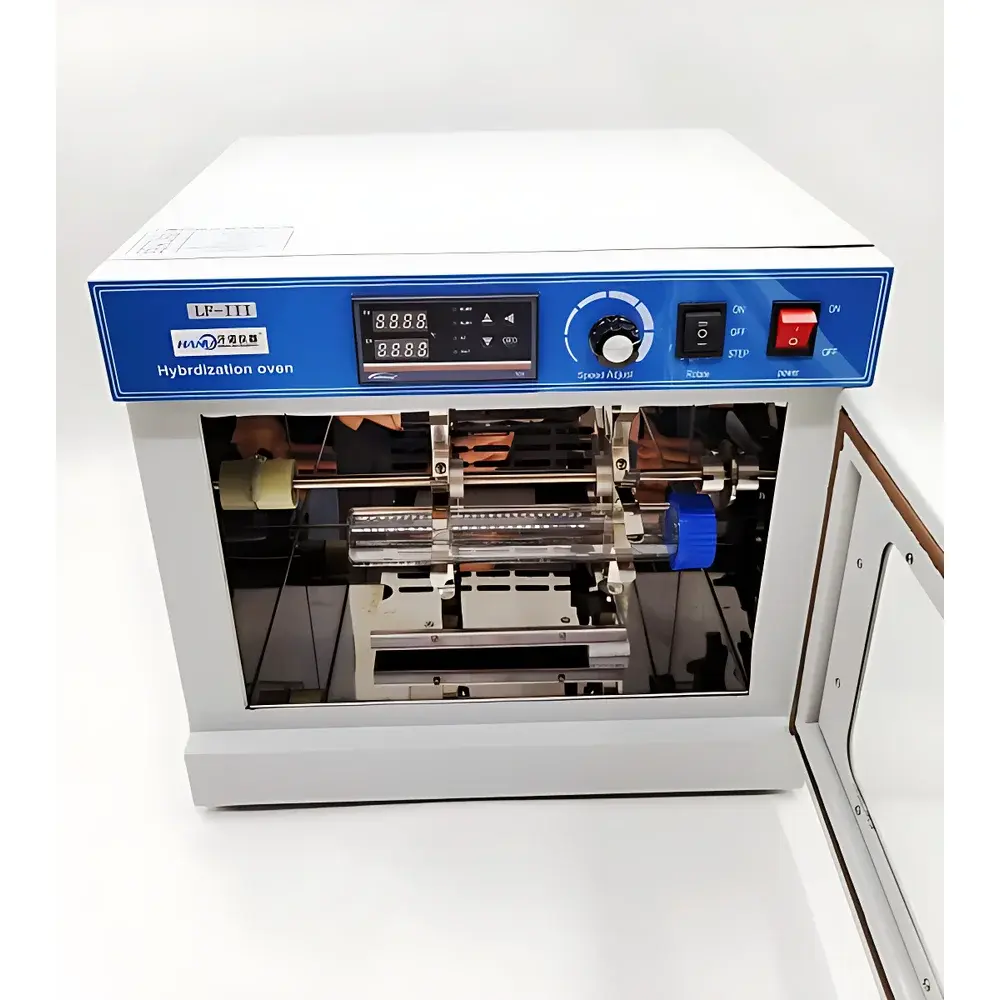
Hanuo LF-III Molecular Hybridization Instrument
| Brand | Hanuo |
|---|---|
| Origin | Shanghai, China |
| Model | LF-III |
| Instrument Type | Nucleic Acid Molecular Hybridization Instrument |
| Temperature Range | Ambient +5°C to 100°C |
| Temperature Uniformity | ±0.5°C |
| Rotational Speed | 5–20 rpm |
| Temperature Resolution | 0.1°C |
| Temperature Equilibration Time | <20 min |
| Vibration Function | Adjustable frequency for microplate agitation |
| Hybridization Tube Capacity | Ø35 × 220 mm |
| Dimensions (L×W×H) | 420 × 380 × 380 mm |
| Power Supply | 220 VAC, 50 Hz |
| Power Consumption | <600 VA |
| Net Weight | 21 kg |
Overview
The Hanuo LF-III Molecular Hybridization Instrument is a benchtop thermal incubation system engineered for controlled nucleic acid hybridization, enzymatic immunoassays, and PCR-related post-amplification processing. It operates on the fundamental principle of temperature-dependent DNA/RNA strand annealing—where complementary sequences form stable duplexes under precisely regulated thermal conditions. Unlike static incubators, the LF-III integrates programmable rotational motion and optional microplate vibration to enhance solution homogeneity, minimize boundary layer effects, and improve probe-target binding kinetics—critical for high-sensitivity detection in diagnostic and research applications. Designed for compatibility with standard hybridization tubes (Ø35 × 220 mm), it supports both membrane-based and solution-phase hybridization protocols without requiring vacuum or fluidics infrastructure. Its architecture prioritizes thermal stability and reproducibility over broad automation, making it suitable for laboratories performing routine molecular diagnostics—including viral/bacterial pathogen genotyping, SNP screening, and quantitative/semi-quantitative ELISA-PCR integration workflows.
Key Features
- Precise digital PID temperature control with resolution of 0.1°C and uniformity maintained within ±0.5°C across the chamber volume
- Adjustable rotation speed (5–20 rpm) with ±0.5 rpm accuracy, enabling consistent mixing during hybridization or antibody incubation steps
- Dedicated microplate vibration module with tunable frequency—optimized for ELISA plate washing, secondary antibody incubation, and signal amplification steps
- Fast thermal equilibration (<20 minutes from ambient to target temperature), minimizing protocol downtime
- Continuous 24-hour operational capability with thermal overload protection and auto-shutdown safeguards
- Compact footprint (420 × 380 × 380 mm) and low power draw (<600 VA), compatible with standard laboratory electrical circuits
- Robust stainless-steel and reinforced polymer construction ensuring long-term mechanical stability and resistance to chemical exposure
Sample Compatibility & Compliance
The LF-III accommodates standard cylindrical hybridization tubes (Ø35 × 220 mm), supporting both nylon and nitrocellulose membranes, glass slides, and solution-phase hybridization formats. While not designed for high-throughput multi-well plate hybridization, its vibration-enabled microplate mode meets common requirements for ELISA-coupled nucleic acid detection systems. The instrument complies with IEC 61010-1:2010 for safety in laboratory electrical equipment and conforms to electromagnetic compatibility standards EN 61326-1:2013. Though not certified for clinical diagnostic use under ISO 13485 or FDA 21 CFR Part 820, it is routinely deployed in GLP-aligned research labs performing method development for nucleic acid assays. Users implementing the LF-III in regulated environments should validate temperature distribution, rotational consistency, and vibration amplitude per internal SOPs aligned with ISO/IEC 17025 or CLIA guidelines.
Software & Data Management
The LF-III utilizes an embedded microcontroller-based interface with LED display and tactile keypad navigation—designed for reliability rather than cloud connectivity. All temperature setpoints, rotation speeds, vibration parameters, and runtime durations are locally stored and recalled via non-volatile memory. No proprietary software or PC interface is provided; however, the device supports external data logging via optional analog voltage output (0–5 V) proportional to chamber temperature—enabling integration with third-party DAQ systems or LIMS platforms. Audit trails are not natively generated, but manual logbook entries or external time-stamped thermal recordings satisfy basic GLP documentation needs. For laboratories requiring 21 CFR Part 11 compliance, validation of operator access controls and parameter change history must be implemented externally through procedural controls.
Applications
- Membrane-based Southern/Northern blot hybridization using radioisotopic or chemiluminescent probes
- Pre-hybridization blocking and post-hybridization stringency washes under controlled thermal gradients
- Enzyme-linked immunosorbent assay (ELISA) incubation steps where gentle agitation improves antigen-antibody binding efficiency
- Integration with PCR workflows for semi-quantitative detection—e.g., hybridization-based confirmation of amplicon identity prior to sequencing
- Viral load monitoring and bacterial species identification in clinical microbiology research settings
- Validation studies for hybridization-based point-of-care test development
FAQ
What types of hybridization tubes are compatible with the LF-III?
Standard cylindrical tubes with outer diameter 35 mm and length up to 220 mm—commonly used for membrane hybridization in sealed bags or open vessels.
Does the LF-III support programmable multi-step temperature profiles?
No—it maintains a single user-defined temperature setpoint throughout operation; gradient or ramping functions are not available.
Can the vibration function be used independently of rotation?
Yes—the microplate vibration mode operates separately from tube rotation, allowing independent optimization for ELISA or bead-based assays.
Is the LF-III suitable for overnight hybridization protocols?
Yes—its 24-hour continuous operation capability and thermal stability make it appropriate for extended incubations typical in low-stringency hybridizations.
How is temperature uniformity verified across the chamber?
Uniformity is specified as ±0.5°C at steady state; users should perform mapping per ASTM E2251-17 using calibrated thermocouples at multiple spatial points during IQ/OQ qualification.