
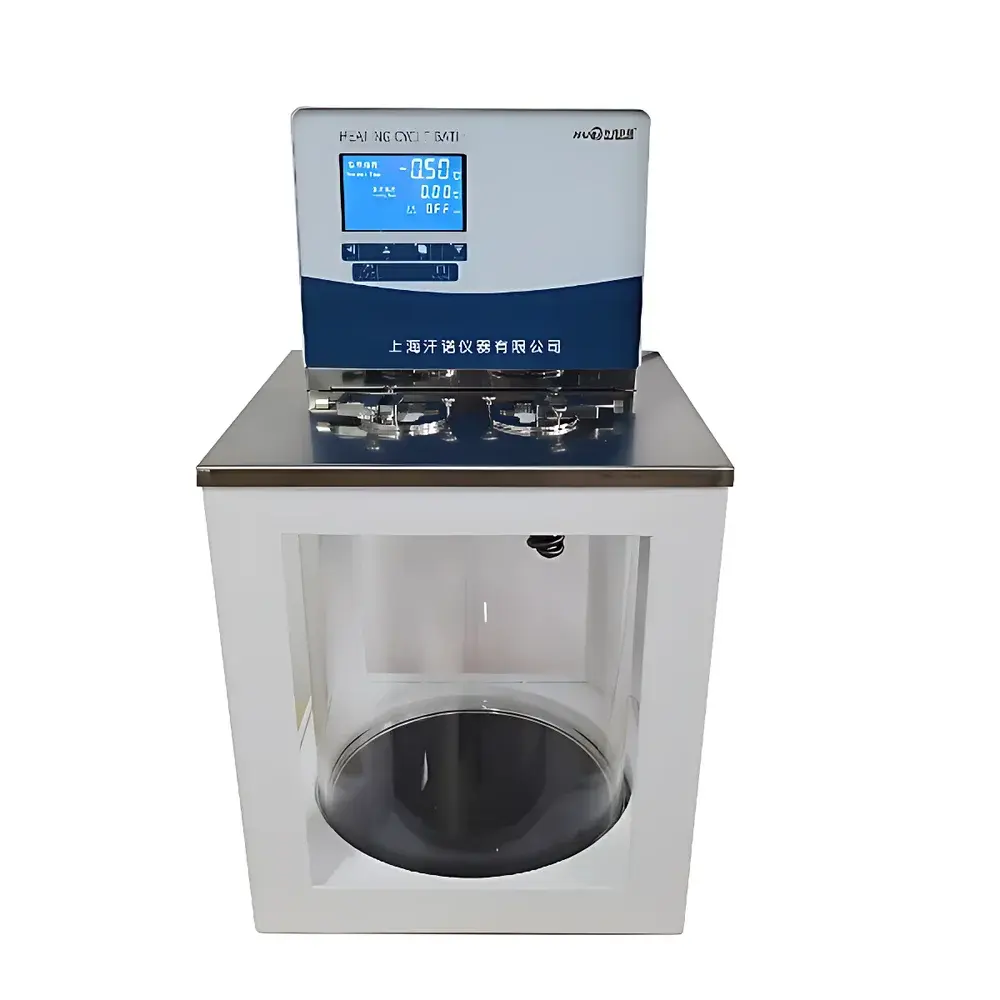
Hanuo WS-2-400-2 Intelligent Transparent Glass Water Bath Circulator
| Brand | Hanuo |
|---|---|
| Origin | Shanghai, China |
| Model | WS-2-400-2 |
| Instrument Type | Constant-Temperature Water Bath Circulator |
| Circulation Mode | Internal Circulation Only |
| Temperature Control | Heating-Only |
| Bath Volume | 24 L |
| Temperature Range | RT + 5 °C to 100 °C |
| Temperature Stability | ±0.05 °C |
| Temperature Resolution | 0.01 °C |
| Input Power | 1200 W |
| Supply Voltage | 220 V AC |
| Display | Large LCD with Touch Keypad |
| Safety Features | Dual-Stage Overtemperature Protection, Dry-Run Prevention via Level Sensor, PT100 Sensor Fault Detection, Adjustable Temperature Offset Calibration |
| Communication Interface (Optional) | RS-232 or RS-485 |
Overview
The Hanuo WS-2-400-2 Intelligent Transparent Glass Water Bath Circulator is an engineered thermal stability platform designed for precision temperature-controlled immersion applications in analytical laboratories and material testing environments. Utilizing a high-efficiency resistive heating system coupled with a PID-based digital temperature controller, the unit maintains consistent thermal conditions within a transparent borosilicate glass bath chamber—enabling real-time visual monitoring of samples during viscosity measurements, polymer dissolution, pharmaceutical solubility studies, or petroleum product analysis per ASTM D445 and ISO 3104. Its open-bath architecture (dual Ø65 mm ports, 400 mm depth) supports standardized viscometer immersion, while the internal recirculation pump ensures uniform thermal distribution across the 24-liter working volume—critical for reproducible rheological data acquisition in QC/QA workflows.
Key Features
- Transparent borosilicate glass bath chamber with four-sided viewing windows for unobstructed sample observation and alignment verification.
- Digital PID temperature controller with auto-tuning capability; user-adjustable P/I/D parameters for optimized response across diverse thermal loads and media (water, silicone oil, ethylene glycol).
- High-resolution 0.01 °C temperature display and ±0.05 °C stability at setpoint—validated under steady-state conditions per IEC 61000-4-30 compliance requirements.
- Multi-layer safety architecture: primary overtemperature cutoff (mechanical thermostat), secondary electronic limit (software-enforced), dry-run protection via liquid-level sensor, and real-time PT100 resistance fault detection.
- Full parameter lock function prevents unauthorized modification of setpoints, calibration offsets, or operational modes—supporting GLP-compliant documentation practices.
- Integrated temperature offset correction allows post-calibration adjustment to compensate for sensor drift or bath gradient effects—traceable to NIST-traceable reference thermometers.
- Energy-efficient 1200 W heating element operating at 220 V AC, rated for continuous duty at 100 °C with thermal load management to minimize ambient heat dissipation.
Sample Compatibility & Compliance
The WS-2-400-2 accommodates standard rotational viscometers (e.g., Brookfield, Anton Paar), capillary viscometers (Ubbelohde, Cannon-Fenske), and immersion-type density meters. Its open-top design permits vertical insertion of probe assemblies up to 380 mm in length. The bath complies with general electrical safety standards IEC 61010-1 and electromagnetic compatibility requirements IEC 61326-1. While not certified for hazardous locations, it meets essential performance criteria referenced in USP (Viscosity Measurements), ASTM D1259 (Plastics—Thermal Stability), and ISO 1628-1 (Polymers in Solution—Viscosity Number Determination). All firmware logic adheres to deterministic timing constraints required for audit-ready operation in regulated environments.
Software & Data Management
The unit supports optional RS-232 or RS-485 serial communication for integration into centralized laboratory information management systems (LIMS) or SCADA platforms. ASCII protocol enables bidirectional command exchange—including real-time temperature readback, setpoint updates, alarm status polling, and event logging. When connected to compliant software (e.g., LabVIEW, MATLAB, or custom Python scripts using PySerial), the device provides timestamped data streams suitable for 21 CFR Part 11–aligned electronic records—provided external validation confirms audit trail integrity, user authentication, and data immutability controls.
Applications
- Viscosity determination of crude oils, lubricants, and synthetic esters per ASTM D445 and IP 71.
- Thermal conditioning of polymer melts prior to melt flow index (MFI) testing per ASTM D1238.
- Solubility and dissolution rate profiling of active pharmaceutical ingredients (APIs) in aqueous and non-aqueous media.
- Calibration verification of liquid-in-glass thermometers and digital probes against reference standards.
- Controlled-temperature incubation of enzymatic reaction mixtures where optical clarity enables spectrophotometric endpoint monitoring.
FAQ
Is the bath suitable for use with flammable solvents?
No. The WS-2-400-2 is rated for aqueous and high-flashpoint silicone oils only. It lacks explosion-proof certification and must not be operated with low-flashpoint organic solvents such as acetone, ethanol, or hexane.
Can temperature calibration be performed in-house?
Yes. The unit includes a user-accessible temperature offset adjustment function. Calibration should be conducted using a NIST-traceable reference thermometer immersed at the geometric center of the bath, following ISO/IEC 17025–recommended procedures.
What maintenance is required for long-term stability?
Routine inspection of the water level sensor, periodic cleaning of the glass chamber with mild detergent and deionized water, and annual verification of heater resistance and grounding continuity are recommended. Avoid abrasive cleaners that may scratch the glass surface.
Does the internal circulation pump operate continuously?
Yes. The impeller-driven circulation system runs synchronously with heating to ensure laminar, homogeneous thermal distribution—no manual activation or speed adjustment is provided.
Is remote monitoring possible without additional hardware?
Basic remote readout requires only the optional RS-232 cable and terminal emulation software. For automated data logging or network integration, a USB-to-serial adapter or industrial protocol gateway may be necessary depending on host system configuration.



