
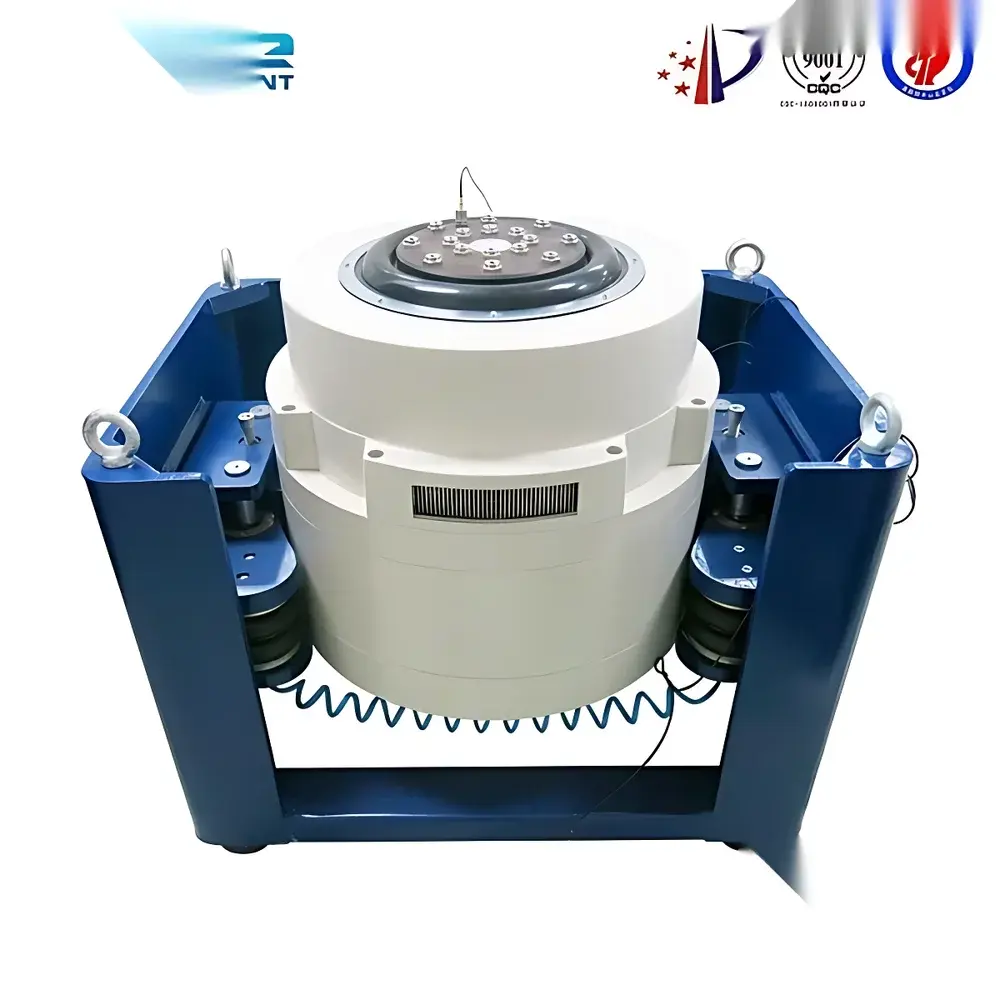
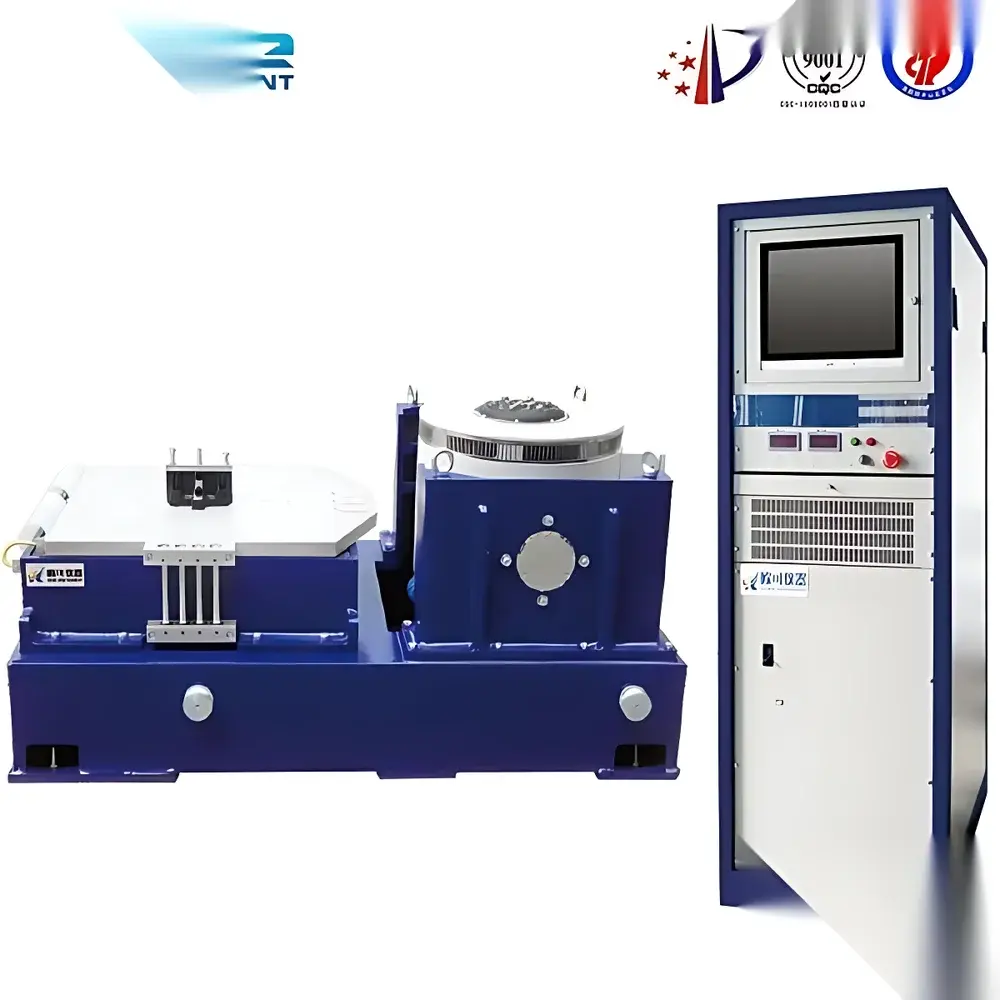
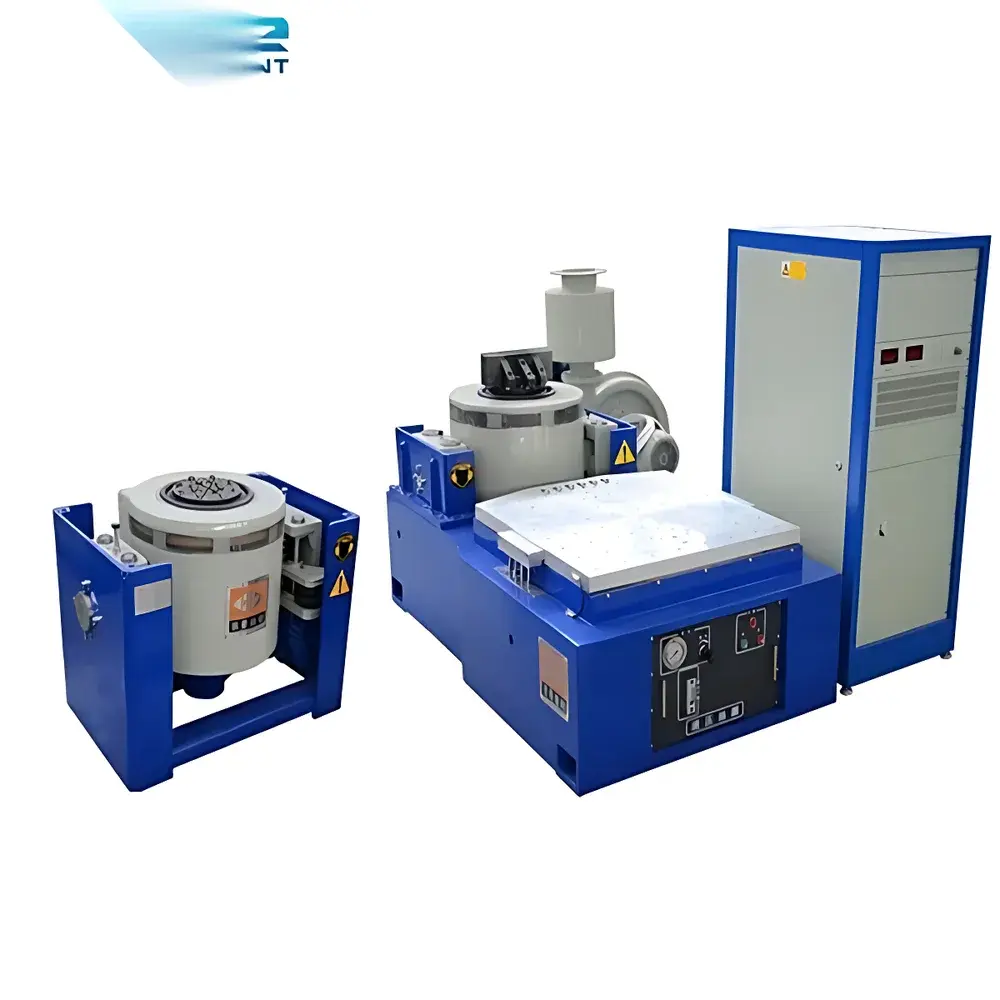
Sinusoidal Electromagnetic Vibration Shaker ES-6
| Brand | Other Brands |
|---|---|
| Origin | Imported |
| Manufacturer Type | Authorized Distributor |
| Table Surface Dimensions | 500 × 500 mm |
| Vibration Axes | Vertical, Horizontal, Triaxial |
| Max. Load Capacity | 100 kg |
| Frequency Range | 1–400 Hz |
| Sweep Frequency Range | 1–600 Hz |
| Displacement Amplitude | 0–5 mm |
| Max. Acceleration | 20 g |
| Vibration Waveforms | Sinusoidal, Half-Sinusoidal |
| Drive Power | 2.2 kW |
| Supply Voltage | 220 V ±10% |
| Max. Current | 5 A |
| Frequency Resolution | 0.01 Hz |
| Frequency Accuracy | ±0.1 Hz |
| Shaker Body Dimensions | 50 × 50 × 16 cm |
| Time Control Range | Up to 1 year (programmable in seconds) |
| Communication Interface | RS-485 |
Overview
The Sinusoidal Electromagnetic Vibration Shaker ES-6 is an electromagnetically driven mechanical excitation system engineered for precise, repeatable sinusoidal and half-sinusoidal vibration testing in laboratory and industrial quality assurance environments. Based on Lorentz-force actuation principles, the shaker converts electrical current into controlled mechanical motion via a voice-coil motor assembly interacting with a permanent magnetic field—enabling high-fidelity waveform reproduction without hydraulic or pneumatic complexity. Its design supports both steady-state harmonic excitation and dynamic spectral sweeps across a broad operational bandwidth (1–400 Hz nominal, extendable to 600 Hz during sweep modes), making it suitable for modal analysis, fatigue life assessment, resonance detection, and compliance verification against international vibration test standards including ISO 10816, IEC 60068-2-6, and MIL-STD-810H Method 514.7.
Key Features
- Triaxial vibration capability—switchable between vertical, horizontal, and simultaneous three-axis operation via configurable mounting interface and controller logic.
- High-fidelity waveform generation: digitally synthesized sinusoidal and half-sinusoidal profiles with programmable amplitude, frequency, and phase relationships.
- Precision frequency control: real-time digital display resolution of 0.01 Hz and closed-loop accuracy within ±0.1 Hz across the full operating range.
- Robust mechanical architecture: rigid 500 × 500 mm aluminum alloy table surface rated for 100 kg static load and sustained 20 g peak acceleration at resonance.
- Integrated RS-485 serial interface enabling remote command execution, real-time data streaming, and synchronization with external DAQ systems or environmental chambers.
- Programmable time-based test sequencing: user-defined test durations from 1 second up to 365 days, supporting multi-step profiles with ramp, dwell, and abort conditions.
- Thermally optimized 2.2 kW electromagnetic drive unit with forced-air cooling, compliant with IEC 60034 insulation class F and continuous duty cycle specifications.
Sample Compatibility & Compliance
The ES-6 accommodates a wide range of test specimens—from printed circuit board assemblies and automotive ECUs to aerospace structural subcomponents—via standardized ¼”-20 and M6 threaded mounting patterns across the table surface. Its triaxial configuration allows evaluation of directional sensitivity in multi-degree-of-freedom systems. The shaker meets electromagnetic compatibility requirements per EN 61326-1 (industrial environment) and safety standards per EN 61000-6-2/6-4. It supports traceable calibration per ISO/IEC 17025-accredited procedures and integrates seamlessly into GLP/GMP-compliant test workflows when paired with audit-trail-enabled software (see Software & Data Management section). Test reports generated using this system are admissible for regulatory submissions requiring evidence of mechanical robustness under defined vibratory stress conditions.
Software & Data Management
The ES-6 operates with vendor-neutral SCPI-compatible command sets over RS-485, enabling integration with LabVIEW, MATLAB, Python (PySerial), or custom-built test executive platforms. Optional PC-based control software provides graphical waveform editing, real-time FFT spectrum monitoring, automated sweep parameterization (logarithmic, linear, stepped), and pass/fail threshold mapping against user-defined acceleration or displacement envelopes. All test logs—including timestamps, setpoints, actual measured values, and system status flags—are stored in CSV or XML format with embedded metadata for full traceability. When deployed in regulated environments, the software supports 21 CFR Part 11-compliant electronic signatures, role-based access control, and immutable audit trails for change history and operator actions.
Applications
- Electronics reliability testing: solder joint fatigue, connector retention, and MEMS device integrity under harmonic excitation.
- Aerospace component qualification: vibration screening of avionics enclosures, sensor housings, and actuator subassemblies per DO-160 Section 8.
- Automotive NVH development: base excitation of suspension components, battery modules, and infotainment units to characterize resonant modes and damping behavior.
- Academic research: experimental modal analysis (EMA), structural health monitoring (SHM) algorithm validation, and piezoelectric energy harvester characterization.
- Quality assurance in manufacturing: incoming inspection of castings, weldments, and composite laminates using resonance search and dwell tests.
FAQ
What types of vibration waveforms does the ES-6 support?
The ES-6 generates pure sinusoidal and half-sinusoidal waveforms with user-adjustable amplitude, frequency, and duration. It does not support random, shock, or transient pulse profiles.
Can the ES-6 perform simultaneous multi-axis vibration?
Yes—the system supports synchronized vertical + horizontal biaxial operation and optional triaxial configurations via auxiliary shaker coupling and master-slave controller coordination.
Is calibration documentation provided with shipment?
Each unit ships with a factory calibration certificate referencing NIST-traceable accelerometers and laser vibrometers, valid for 12 months under normal operating conditions.
What is the maximum payload for sustained 20 g operation?
At 20 g peak acceleration, the recommended maximum mass is 50 kg to ensure long-term actuator reliability and thermal stability; 100 kg is the static load limit at low-frequency, low-acceleration conditions.
Does the ES-6 comply with FDA or ISO 13485 requirements for medical device testing?
While the hardware itself is not certified to ISO 13485, its performance characteristics and data integrity features (e.g., audit trail, electronic signature support) enable use in FDA-regulated medical device vibration validation protocols when implemented within a validated QMS framework.



