
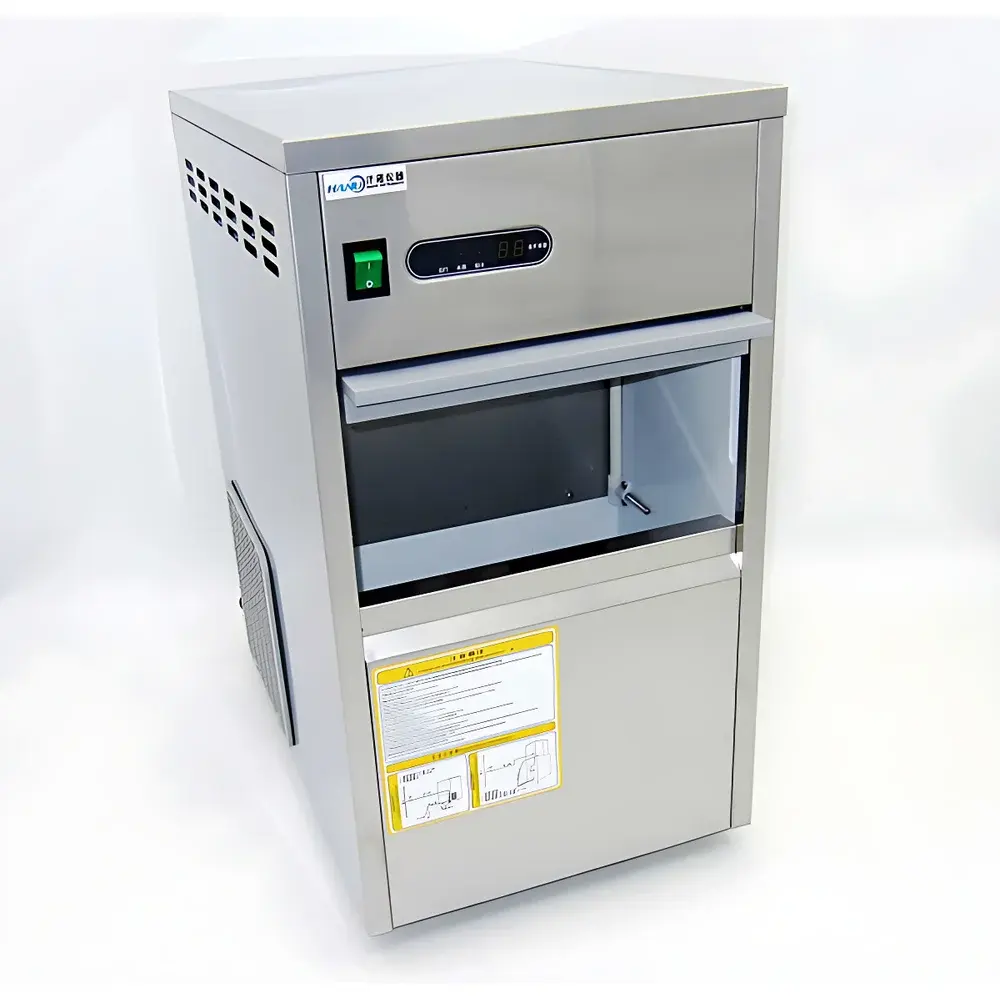
Hanuo FM150 Integrated Flake Ice Maker
| Brand | Hanuo |
|---|---|
| Origin | Shanghai, China |
| Model | FM150 |
| Ice Type | Flake Ice |
| Ice Production Capacity | 150 kg/24 h |
| Storage Capacity | 25 kg |
| Water Consumption | 5 kg/h |
| Cooling Method | Air-Cooled |
| Ice Making Principle | Dual-Screw Extrusion |
| Refrigerant | R134a |
| Power Supply | 220 V / 550 W |
| Dimensions (W×D×H) | 500 × 611 × 940 mm |
| Inlet | Automatic Tap Water Feed |
| Housing Material | Full Stainless Steel (AISI 304) |
| Compliance | CE-marked for laboratory use per EN 61000-6-3 & EN 61000-6-1 |
Overview
The Hanuo FM150 Integrated Flake Ice Maker is a compact, self-contained refrigeration system engineered for consistent, on-demand production of irregular, thin-flake ice—optimized for thermal contact efficiency and rapid cooling in scientific and industrial environments. Unlike cubed or nugget ice systems, flake ice generation relies on a dual-screw extrusion process: chilled evaporator surfaces freeze a thin water film, which is then mechanically scraped and compressed by counter-rotating stainless-steel screws to produce low-density, high-surface-area ice flakes (typically 1–3 mm thick, 5–15 mm diameter). This morphology ensures superior conformability around biological samples, reagent containers, and temperature-sensitive instrumentation—critical for cryopreservation workflows, cold-chain validation, and exothermic reaction quenching in QC/QA labs. The unit operates with R134a refrigerant under ASHRAE Standard 34 classification, and its air-cooled condenser eliminates dependency on facility water loops—making it suitable for decentralized lab installations where chilled water infrastructure is unavailable or impractical.
Key Features
- Integrated design with built-in storage bin (25 kg capacity), eliminating need for external ice transport or secondary handling.
- Dual-screw extrusion mechanism ensures uniform flake geometry, minimal ice bridging, and continuous output without manual defrost cycles.
- Full stainless-steel (AISI 304) construction—including evaporator drum, auger housing, and exterior panels—for corrosion resistance and compliance with ISO 14644-1 Class 7 cleanroom-compatible surface finish requirements.
- Microprocessor-based control system with real-time status indicators: operational mode, full-bucket detection, low-water alarm, and fault diagnostics (e.g., compressor overheat, sensor drift, or feed interruption).
- Automatic tap-water intake with integrated float valve and sediment filter—designed for stable operation under variable municipal pressure (0.1–0.6 MPa).
- Energy-efficient air-cooled condenser with axial fan and intelligent thermal load modulation; meets IEC 60335-1 safety standards for laboratory-class appliances.
Sample Compatibility & Compliance
The FM150 is validated for use with biological specimens (e.g., tissue biopsies, cell suspensions), diagnostic reagents, and pharmaceutical intermediates requiring sub-0°C stabilization during processing or transit. Its flake ice output exhibits low meltwater runoff (<8% mass loss over 30 min at 25°C ambient), minimizing dilution risks in sample preparation. The unit conforms to EN 61000-6-3 (EMC emission limits) and EN 61000-6-1 (immunity for residential/commercial environments), and its electrical architecture supports GLP-aligned documentation via optional RS485 Modbus RTU interface. While not certified for GMP manufacturing suites, it satisfies ISO/IEC 17025 Annex A.2 requirements for ancillary equipment used in accredited testing laboratories—provided routine calibration of water inlet flow rate and bin-level sensors is performed per internal SOPs.
Software & Data Management
The FM150 features embedded firmware with non-volatile memory logging of cumulative operating hours, total ice output (kg), and fault event timestamps (e.g., “Low Water Alert – 2024-06-12 14:22”). No proprietary software is required; event logs are accessible via front-panel LCD menu navigation. For integration into centralized lab monitoring platforms, the optional RS485 port enables read-only access to real-time parameters—including condenser temperature, evaporator surface temp, and motor current draw—using standard Modbus RTU protocol (function code 03). Audit trails comply with FDA 21 CFR Part 11 principles when paired with validated third-party SCADA systems that enforce user authentication and electronic signature workflows.
Applications
- Life sciences: Cold preservation of primary cells prior to cryovial loading; temperature control during ELISA plate incubation.
- Clinical diagnostics: Stabilization of CSF and serum samples during transport from collection site to central lab.
- Pharmaceutical QA: Rapid cooling of dissolution media in USP Apparatus II testing; maintaining excipient integrity during granulation trials.
- Food safety labs: Chilling homogenized food matrices pre-analysis (e.g., ISO 6579 for Salmonella enrichment).
- Industrial R&D: Thermal management of exothermic polymerization reactions in bench-scale reactors.
FAQ
What is the expected service life of the dual-screw extrusion assembly under continuous lab use?
With scheduled maintenance (biannual lubrication of drive gearboxes and quarterly inspection of scraper blade clearance), the extrusion module maintains dimensional stability for ≥8,000 operational hours.
Can the FM150 be installed in an enclosed cabinet or under a lab bench?
Yes—provided minimum rear and top clearances of 150 mm are maintained for condenser airflow; ambient temperature must remain ≤32°C per IEC 60068-2-14.
Is R134a refrigerant compatible with long-term regulatory compliance in the EU and North America?
R134a remains permitted under current F-Gas Regulation (EU) No 517/2014 and EPA SNAP Program for laboratory-scale equipment; however, users should monitor phase-down schedules for future retrofit planning.
Does the unit support remote monitoring via Ethernet or Wi-Fi?
No native Ethernet/Wi-Fi interface is included; connectivity requires external Modbus-to-Ethernet gateway hardware configured per IEEE 802.3 standards.
How frequently must the water inlet filter be replaced in hard-water regions?
In areas with >150 ppm CaCO₃ hardness, replace the 50-µm sediment filter every 90 days or after 1,200 L of throughput—whichever occurs first.



