
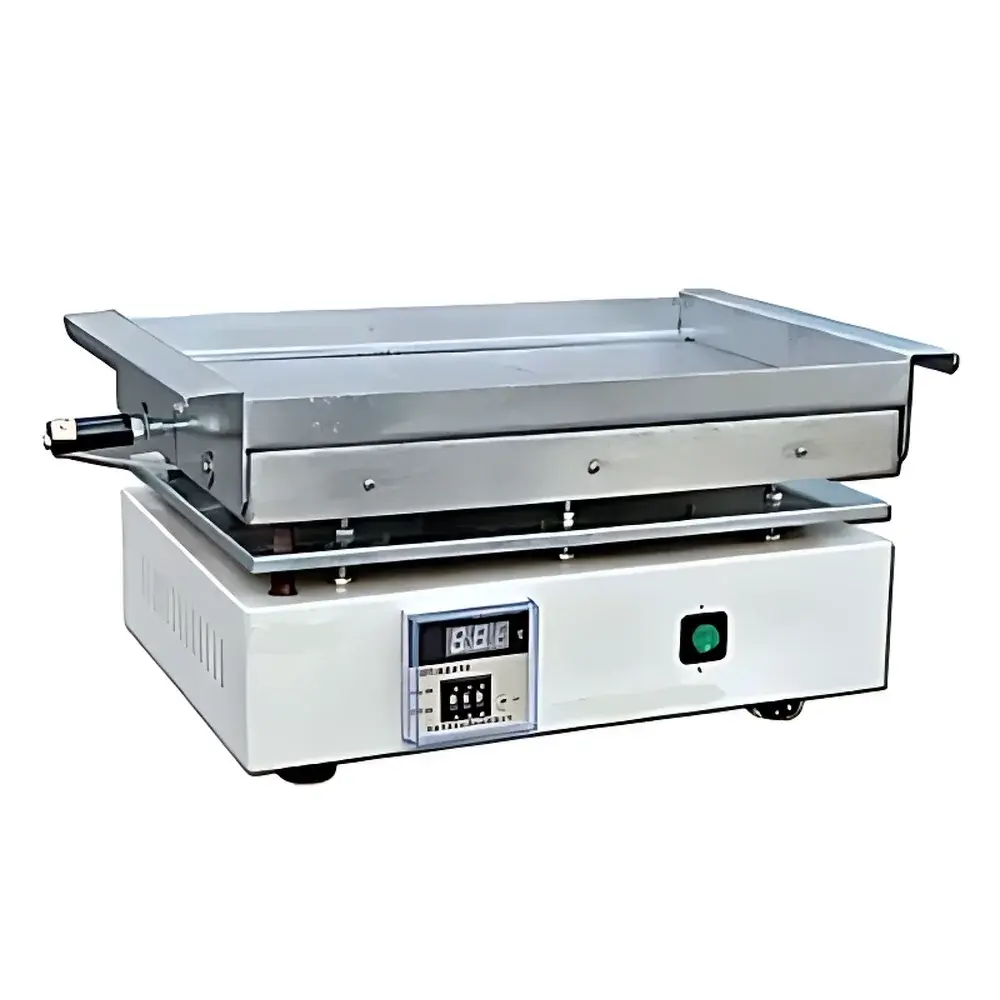
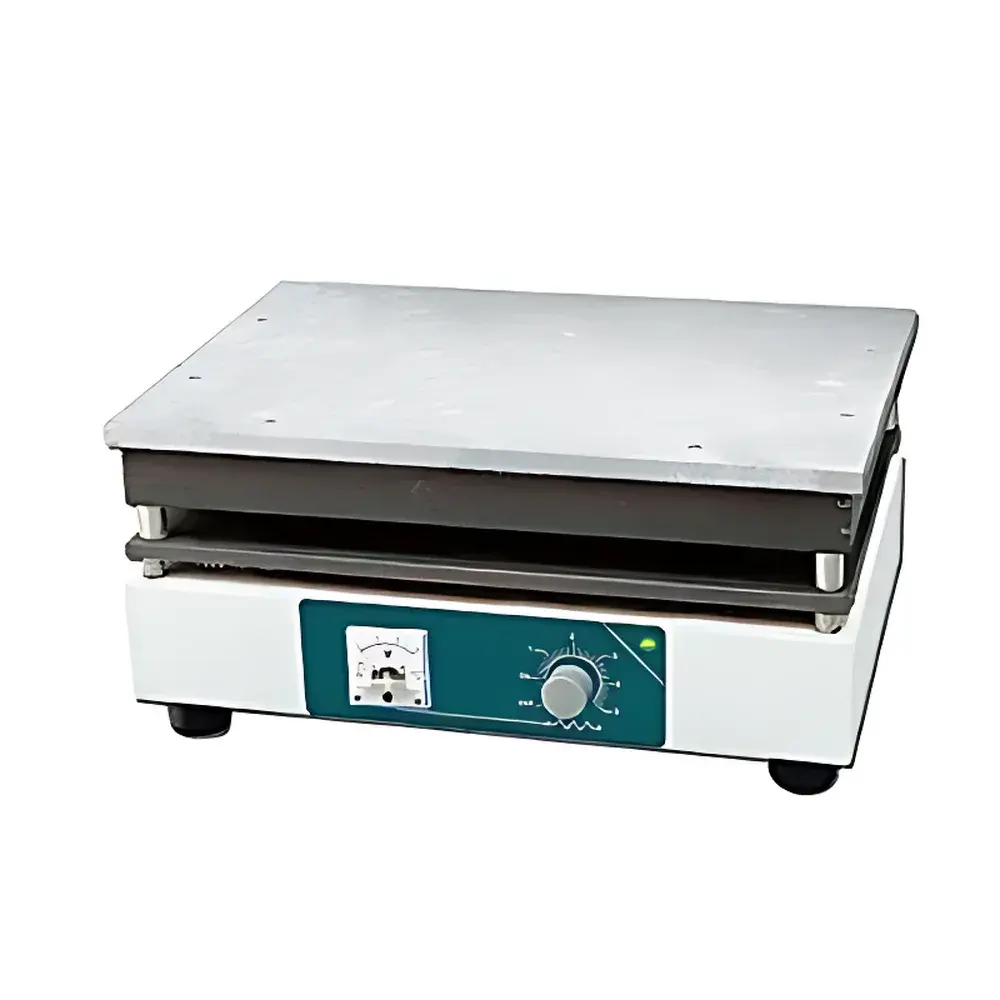
Hanuo DB-1 Stainless Steel Electric Heating Plate
| Brand | Hanuo |
|---|---|
| Model | DB-1 |
| Heating Power | 1.5 kW |
| Max Surface Temperature | 400 °C |
| Temperature Uniformity | ±3 °C |
| Heating Area | 400 × 280 mm |
| Plate Dimensions | 400 × 280 mm |
| Display | Optional Digital LED Display |
| Voltage | 220 V AC |
| Net Weight | 15 kg |
| Enclosure Finish | Electrostatic Powder Coating |
Overview
The Hanuo DB-1 Stainless Steel Electric Heating Plate is a robust, benchtop thermal platform engineered for precise, repeatable, and safe conductive heating in analytical laboratories, sample preparation workflows, and routine digestion protocols. Unlike open-coil hotplates, the DB-1 employs a fully enclosed resistive heating element embedded beneath a seamless 304 stainless steel top plate—eliminating exposed coils, minimizing oxidation risk, and preventing sample contamination from particulate shedding or thermal degradation byproducts. Its operational principle relies on Joule heating via silicon-controlled rectifier (SCR) phase-angle power control, enabling smooth, stepless adjustment of thermal output across the full 0–400 °C range. Designed for compliance with general laboratory safety standards (IEC 61010-1), the unit delivers stable surface temperatures with ±3 °C uniformity across its 400 × 280 mm active zone—critical for consistent evaporation, drying, ashing, or low-pressure acid digestion where thermal gradients can compromise reproducibility.
Key Features
- Seamless 304 stainless steel heating surface resistant to corrosion from acids (e.g., HNO₃, HCl), alkalis, and organic solvents—ideal for trace-metal sample prep under cleanroom or ISO/IEC 17025-accredited environments.
- SCR-based infinite variable power regulation ensures fine-grained thermal control without thermal overshoot, supporting method-defined ramp-and-hold protocols.
- Electrostatically applied powder coating on the structural chassis provides mechanical durability, chemical resistance, and long-term aesthetic integrity—meeting typical lab equipment finish specifications per ASTM D7234.
- Bench-friendly footprint (400 × 280 × 200 mm) and modest 15 kg net weight facilitate integration into fume hoods, laminar flow cabinets, or modular lab benches without requiring anchoring or dedicated power circuits.
- Digital LED display option enables real-time surface temperature monitoring with ±1 °C readout resolution—supporting documentation requirements for GLP-compliant workflows.
Sample Compatibility & Compliance
The DB-1 accommodates standard laboratory vessels including borosilicate glass beakers (50–1000 mL), quartz crucibles, PTFE digestion cups, and ceramic evaporating dishes. Its flat, non-porous surface ensures even contact conduction and eliminates edge cooling effects common in ribbed or cast-iron plates. While not certified for Class I Div 1 hazardous locations, the unit complies with general-purpose electrical safety requirements for non-explosive laboratory environments (IEC 61010-1 Ed. 3). It supports method validation under EPA Method 3050B (acid digestion of sediments and soils) and ASTM D5686 (determination of moisture content in aggregates) when used within defined thermal parameters. No integrated temperature probe port is provided; external PT100 or thermocouple-based verification is recommended for audit-ready calibration records.
Software & Data Management
The Hanuo DB-1 operates as a standalone analog-controlled instrument and does not include embedded firmware, USB connectivity, or data logging capability. Temperature setpoint and output are manually adjusted via front-panel rotary controller. For labs requiring electronic recordkeeping, optional third-party digital temperature loggers (e.g., Omega OM-EL-USB-TC) may be deployed alongside the unit to capture surface temperature profiles over time. Such external validation aligns with FDA 21 CFR Part 11 principles when paired with appropriate procedural controls and audit trail documentation—though the DB-1 itself does not implement electronic signature or user access management features.
Applications
- Controlled evaporation of solvents during sample concentration prior to ICP-MS or AAS analysis.
- Low-temperature ashing of biological tissues at ≤350 °C to preserve elemental integrity.
- Pre-drying of filter papers, gravimetric crucibles, or desiccant trays in environmental and pharmaceutical QC labs.
- Heating reaction mixtures in sealed vials during derivatization steps (e.g., dansylation, silylation) where oil baths are impractical.
- Supporting ASTM E1867 gelatinization studies in food science labs through precise, sustained heating of starch suspensions.
FAQ
Is the DB-1 suitable for use with hydrofluoric acid (HF)?
No. Although the 304 stainless steel surface resists many common acids, it is not HF-resistant. Use only PTFE- or quartz-lined alternatives for HF-based digestions.
Does the unit include over-temperature protection?
Yes—it incorporates a redundant bimetallic thermal cutoff rated at 450 °C to prevent catastrophic failure in case of controller malfunction.
Can the digital display be retrofitted post-purchase?
No. The display option must be specified at time of order; internal wiring and PCB layout differ between analog and digital variants.
What is the recommended calibration frequency?
Per ISO/IEC 17025 Clause 6.4.10, verify surface uniformity and accuracy annually—or before critical method validation—using NIST-traceable surface probes.
Is the DB-1 compatible with programmable ramp-soak controllers?
Not natively. Integration requires external SCR controllers with 4–20 mA or 0–10 V analog input interfaces; consult Hanuo technical support for wiring schematics and isolation recommendations.



