
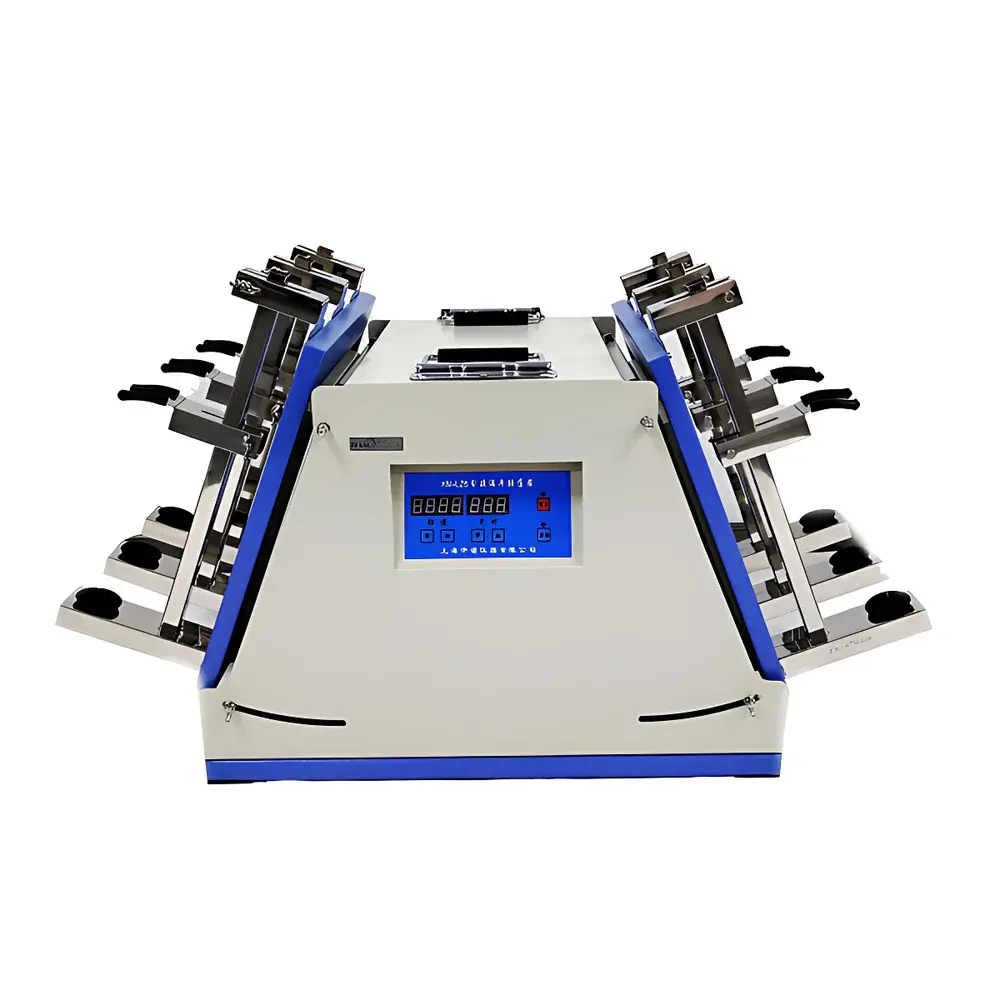
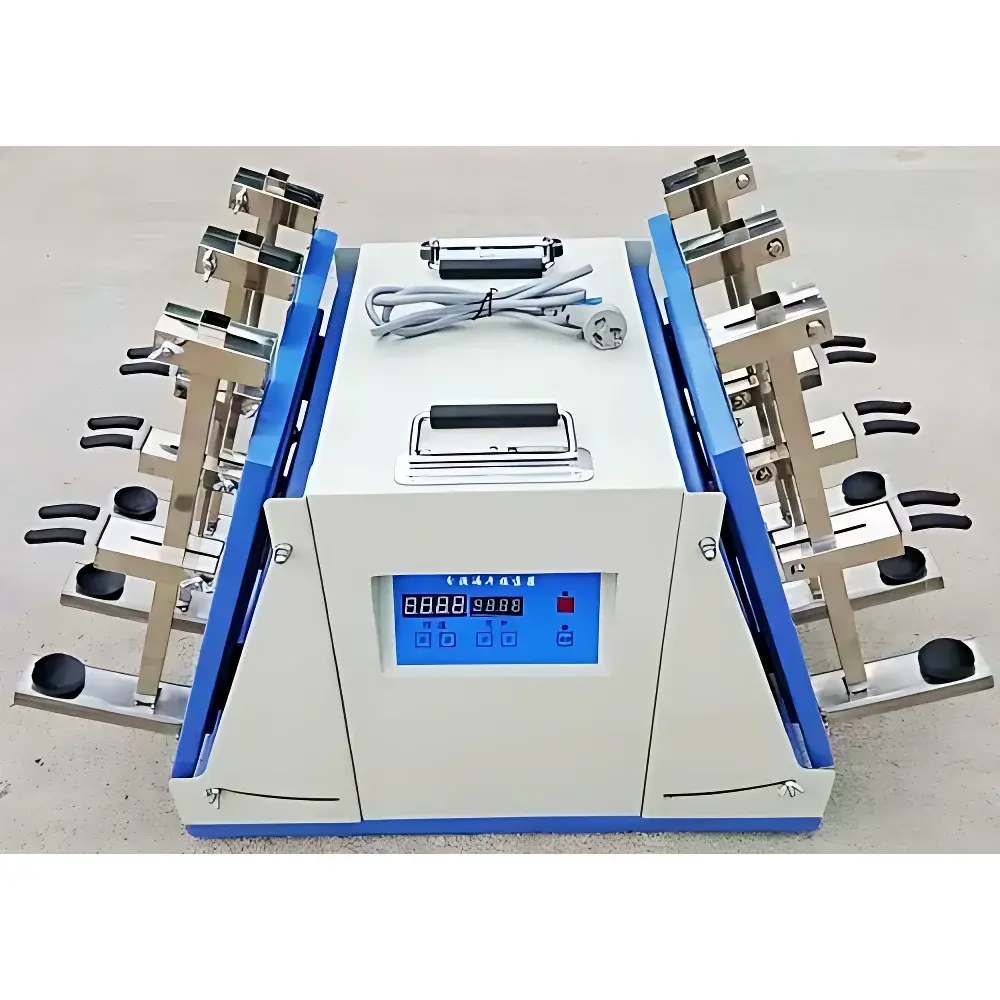
Hanuo HN-LZ6 Vertical/Lateral Liquid-Liquid Extraction Shaker
| Brand | Hanuo |
|---|---|
| Origin | Shanghai, China |
| Model | HN-LZ6 |
| Extraction Efficiency | 0–99% |
| Extraction Time Range | 0–999 min |
| Oscillation Modes | Vertical or Adjustable Tilt (0–22°) |
| Simultaneous Extraction Capacity | 6 separatory funnels |
| Oscillation Frequency Range | 10–300 rpm (vertical), 20–250 rpm (tilt) |
| Amplitude | 45 mm |
| Max Load per Side | ~7 kg (including fixtures) |
| Noise Level | ≤55 dB(A) |
| Drive System | Brushless DC Motor |
| Fixture Compatibility | 50–3000 mL (standard & large fixtures included) |
| Timer Function | Digital, memory-retentive, supports timed & continuous operation |
| Safety Features | Soft-start & soft-stop acceleration/deceleration profiles |
Overview
The Hanuo HN-LZ6 Vertical/Lateral Liquid-Liquid Extraction Shaker is an engineered laboratory platform designed for reproducible, controlled mechanical agitation during solvent-based liquid-liquid extraction (LLE) procedures. Operating on the principle of reciprocating linear oscillation—either vertically or at a user-adjustable tilt angle up to 22°—the device induces efficient phase mixing between immiscible solvents while minimizing emulsion formation and facilitating rapid phase separation post-agitation. Its robust brushless DC motor delivers stable rotational frequency across the full 10–300 rpm range (vertical mode) with precise digital feedback, ensuring consistent kinetic energy transfer critical for method transferability in regulated environments. The system is purpose-built for applications requiring parallel processing of up to six separatory funnels under identical mechanical conditions, supporting standard volumetric formats from 50 mL to 3 L. Unlike orbital shakers or vortex mixers, the HN-LZ6’s linear oscillation geometry provides superior control over interfacial shear stress and residence time distribution—key parameters influencing extraction yield, selectivity, and recovery linearity per ISO 11843-1 and EPA Method 3510C.
Key Features
- Two selectable oscillation geometries: true vertical motion or adjustable tilt (0–22°) to optimize mixing intensity and phase coalescence kinetics
- Digital RPM display with memory retention—automatically recalls last-used frequency and timer settings after power cycle
- True stepless speed control (10–300 rpm vertical; 20–250 rpm tilt) calibrated via internal tachometric feedback
- Programmable timer (0–999 minutes) with dual operating modes: fixed-duration extraction or continuous agitation
- Soft-start and soft-stop algorithms limit mechanical shock to glassware, reducing risk of stopper ejection or funnel fracture during initiation/cessation
- Low-noise operation (≤55 dB[A]) achieved through precision-balanced drive train and vibration-damped chassis construction
- Modular fixture system: includes six standard clamps compatible with 50–1000 mL funnels and optional large-capacity clamps (50–3000 mL)
- Load-rated platform (7 kg per side, inclusive of fixtures) with reinforced aluminum alloy frame and non-slip silicone contact surfaces
Sample Compatibility & Compliance
The HN-LZ6 accommodates a broad spectrum of extraction vessels—including standard ground-glass joint separatory funnels (125, 250, 500, and 1000 mL), screw-cap extraction bottles, and PTFE-lined stoppered vials—without adapter modification. Its dual-clamp design ensures secure retention across variable neck diameters and center-of-gravity positions. From a regulatory standpoint, the instrument supports GLP-compliant workflows through deterministic timing, repeatable amplitude control (45 mm fixed), and operational transparency (no hidden software layers or proprietary firmware). While not certified to IEC 61010-1 as a standalone analytical instrument, its electrical safety architecture conforms to GB 4793.1–2007 (equivalent to IEC 61010-1:2010) for laboratory equipment. The absence of microprocessor-based data logging precludes direct 21 CFR Part 11 compliance; however, manual log entries paired with the device’s stable mechanical output support audit-ready documentation when integrated into validated SOPs per ISO/IEC 17025:2017 Clause 7.2.2.
Software & Data Management
The HN-LZ6 operates via a dedicated hardware control panel with tactile push-button interface and LED-based parameter display—no external PC, drivers, or proprietary software required. All operational parameters (speed, time, mode) are set locally and retained in non-volatile memory. No data export functionality is provided, aligning with its role as a dedicated mechanical agitator rather than a connected analytical endpoint. Users maintain traceability by recording run parameters manually in lab notebooks or LIMS-integrated electronic batch records. For laboratories requiring automated data capture, third-party USB-hub-connected timers or industrial PLC interfaces may be deployed externally—though such integrations fall outside the manufacturer’s validation scope.
Applications
- Environmental analysis: extraction of priority pollutants (e.g., PAHs, PCBs, organochlorine pesticides) from aqueous matrices per EPA Methods 3510C, 3520C, and ISO 18856
- Food and agricultural testing: isolation of lipophilic contaminants (e.g., mycotoxins, veterinary drug residues) from homogenized tissue or oil extracts
- Clinical and pharmaceutical research: purification of small-molecule APIs or metabolites from biological fluids using buffered organic-aqueous systems
- Soil and sediment processing: accelerated leaching of heavy metals or hydrophobic organic compounds prior to AAS/ICP-MS quantification
- Method development labs: comparative evaluation of extraction efficiency across solvent systems, pH gradients, or salt concentrations under tightly controlled agitation profiles
FAQ
What types of separatory funnels are compatible with the HN-LZ6?
Standard ground-glass joint funnels ranging from 50 mL to 1000 mL are supported out-of-the-box; optional large-capacity clamps extend compatibility to 3000 mL vessels.
Can the tilt angle be locked at intermediate positions between 0° and 22°?
Yes—the tilt mechanism features a calibrated vernier scale and locking knob enabling precise, repeatable angular positioning within the full 0–22° range.
Is the oscillation amplitude adjustable?
No—the mechanical stroke is fixed at 45 mm to ensure consistent energy input and avoid resonance-induced instability across load configurations.
Does the unit include overload or temperature protection?
The brushless DC motor incorporates thermal cutoff circuitry; however, no ambient temperature sensor or current-limiting feedback loop is integrated beyond basic motor protection.
How is calibration verified for regulatory use?
Users perform periodic verification using a handheld tachometer and stopwatch against displayed RPM and timer values—recommended annually or per internal QA schedule.



