
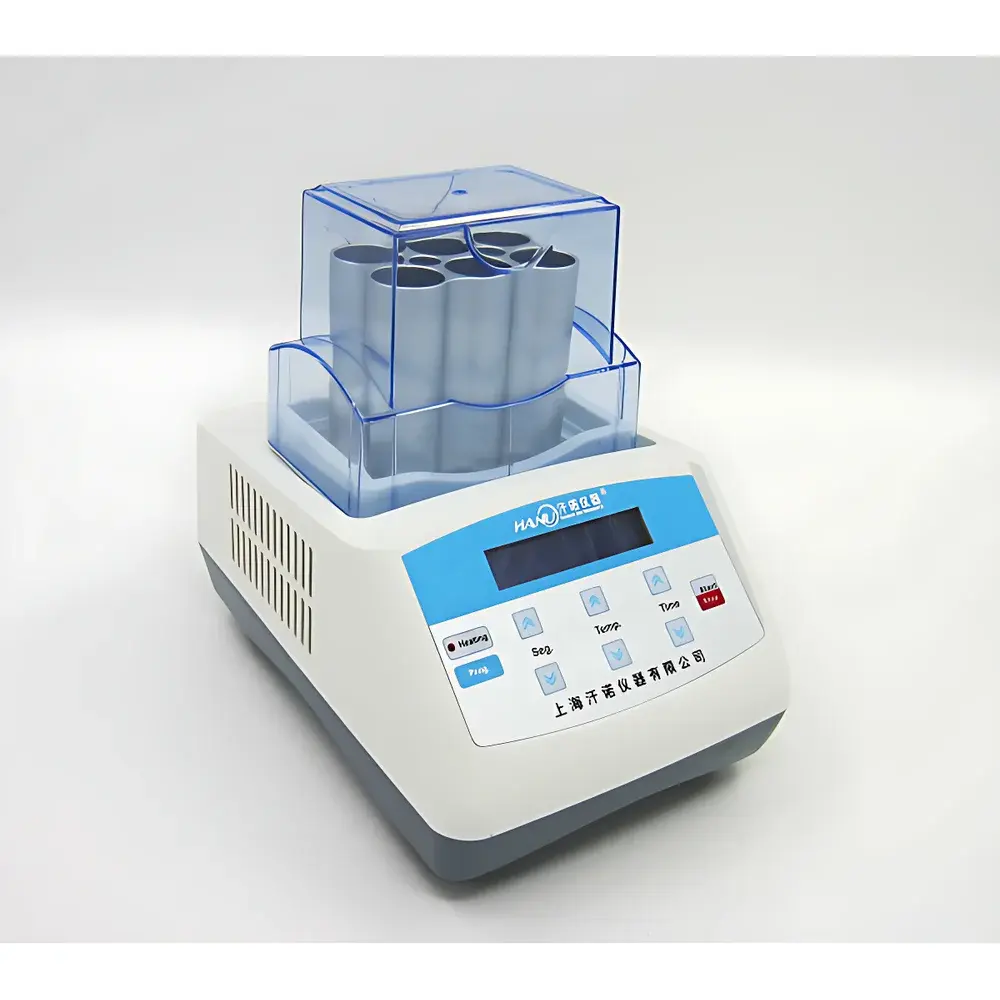
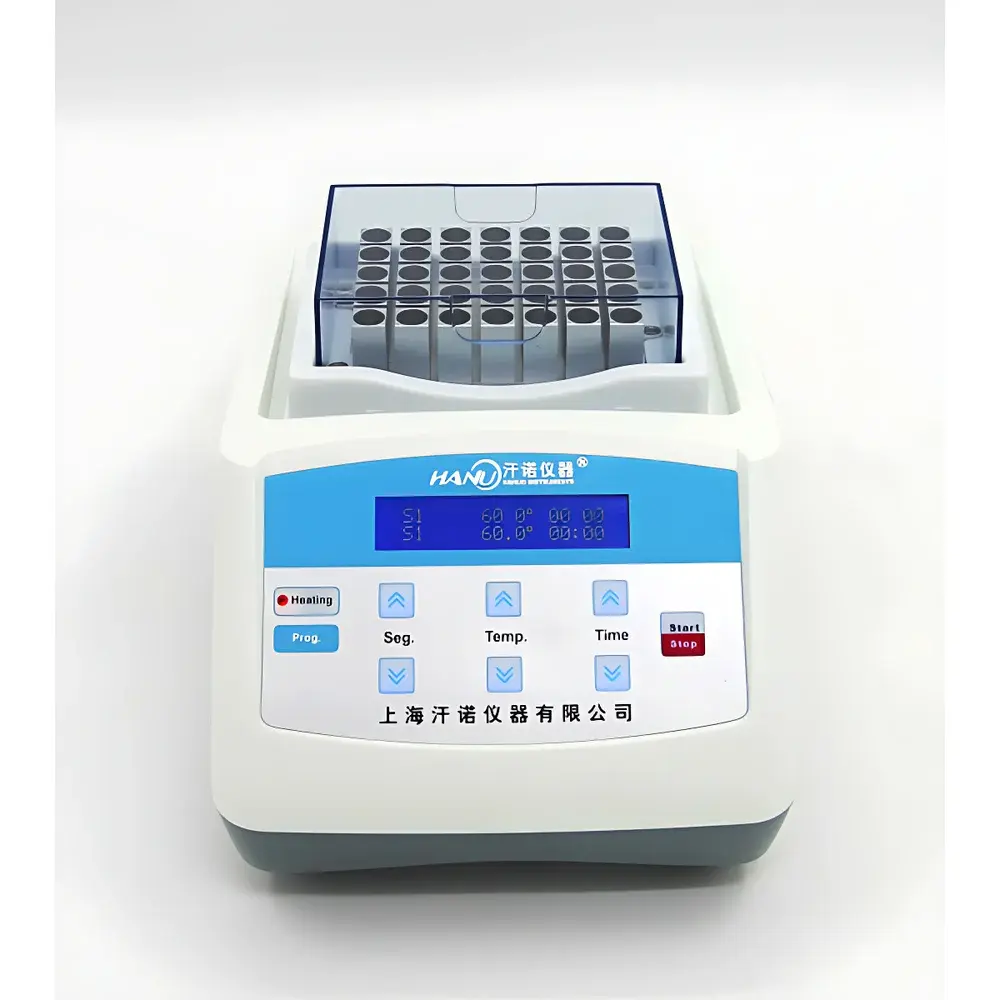
Hanuo HNMTC-100 Refrigerated Vortex Mixer with Temperature Control
| Brand | Hanuo |
|---|---|
| Origin | Shanghai, China |
| Model | HNMTC-100 |
| Oscillation Frequency | 300–1800 rpm |
| Oscillation Amplitude | 3 mm (horizontal rotation) |
| Temperature Range | −5°C to 100°C |
| Temperature Uniformity | ≤ ±0.3°C |
| Temperature Stability | ±0.3°C |
| Temperature Display Resolution | 0.1°C |
| Heating Rate | <15 min (20°C → 100°C) |
| Cooling Rate | ≥7°C/min (100°C → 20°C), ≥1.2°C/min (ambient → ambient −20°C at 30°C ambient) |
| Timer Range | 0–99 h 59 min, multi-step programming |
| Power Consumption | 200 W |
| Dimensions (W×D×H) | 270 × 190 × 170 mm |
| Net Weight | 8.3 kg |
| Standard Plate | 1 interchangeable module included |
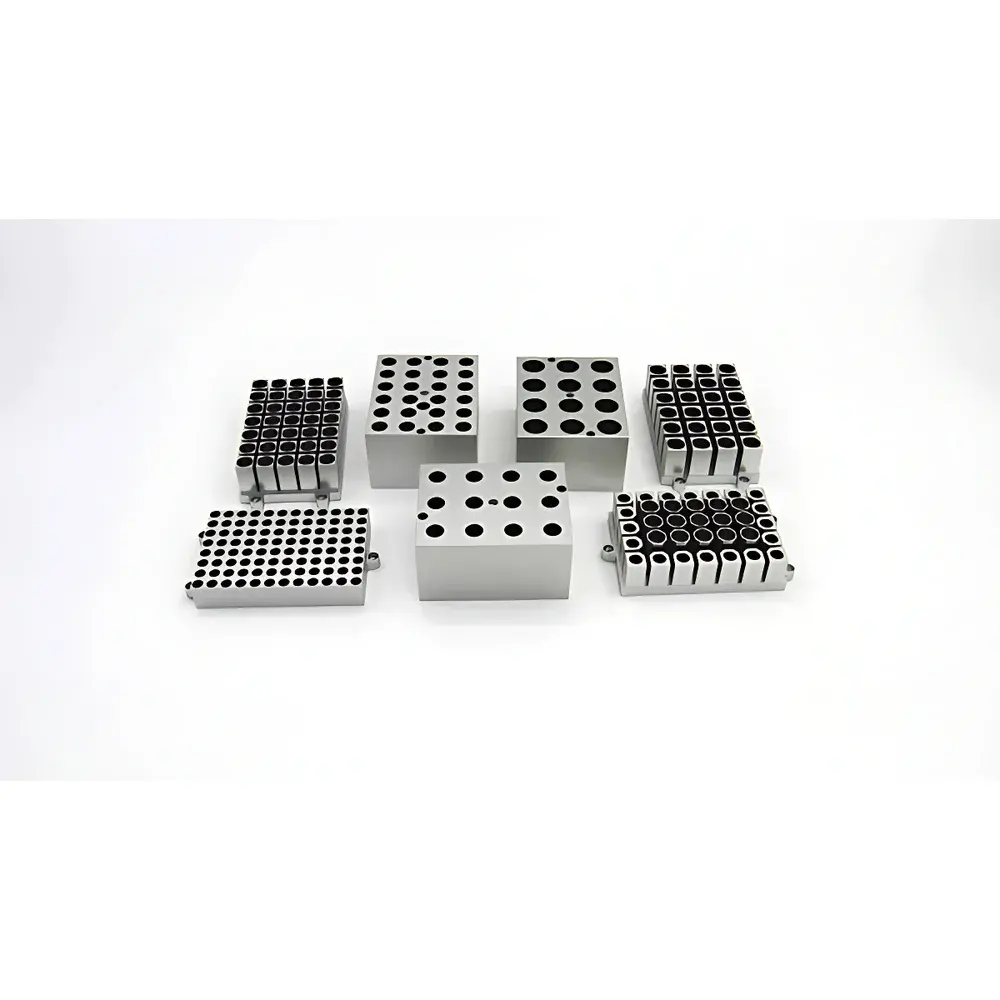
| Optional Modules | A–N series (including 96-well PCR plates, 0.2–50 mL tube formats, deep-well plates, and custom cavities) |
Overview
The Hanuo HNMTC-100 Refrigerated Vortex Mixer with Temperature Control is an integrated laboratory instrument engineered for precise thermal management and homogeneous sample agitation in life science workflows. Combining Peltier-based refrigeration, resistive heating, microprocessor-controlled oscillation, and programmable timing logic, it operates on a 2D horizontal orbital motion principle—delivering consistent kinetic energy transfer across diverse vessel geometries without vortex-induced shear artifacts. Unlike conventional shakers or dry baths, the HNMTC-100 maintains active temperature regulation *during* mixing, enabling real-time control of enzymatic reactions, nucleic acid hybridization, cell lysis, and reagent equilibration under defined thermal conditions. Its operational envelope spans −5°C to 100°C, supporting both cryogenic stabilization (e.g., cold-sensitive protein handling) and high-temperature incubation (e.g., restriction digests or denaturation steps), all within a compact benchtop footprint.
Key Features
- Bi-directional Peltier thermoelectric system for rapid, bidirectional temperature control—achieving ≤25 min cooling from ambient to ambient −20°C (tested at 30°C ambient) and <15 min heating from 20°C to 100°C;
- Microprocessor-driven DC brushless motor delivering stable rotational speeds from 300 to 1800 rpm with <±2 rpm deviation and low mechanical drift over extended operation;
- Programmable multi-step protocols: up to 99 hours 59 minutes total runtime with user-defined temperature ramps, dwell times, and speed transitions;
- Automatic power recovery function—resumes pre-interruption settings upon grid restoration, preserving experimental continuity and data integrity;
- High-precision thermal architecture: ±0.3°C stability and ≤±0.3°C uniformity across the entire plate surface, verified per ISO/IEC 17025 traceable calibration procedures;
- Modular platform design compliant with ANSI/SLAS standards for microplate and tube compatibility; supports interchangeable modules A–N covering 0.2 mL PCR tubes, 96-/384-well plates, 1.5–50 mL conical tubes, and custom cavity configurations;
- Integrated safety systems including over-temperature cutoff, motor stall detection, lid-open interlock, and short-circuit protection;
- Front-panel interface with intuitive navigation, real-time parameter display (temperature, speed, remaining time), and non-volatile memory for up to 10 user-saved protocols.
Sample Compatibility & Compliance
The HNMTC-100 accommodates standard ANSI/SLAS-compliant labware without adapter requirements: skirted, semi-skirted, and non-skirted 96-well PCR plates; 0.2–2.0 mL microcentrifuge tubes; 5–50 mL conical tubes; 96- and 384-well deep-well plates; and flat-bottom ELISA plates. All modules are manufactured from anodized aluminum for optimal thermal conductivity and chemical resistance. The instrument meets IEC 61010-1:2010 safety requirements for laboratory electrical equipment and complies with electromagnetic compatibility (EMC) standards per EN 61326-1. While not certified for GMP manufacturing environments, its programmable logging capability—including timestamped temperature/speed records—supports GLP-aligned documentation when used with external audit-trail software. It is suitable for applications requiring adherence to ASTM E2925 (standard practice for thermal validation of laboratory equipment) and USP <1049> (thermal mapping of controlled environments).
Software & Data Management
The HNMTC-100 operates as a standalone unit with no proprietary PC software dependency. However, its embedded firmware supports RS-232 serial output (optional USB-to-serial adapter) for external data capture via third-party logging tools or LIMS interfaces. Timestamped operational logs—including setpoints, actual readings, alarm events, and protocol execution status—are stored in non-volatile memory and retrievable via serial dump. For regulated environments, users may integrate the device into 21 CFR Part 11–compliant workflows by coupling it with validated electronic lab notebooks (ELNs) that enforce user authentication, audit trails, and electronic signatures. Firmware updates are performed via secure UART bootloader, ensuring version control and traceability.
Applications
- PCR setup and master mix equilibration at 4°C prior to amplification;
- Enzyme kinetics assays requiring simultaneous agitation and sub-ambient temperature maintenance;
- Cell suspension homogenization during transfection or electroporation preparation;
- Antibody conjugation and labeling reactions conducted at elevated temperatures (e.g., 37°C or 65°C) with continuous mixing;
- Protein solubilization and refolding studies involving gradient temperature profiles;
- Sample thawing with agitation to prevent localized overheating or ice recrystallization;
- Pre-analytical processing of clinical specimens (e.g., plasma separation, serum dilution) under temperature-controlled conditions.
FAQ
Does the HNMTC-100 support remote monitoring or network connectivity?
No—the device lacks Ethernet, Wi-Fi, or Bluetooth interfaces. Remote access requires external serial-to-IP gateways configured independently.
Can multiple modules be installed simultaneously?
No—only one module is mounted at a time. Module swaps are tool-free and completed in <15 seconds.
Is the temperature calibration traceable to NIST or other national standards?
The factory calibration uses traceable reference thermistors; full NIST-traceable certification requires third-party service with documented uncertainty budgets.
What is the maximum load capacity for the 50 mL module (M-type)?
The M-module supports six 50 mL conical tubes at ≤600 rpm; exceeding this speed risks imbalance-induced vibration or thermal gradient formation.
How frequently should temperature verification be performed in routine use?
Per CLSI EP25-A guidelines, daily verification with a calibrated thermistor probe is recommended for critical applications; weekly verification suffices for general research use.



