
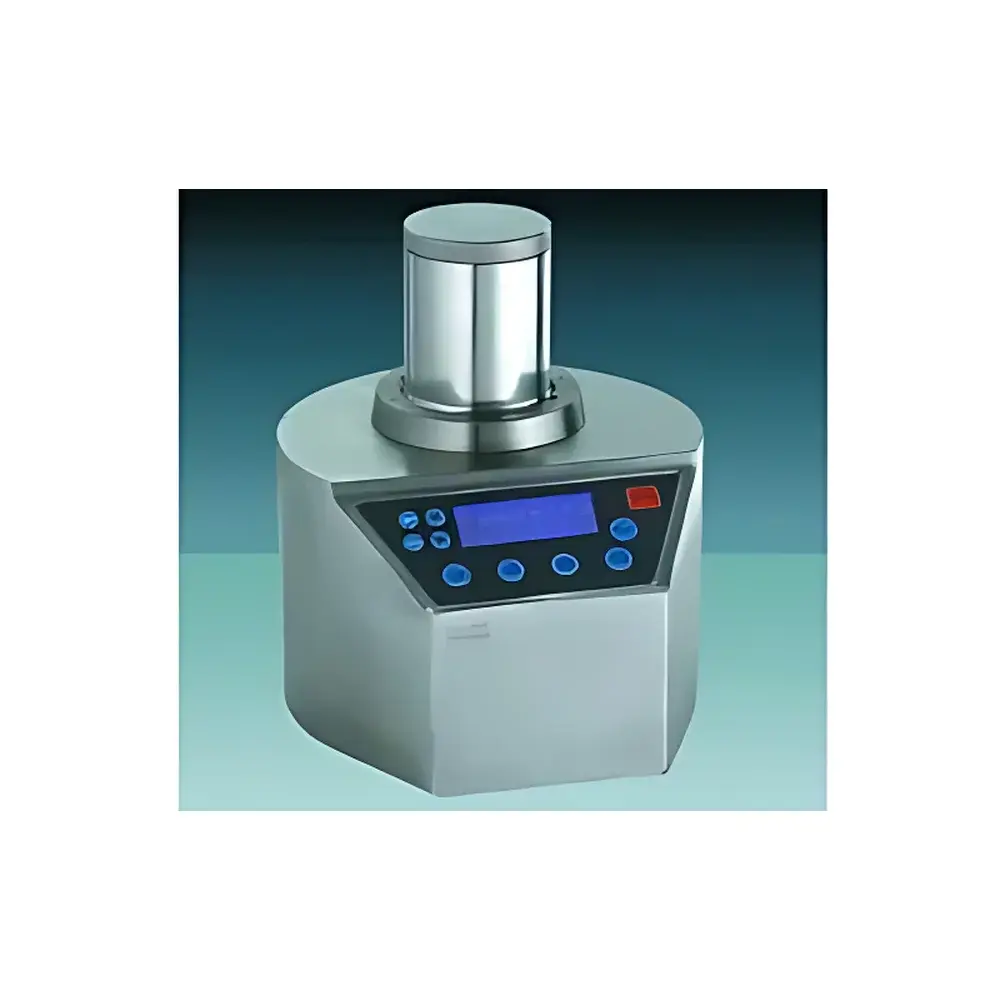
Hanuo ZW-800D Intelligent Sealed Homogenizer
| Brand | Hanuo |
|---|---|
| Origin | Zhejiang, China |
| Model | ZW-800D |
| Power | 300 W |
| Voltage/Frequency | 220 V / 50 Hz |
| Speed Range | 1,000–10,000 rpm |
| Timer Range | 0–300 s |
| Weight | 10 kg |
| Dimensions | 26 × 24 × 16 cm |
| Housing Material | AISI 304 Stainless Steel |
| Cup Material | Stainless Steel (Autoclavable) |
| Sealing | Integrated Blade-Cup Assembly with Wear-Resistant Shaft Seal |
Overview
The Hanuo ZW-800D Intelligent Sealed Homogenizer is a precision-engineered laboratory instrument designed for rapid, reproducible sample homogenization in regulated and research-intensive environments. It operates on the principle of high-shear mechanical disruption, utilizing a high-torque, brushless high-speed motor coupled directly to a stainless-steel cross-blade rotor housed within a fully sealed, autoclavable cup assembly. This configuration ensures consistent energy transfer to the sample—whether solid dosage forms (e.g., tablets, capsules), viscous suspensions (creams, ointments), emulsions, or particulate-laden liquids—without aerosol generation or cross-contamination. Unlike open-beaker blending methods, the ZW-800D’s hermetic design meets critical biosafety and sterility requirements common in pharmaceutical microbiological testing (e.g., USP , EP 2.6.12), making it suitable for pre-incubation sample preparation under ISO 17025-accredited laboratories.
Key Features
- Fully sealed, one-piece stainless-steel homogenization cup with integrated blade hub—eliminates leakage pathways and enables full-cycle autoclaving (121 °C, 20 min, saturated steam)
- AISI 304 stainless-steel housing with electropolished finish—resistant to corrosion from solvents, acids, and disinfectants; compliant with FDA-recommended cleanability standards for non-porous surfaces
- Cross-shaped hardened stainless-steel rotor with optimized blade geometry—delivers uniform shear distribution across sample volume, minimizing thermal gradients and particle agglomeration
- Digitally adjustable speed control (1,000–10,000 rpm) and programmable timer (0–300 s) with ±1 s accuracy—enables method standardization and protocol replication per GLP/GMP documentation requirements
- High-efficiency, low-heat-output motor (300 W continuous duty)—designed for repeated short-duration cycles without thermal drift or bearing fatigue
- Double-lip shaft seal with fluorocarbon elastomer gasket—maintains integrity under repeated sterilization cycles and prevents lubricant migration into the sample zone
Sample Compatibility & Compliance
The ZW-800D accommodates a broad spectrum of sample matrices: solid oral dosage forms (tablets, capsules, granules), semi-solids (ointments, gels, creams), oils, aqueous suspensions, and microbial culture media additives. Its sealed architecture conforms to containment guidelines outlined in WHO TRS 961 Annex 2 (Good Manufacturing Practices for Sterile Pharmaceutical Products) and supports compliance with pharmacopoeial methods requiring “mechanical dispersion under controlled conditions.” The unit is routinely deployed in QC labs performing microbial limit tests per USP , EP 2.6.12, and JP 4.07, where consistent particle size reduction and suspension homogeneity directly impact colony-forming unit (CFU) recovery rates. All wetted parts are non-leaching and extractables-tested per USP .
Software & Data Management
The ZW-800D operates via an embedded microcontroller interface with tactile membrane keypad and LED status display—no external PC dependency required. While not equipped with network connectivity or audit-trail software, its manual parameter entry system supports ALCOA+ data integrity principles when used in conjunction with lab-controlled SOPs: all speed/timer settings are recorded manually in batch records alongside operator ID, date/time, and sample identification. For labs implementing 21 CFR Part 11 compliance, the device may be integrated into validated workflows using external electronic lab notebooks (ELNs) that capture instrument metadata via time-stamped operator logs. Routine performance verification (RPV) protocols—including speed calibration with certified tachometer and timer validation using stopwatch traceable to NIST standards—are recommended quarterly.
Applications
- Pharmaceutical QC: Disintegration and suspension of solid dosage forms prior to membrane filtration or pour-plate enumeration
- Bioburden testing: Homogenization of transdermal patches, topical creams, and inhalation suspensions for viable microbial recovery
- Food safety labs: Preparation of composite food samples (meat, dairy, produce) for pathogen enrichment per ISO 6579-1 and FDA BAM protocols
- Cosmetic microbiology: Emulsion breakdown and preservative efficacy test (PET) sample conditioning per ISO 11930
- Academic research: Cell lysis support for non-enzymatic extraction protocols where protease inhibition is critical
FAQ
Is the ZW-800D compatible with ISO 13485-certified medical device manufacturing environments?
Yes—the stainless-steel construction, autoclavability, and absence of polymer gaskets in the wetted path meet material compatibility criteria for Class IIa/IIb device production support equipment.
Can the homogenization cup be cleaned in a laboratory dishwasher?
No—dishwasher detergents containing chlorides or phosphates may compromise the passive oxide layer on AISI 304 steel; manual cleaning with neutral pH enzymatic cleaner followed by autoclaving is recommended.
Does the unit include validation documentation (IQ/OQ/PQ templates)?
The manufacturer provides basic operational instructions and electrical safety certification (CE-marked per EN 61000-6-2/6-3); site-specific IQ/OQ/PQ protocols must be developed per user-defined risk assessment and regulatory scope.
What maintenance intervals are recommended for long-term reliability?
Shaft seal inspection every 500 operating hours; motor brush replacement is not applicable (brushless DC motor); annual torque verification of coupling bolts per ISO 5344.



