
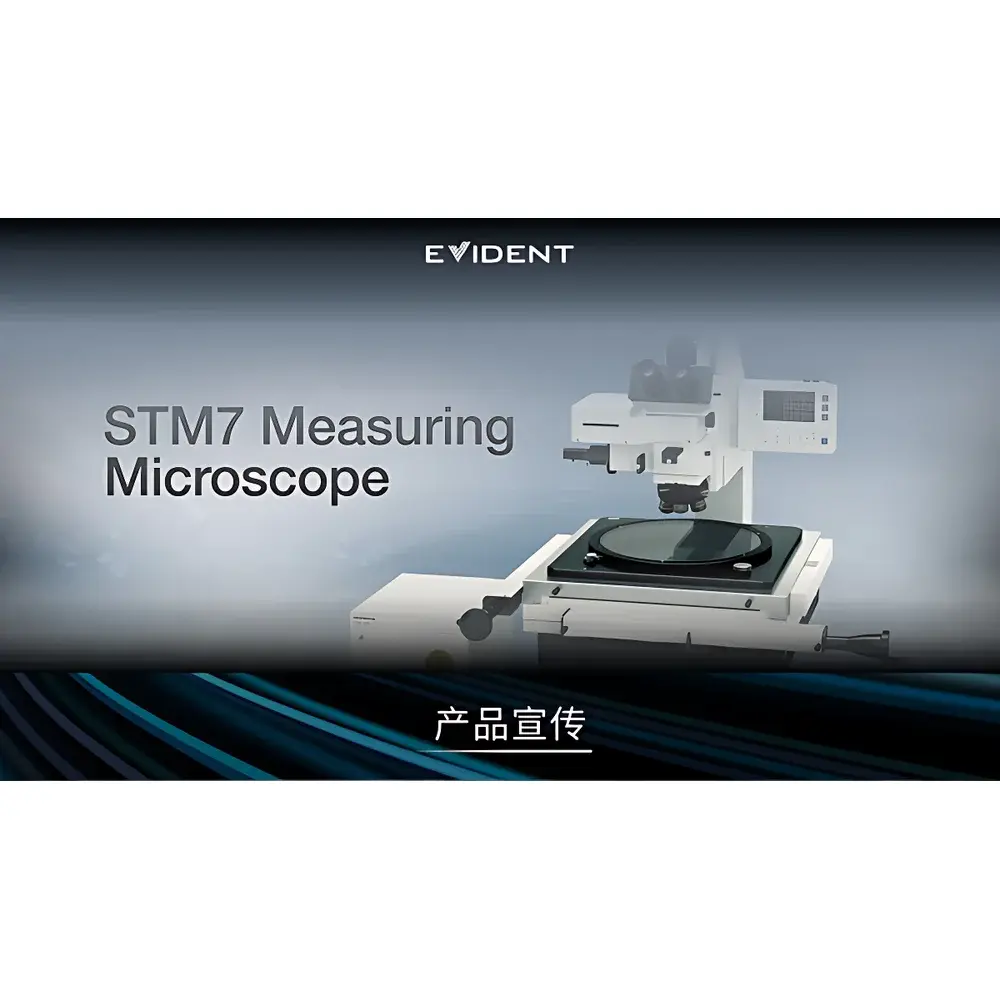
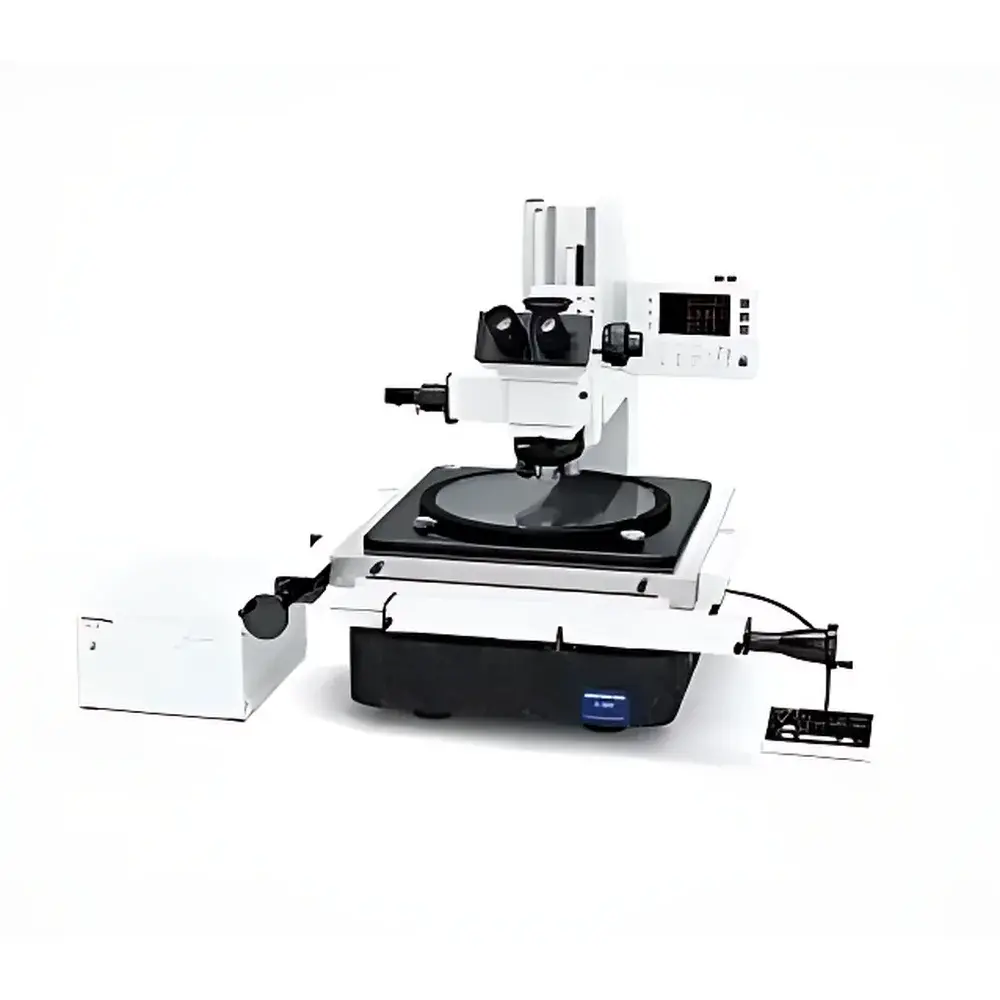
Olympus STM7 Tool Measuring Microscope
| Brand | Olympus |
|---|---|
| Origin | Japan |
| Manufacturer | Olympus Corporation |
| Product Category | Imported Instrument |
| Model | STM7 |
| Pricing | Available Upon Request |
Overview
The Olympus STM7 Tool Measuring Microscope is an advanced optical metrology instrument engineered for high-precision, three-axis (X-Y-Z) dimensional measurement of mechanical components, electronic assemblies, precision molds, and micro-fabricated parts. Built upon Olympus’ decades-long heritage in optical design and industrial metrology, the STM7 integrates UIS2 infinity-corrected optical architecture — a platform widely adopted in high-end research and production-grade microscopy — to deliver diffraction-limited resolution, exceptional contrast, and near-zero residual aberration across the entire field of view. Its optical path supports multiple contrast modes including brightfield, darkfield, differential interference contrast (DIC), and polarized light imaging — enabling simultaneous visual inspection and quantitative geometric analysis without optical compromise. The system is fundamentally designed for traceable, repeatable, and operator-independent measurement, making it suitable for both routine QC labs and R&D environments requiring sub-micrometer spatial fidelity.
Key Features
- UIS2 infinity-corrected optical system ensuring uniform resolution, flatness of field, and chromatic/monochromatic aberration correction up to 100× magnification
- Granite base structure with finite-element-modeled (FEM) optimized mechanical frame, delivering exceptional thermal stability and vibration damping for sub-µm repeatability (≤0.5 µm typical 3σ repeatability in XY, ≤1.0 µm in Z)
- Patented active-reflection confocal auto-focus system — the first commercially deployed on a tool measuring microscope — enabling robust, non-contact Z-height acquisition with nanometer-level focus detection sensitivity
- Motorized XYZ stage with linear encoders (resolution: 0.1 µm) and programmable motion control for automated multi-point measurement routines
- Dual-illumination system: coaxial LED brightfield + oblique LED darkfield, both intensity-tunable and independently switchable for optimal edge detection and surface topography visualization
- Integrated digital camera interface supporting USB 3.0 output, real-time image streaming, and pixel calibration traceable to NIST-traceable standards
Sample Compatibility & Compliance
The STM7 accommodates samples ranging from miniature semiconductor packages (e.g., QFN, BGA, SMT components) to large machined parts (up to 300 mm × 200 mm stage travel). Specimen thickness is unrestricted due to its vertical working distance (≥80 mm at 10× objective), allowing direct measurement of stepped or recessed features. All optical and mechanical subsystems comply with ISO 9001 manufacturing protocols. Calibration procedures adhere to ISO/IEC 17025 requirements when performed by Olympus-certified service engineers. Measurement data integrity meets GLP and GMP documentation expectations; audit trails, user authentication, and electronic signature support are available via optional Olympus Stream Metrology software modules compliant with FDA 21 CFR Part 11.
Software & Data Management
Olympus Stream Metrology software provides a unified platform for image capture, feature recognition, geometric dimensioning (GD&T), statistical process control (SPC) charting, and report generation. It supports automated edge detection algorithms trained on metallurgical, ceramic, and polymer surface profiles, reducing operator subjectivity. Measurement results are stored in structured XML-based project files with embedded metadata (operator ID, timestamp, calibration certificate ID, environmental conditions). Raw image data retains full bit-depth (12-bit or 16-bit) and is exportable in TIFF, PNG, or vendor-neutral formats compatible with third-party metrology suites (e.g., PolyWorks, Q-DAS). Software updates follow a controlled release cycle aligned with IEC 62304 medical device software standards where applicable.
Applications
- Precision machining QA: thread pitch, radius, angle, concentricity, and positional tolerance verification per ASME Y14.5
- Electronics manufacturing: solder joint geometry, pad coverage ratio, stencil aperture inspection, and PCB trace width/spacing validation
- Tool & die inspection: wear analysis of cutting edges, cavity depth profiling, and EDM spark erosion uniformity assessment
- Micro-optics fabrication: lens centering error, prism apex angle, and aspheric surface deviation mapping
- Academic and national metrology labs: reference standard calibration, inter-laboratory comparison studies, and uncertainty budgeting per GUM (JCGM 100)
FAQ
What is the minimum measurable feature size supported by the STM7?
The practical resolution limit is ~0.7 µm laterally (at 100× objective, λ = 550 nm), governed by Abbe diffraction. Feature detection depends on contrast, illumination mode, and signal-to-noise ratio — not solely magnification.
Does the STM7 support automated GD&T evaluation?
Yes — via Olympus Stream Metrology software, which includes built-in tools for true position, profile of a surface, circularity, parallelism, and perpendicularity per ISO 1101 and ASME Y14.5–2018.
Is on-site calibration and traceability documentation provided?
Olympus offers factory- or on-site calibration services with NIST-traceable artifacts and ISO/IEC 17025-accredited certificates, including uncertainty budgets and measurement procedure descriptions.
Can the STM7 be integrated into a factory MES or PLM system?
Through OPC UA and RESTful API interfaces (available as optional software modules), raw measurement data and pass/fail status can be exported directly to Siemens Opcenter, PTC ThingWorx, or custom enterprise databases.
What maintenance intervals are recommended for long-term metrological stability?
Annual preventive maintenance is advised, including optical alignment verification, encoder recalibration, granite base leveling check, and confocal sensor performance validation using certified step-height standards.



