
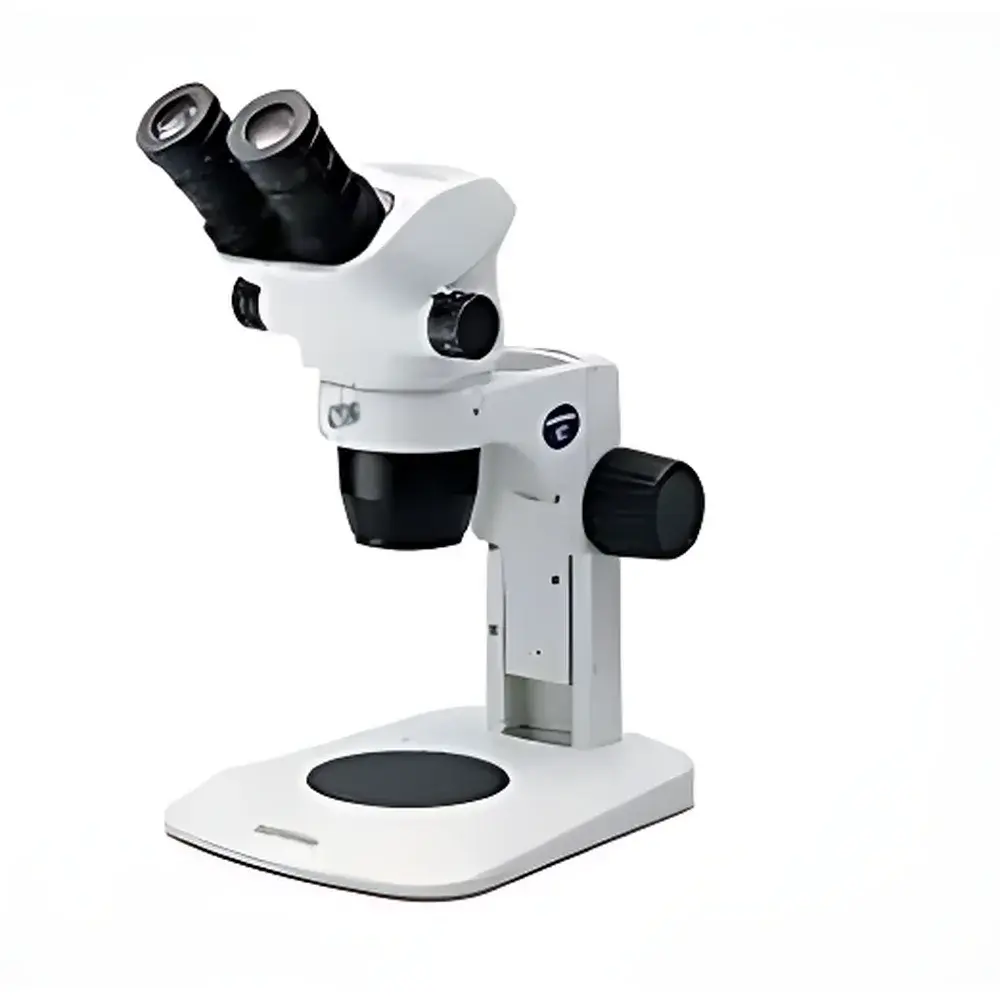
Olympus SZ61 / SZ51 Stereo Microscope
| Brand | Olympus |
|---|---|
| Origin | Japan |
| Manufacturer | Olympus Corporation |
| Product Type | Imported |
| Model | SZ61 / SZ51 |
| Total Magnification | 2.0×–270× (SZ61), 2.4×–240× (SZ51) |
| Zoom Ratio | 6.7× (0.67×–4.5×) (SZ61), 5× (0.8×–4×) (SZ51) |
| Illumination Type | LED |
Overview
The Olympus SZ61 and SZ51 stereo microscopes are precision-engineered Greenough-type stereomicroscopes designed for high-fidelity, three-dimensional visual inspection in industrial quality control, electronics assembly, precision manufacturing, and academic research laboratories. Unlike Common Main Objective (CMO) systems, the Greenough optical design employs two separate, parallel optical paths—each with its own objective lens and eyepiece—producing natural depth perception, minimal chromatic aberration, and high-resolution stereoscopic imaging across the entire zoom range. These instruments integrate a compact, ergonomically optimized mechanical architecture with modular illumination and mounting options, enabling seamless integration into automated workstations, inline inspection stations, and benchtop analytical setups. The SZ61 and SZ51 share identical optical core principles but differ in zoom ratio and base magnification, allowing users to select the optimal balance between working distance, field of view, and maximum usable magnification for specific application requirements.
Key Features
- Greenough optical system delivering true stereoscopic vision with high depth of field, excellent color fidelity, and edge-to-edge image clarity
- Electrostatic discharge (ESD)-protected internal optics and housing—critical for safe handling of electrostatic-sensitive components in semiconductor, PCB, and microelectronics assembly
- Compact, low-profile mechanical design with V-shaped light path architecture—enabling slender objective nose geometry ideal for integration into confined spaces or robotic workcells
- Smooth, backlash-free zoom mechanism with calibrated magnification markings; SZ61 offers 6.7× zoom (0.67×–4.5×), SZ51 provides 5× zoom (0.8×–4×)
- Dual-path LED illumination compatibility—including transmitted LED base units (ultra-thin profile, rotation-actuated transmittance/reflection switching), dual-arm interlocking fiber-optic reflected-light illuminators, coaxial illumination (SZ61 only), and adjustable ring-type white LED illumination
- Modular head configurations: standard binocular (SZ61/SZ51), trinocular (SZ61TR) for digital imaging, and 60° inclined head (SZ61-60/SZ51-60) for ergonomic seated operation or machine-mounted deployment
Sample Compatibility & Compliance
The SZ61 and SZ51 accommodate a broad spectrum of macro- to meso-scale specimens—from bare silicon wafers and solder joints to biological tissue sections, botanical samples, and assembled medical devices—without requiring coverslips or immersion media. Their long working distances (typical range: 43–110 mm depending on zoom setting and accessory configuration) support manipulation tools, probes, and micro-manipulators beneath the objective. All optical components comply with JIS B 7151 and ISO 10934-1 standards for stereomicroscope performance verification. The ESD-safe construction meets IEC 61340-5-1 requirements for electrostatic protection in controlled environments. Optional trinocular tubes support ISO/IEC 17025-compliant digital documentation workflows when paired with calibrated CMOS cameras and traceable image analysis software.
Software & Data Management
When equipped with a trinocular tube (e.g., SZ61TR), the microscope interfaces seamlessly with Olympus cellSens™ Digital Imaging Software or third-party SDK-compatible applications (e.g., HALCON, LabVIEW Vision). The platform supports time-stamped image capture, multi-focus extended-depth-of-field (EDF) stacking, measurement annotation (length, angle, area) with pixel calibration, and batch export in TIFF, JPEG2000, or lossless PNG formats. Audit trails, user access logs, and metadata embedding (including magnification, illumination mode, and timestamp) ensure compliance with FDA 21 CFR Part 11 and GLP/GMP documentation requirements where regulated reporting is mandated.
Applications
- Electronics manufacturing: solder joint inspection (IPC-A-610), component placement verification, flex circuit defect analysis
- Precision assembly: watchmaking, micro-optics alignment, MEMS device handling
- Quality assurance labs: incoming material inspection, finish evaluation (grain structure, surface texture), dimensional spot-checking
- Life sciences: dissection of model organisms, embryology staging, histological slide screening prior to high-magnification microscopy
- Maintenance & repair: aerospace component inspection, turbine blade coating assessment, fiber optic connector end-face evaluation
- Forensics & materials science: toolmark comparison, fracture surface analysis, particulate identification
FAQ
What is the difference between the SZ61 and SZ51 models?
The SZ61 features a higher zoom ratio (6.7× vs. 5×) and slightly lower minimum magnification (0.67× vs. 0.8×), yielding greater overall magnification range (2.0×–270× vs. 2.4×–240×) and improved resolution at high zoom settings.
Can these microscopes be integrated into automated production lines?
Yes—the low-profile chassis, 60° inclined head variants (SZ61-60/SZ51-60), and standardized mounting threads (M4/M6) facilitate rigid coupling to motion stages, robotic arms, and custom fixtures per SEMI E10 and ISO 9001 integration guidelines.
Is coaxial illumination available for both models?
Coaxial reflected-light illumination is exclusively compatible with the SZ61 due to its optical path design and objective thread specification.
Do the LED illumination units require external power supplies?
All Olympus LED illumination modules operate via integrated 100–240 V AC power adapters compliant with IEC 60950-1; no external driver boxes or cooling fans are required.
Are replacement objectives or eyepieces interchangeable between SZ61 and SZ51?
Objective lenses and wide-field eyepieces (e.g., WHB10×, WHP15×) are mechanically and optically interchangeable across both platforms, ensuring long-term serviceability and configuration flexibility.





