
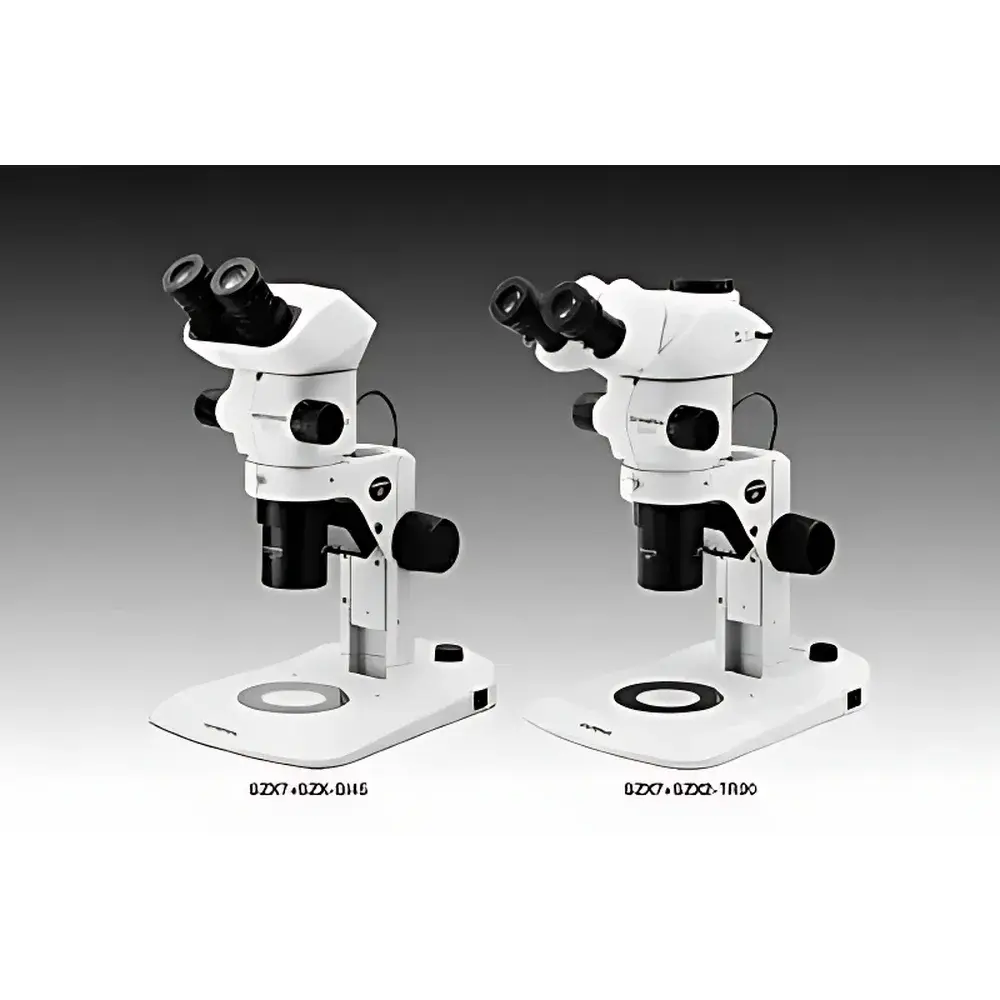
Olympus SZX7 Stereo Microscope
| Brand | Olympus |
|---|---|
| Origin | Japan |
| Manufacturer | Olympus Corporation |
| Product Type | Imported |
| Model | SZX7 |
| Total Magnification Range | 4.0×–336× |
| Zoom Ratio | 7:1 (0.8×–5.6×) |
| Illumination Type | LED |
| ESD Protection | Integrated Anti-Static Coating |
| Optical System | Galilean Parallel-Beam Design |
| Eyepiece Field of View | Widefield (23 mm apparent field) |
| Tilting Binocular Tube | 5°–45° adjustable inclination |
| Compatibility | Trinocular Port for Digital Imaging |
| Intermediate Optics | Interchangeable Auxiliary Lenses (DFPL & DFPLAPO Series) |
Overview
The Olympus SZX7 Stereo Microscope is an entry-level yet highly engineered stereoscopic imaging platform designed for routine inspection, quality control, teaching laboratories, and light industrial applications. Built upon a robust Galilean optical architecture—characterized by parallel light paths and zero optical path difference between left and right channels—the SZX7 delivers true 3D perception with high fidelity, minimal distortion, and exceptional depth rendition. Unlike Greenough-type stereo microscopes, the Galilean design ensures consistent optical performance across the entire zoom range without chromatic or geometric aberration buildup. The system supports seamless integration of high-numerical-aperture (NA) objective lenses aligned parallel to the specimen plane, enabling flat-field imaging with superior resolution and contrast uniformity. Its modular construction allows for configuration scalability—from basic visual inspection to advanced digital documentation—while maintaining ergonomic integrity and electrostatic discharge (ESD) safety compliance essential for electronics assembly and semiconductor handling environments.
Key Features
- 7:1 Continuous Zoom Optics: Provides smooth magnification adjustment from 0.8× to 5.6× at the objective level, combined with interchangeable eyepieces (10×, 15×, 20×) and auxiliary lenses to achieve a total magnification range of 4.0× to 336×.
- Galilean Parallel-Beam Optical Path: Eliminates image disparity between oculars, ensuring accurate spatial interpretation and reduced observer fatigue during extended use.
- ESD-Safe Construction: All major structural components—including the main body, focus mechanism, and auxiliary lens housings—are coated with conductive anti-static material (surface resistivity <10⁹ Ω/sq), meeting IEC 61340-5-1 requirements for static-dissipative instrumentation in cleanroom and microelectronics settings.
- Ergonomic Tilting Binocular Tube: Adjustable inclination from 5° to 45° accommodates users of varying stature and seated/standing postures; widefield 10× eyepieces (23 mm field number) minimize eye strain during prolonged stereoscopic observation.
- Modular Illumination System: Includes LED-based transmitted-light base (SZX-LGB), coaxial reflected-light illuminator (SZX-ILLC), dual-arm fiber-optic illuminator (SZX-DI), and ring-type white LED illuminator (SZX-LEDL) — all compatible with polarization and λ/4 waveplate accessories for stress analysis and birefringence visualization.
Sample Compatibility & Compliance
The SZX7 accommodates specimens ranging from PCB assemblies and solder joints to botanical samples, small mechanical components, and biological tissues. Its large working distance (up to 110 mm with DFPL 0.5× objective) and flexible stage-mounting options—including articulated arm stands (SZ2-STU2, SZ2-STU3) and vertical column mounts—support oversized or irregularly shaped objects that cannot be placed on conventional stages. The system complies with ISO 10934-1 (optical microscopy terminology), JIS B 7151 (stereomicroscope performance standards), and adheres to GLP-relevant design principles for traceable visual documentation. While not certified for FDA 21 CFR Part 11 out-of-the-box, its trinocular port enables integration with validated digital imaging systems supporting audit trail functionality when deployed in regulated QC/QA workflows.
Software & Data Management
Equipped with a standard C-mount trinocular port (23.2 mm), the SZX7 interfaces directly with Olympus’ Stream Basic imaging software or third-party machine vision platforms (e.g., Thorlabs’ ThorCam, QImaging’s QCapture Suite). Image capture, annotation, measurement (distance, angle, area), and report generation are supported via USB 2.0 or HDMI output. When paired with Olympus DP27 or DP74 digital cameras, the system enables time-lapse acquisition, Z-stacking, and multi-focus composites—all stored in TIFF or JPEG formats with embedded EXIF metadata including magnification, illumination mode, and date/time stamp. Optional Stream Premium licenses add histogram analysis, particle counting, and PDF report export compliant with internal SOP documentation protocols.
Applications
- Electronics manufacturing: SMT component placement verification, solder joint inspection, ESD-sensitive device handling.
- Academic teaching labs: Comparative morphology studies, dissection support, and introductory materials science demonstrations.
- Quality assurance: Surface defect detection on machined parts, coating uniformity assessment, and packaging seal integrity evaluation.
- Life sciences: Small organism observation (e.g., Drosophila, zebrafish embryos), microdissection preparation, and histological slide screening prior to compound microscopy.
- Forensic analysis: Toolmark comparison, fiber identification, and document examination under variable lighting conditions (brightfield, darkfield, polarized).
FAQ
What is the maximum working distance achievable with the SZX7?
The working distance varies with selected objective lens; using the DFPL 0.5× objective yields up to 110 mm, while the DFPLAPO 1.25× provides approximately 60 mm.
Can the SZX7 be used for photomicrography in regulated environments?
Yes—when integrated with Olympus-certified digital cameras and Stream software configured with user access controls and electronic signatures, it supports ALCOA+ data integrity principles required in GxP-compliant labs.
Is the LED illumination thermally stable for heat-sensitive samples?
Yes—the white LED light sources operate at ≤35°C surface temperature and feature constant-current drivers to eliminate intensity drift over time, minimizing thermal load on live or polymer-based specimens.
Does the SZX7 support fluorescence observation?
No—fluorescence capability requires epi-illumination modules and filter cubes not included in the standard SZX7 configuration; this function is available on higher-tier models such as the SZX16.
How does the Galilean optical system differ from Greenough design in practice?
Galilean optics maintain identical optical paths for both eyes, eliminating convergence-induced eye strain and enabling accurate stereoscopic measurements without calibration offsets—critical for metrology-grade applications.




