
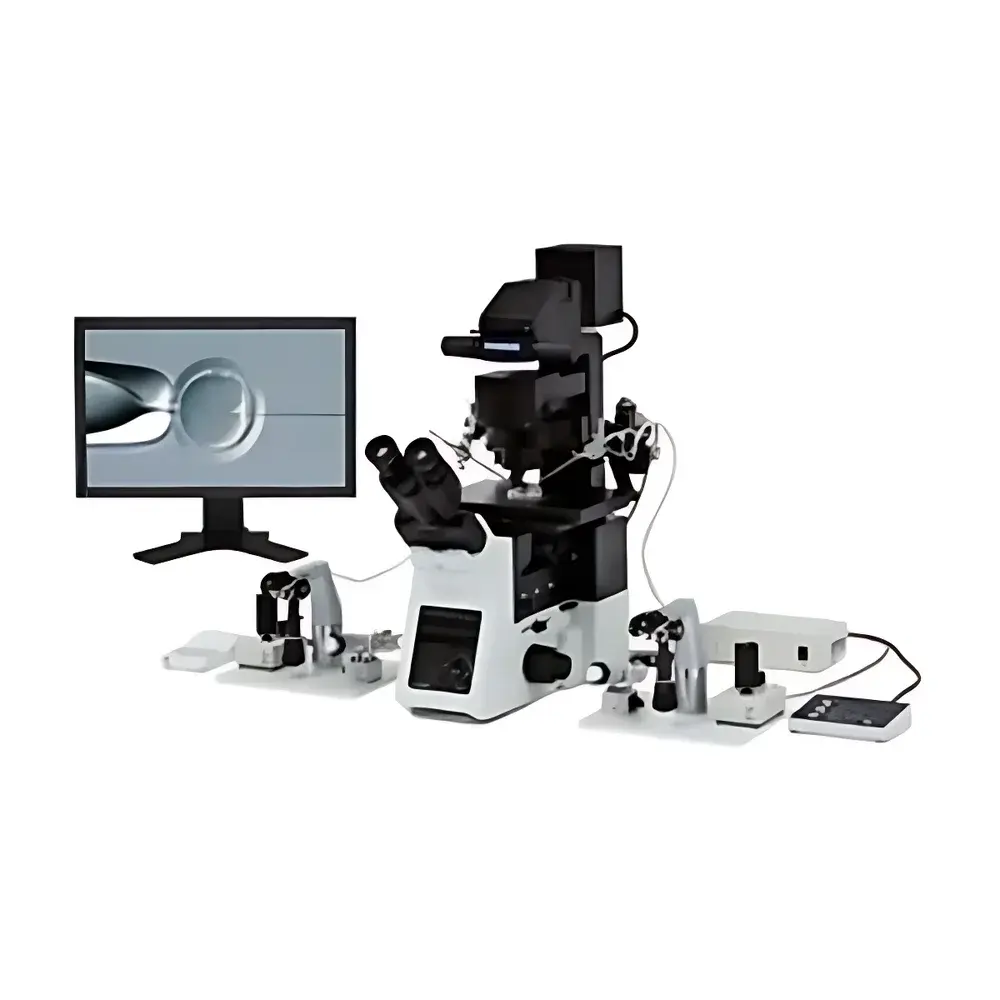
Olympus IX3-ICSI/IMSI Inverted Fluorescence Microscope
| Brand | Olympus |
|---|---|
| Origin | Japan |
| Manufacturer Type | Original Equipment Manufacturer (OEM) |
| Product Category | Imported Instrument |
| Model | IX3-ICSI/IMSI |
| Instrument Type | Inverted Fluorescence Microscope |
| Excitation Source | High-Stability LED Illumination |
| Regulatory Classification | Non-Medical Device |
| Instrument Class | Research-Grade Fluorescence Microscope |
| Eyepieces | Widefield Tilting Binocular, Widefield Binocular (FN 22) |
| Objective Lenses | Interchangeable UIS2 Series with Correction Collars (20×, 40× optimized for dish-bottom thickness) |
| Condenser | Motorized Long-Working-Distance (LWD) Condenser with DIC and Relief Contrast Capabilities |
| Observation Heads | Widefield FN 22 Trinocular or Binocular Configurations |
| DIC Components | Integrated Differential Interference Contrast Module |
| Stage Options | Left-Hand Mechanical Stage, Right-Hand Cross-Stage, Right-Hand Mechanical Stage |
| Compliance | Designed for ISO 13485-aligned laboratory environments |
Overview
The Olympus IX3-ICSI/IMSI Inverted Fluorescence Microscope is an engineered platform dedicated to high-precision assisted reproductive technology (ART), specifically optimized for intracytoplasmic sperm injection (ICSI) and intracytoplasmic morphologically selected sperm injection (IMSI) procedures. Built upon the modular IX3 optical architecture, it integrates advanced optical contrast modalities—including polarized light birefringence imaging, motorized relief contrast (RC), and differential interference contrast (DIC)—to enable non-invasive, label-free assessment of oocyte spindle dynamics, zona pellucida integrity, and cumulus cell adhesion status. Its inverted configuration ensures ergonomic access to culture dishes and micromanipulation setups, while the LED-based excitation system delivers stable, cool, and wavelength-optimized illumination for extended live-cell observation without phototoxicity. The system operates within a controlled optical path designed to minimize chromatic aberration and thermal drift—critical for reproducible spindle visualization during MII-stage oocyte evaluation.
Key Features
- Motorized optical switching: One-touch transition between brightfield, relief contrast, DIC, and polarization modes—enabling real-time spindle birefringence detection without manual component repositioning.
- Integrated LED illumination: Precisely tuned for 550–650 nm polarization-sensitive imaging; no mercury lamp replacement or warm-up time required.
- UIS2 objective suite with correction collars: 20× and 40× LWD objectives feature adjustable correction rings calibrated for standard polystyrene and glass-bottom dish thicknesses (0.13–0.17 mm), ensuring diffraction-limited resolution across heterogeneous substrates.
- Motorized long-working-distance condenser: Supports simultaneous RC and DIC alignment with automated centering and aperture control—reducing setup variability in routine ART workflows.
- Ergonomic stage configurations: Selectable left-hand mechanical, right-hand cross, or right-hand mechanical stages accommodate diverse micromanipulator layouts and operator preference.
- Widefield FN 22 observation heads: Compatible with both tilting binocular and trinocular configurations for seamless integration with digital cameras and recording systems compliant with FDA 21 CFR Part 11 requirements.
Sample Compatibility & Compliance
The IX3-ICSI/IMSI accommodates standard 35 mm, 60 mm, and 100 mm Petri dishes, as well as multi-well plates and microfluidic chambers used in oocyte maturation and embryo culture. Its optical design mitigates birefringence artifacts from plastic substrates—enabling reliable spindle imaging even prior to cumulus cell removal. While not classified as a medical device under FDA 21 CFR 809 or EU MDR Annex XVI, the system is routinely deployed in CLIA-certified IVF laboratories and complies with ISO 13485 quality management principles when integrated into validated SOPs. Documentation support includes instrument qualification templates (IQ/OQ) and traceable calibration records for critical optical components.
Software & Data Management
When paired with Olympus cellSens™ software (v2.4+), the microscope supports time-stamped image acquisition, metadata embedding (operator ID, procedure step, magnification, contrast mode), and encrypted storage aligned with GLP audit trail requirements. Optional add-ons include electronic lab notebook (ELN) synchronization, DIC intensity quantification modules, and birefringence signal thresholding tools for semi-automated spindle scoring. All data exports conform to TIFF, JPEG2000, and OME-TIFF standards for interoperability with LIS/PACS infrastructure.
Applications
- Spindle birefringence imaging for MII oocyte selection in ICSI timing decisions
- Zona pellucida morphology assessment using relief contrast—particularly in vitrified-warmed oocytes
- Real-time monitoring of cytoplasmic streaming and cortical granule distribution pre- and post-ICSI
- High-magnification sperm ultrastructure analysis (IMSI) at ≥6000× effective resolution using 100× oil objectives
- Long-term time-lapse imaging of early embryonic cleavage patterns under low-heat LED illumination
- Validation of spindle stability following cryopreservation protocols
FAQ
Is the IX3-ICSI/IMSI compliant with FDA 21 CFR Part 11 for electronic records?
Yes—when configured with cellSens software and enabled audit-trail licensing, the system meets electronic signature and record retention requirements for regulated ART facilities.
Can the microscope be used with standard micromanipulators from Eppendorf, Narishige, or TransferMan?
Yes—the IX3 stage mounting interface and clearance height (≥70 mm) are compatible with all major ART-grade micromanipulator systems.
Does the system require external cooling or vibration isolation?
No—its solid-state LED illumination and rigid optical bench eliminate active cooling needs; however, placement on a passive vibration-damping table is recommended for sub-micron spindle localization accuracy.
Are objective correction collars factory-calibrated for specific dish brands?
Correction collars are user-adjustable per dish batch; Olympus provides reference calibration charts for common suppliers (e.g., Falcon, Nunc, Thermo Fisher) but does not pre-set collars to proprietary substrates.
What is the typical service interval for preventive maintenance?
Olympus recommends biannual PM by certified field service engineers, including condenser alignment verification, LED output stability testing, and DIC prism calibration—documented in accordance with ISO/IEC 17025 traceability standards.





