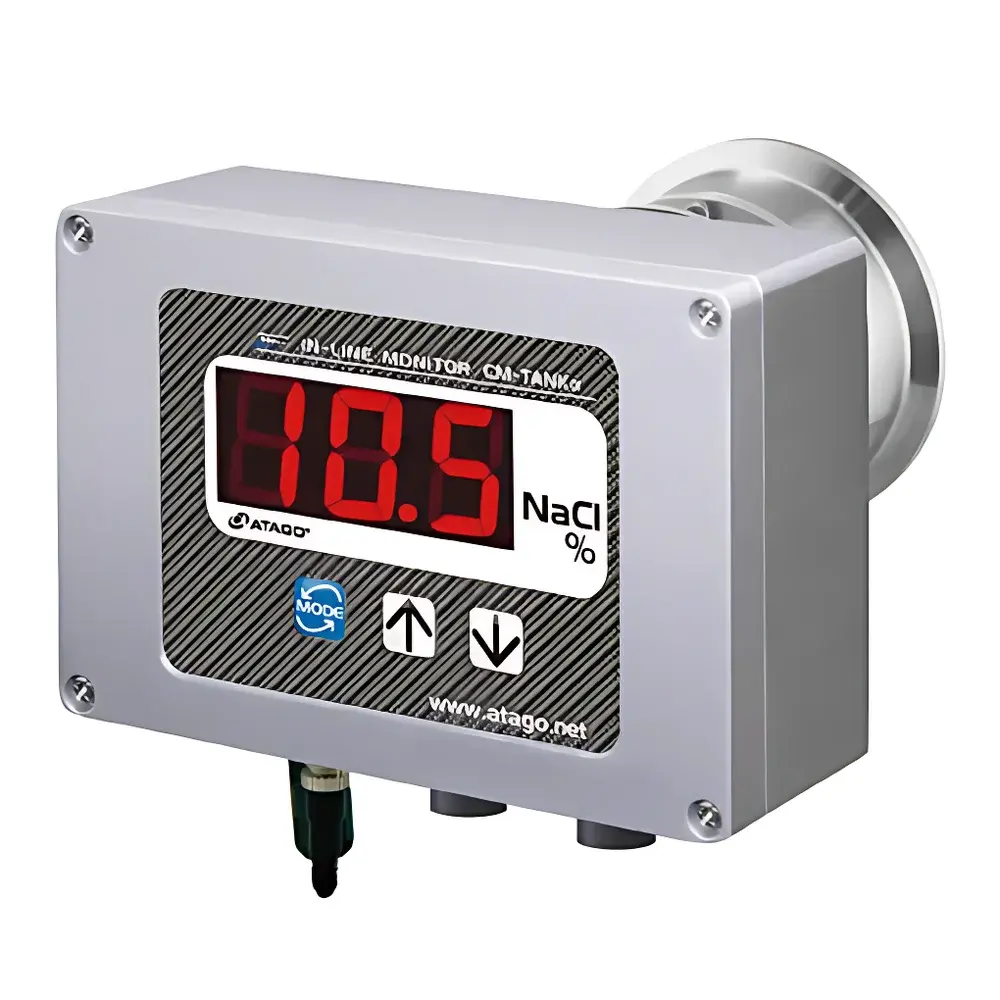
ATAGO CM-TANKα-SW(FER) Online Refractometer for Sodium Chloride Concentration Monitoring
| Brand | ATAGO |
|---|---|
| Origin | Japan |
| Model | CM-TANKα-SW(FER) |
| Measurement Range | Salt (NaCl) 0.00–28.0% w/w |
| Temperature Range | −15 to +160 °C |
| Salt Resolution | 0.01% (0.00–9.99%), 0.1% (10.0–28.0) |
| Temperature Resolution | 1 °C |
| Salt Accuracy | ±0.1% |
| Temperature Accuracy | ±1 °C |
| Temperature Compensation Range | 5–100 °C |
| Output | DC 4–20 mA / RS-232C |
| Response Time | ~1 s |
| Power Supply | DC 24 V |
| Prism Material | Synthetic Sapphire |
| Sample Cell Material | SUS316L |
| Ingress Protection | IP67 |
| Dimensions | 160 × 167 × 110 mm |
| Weight | 2.4 kg (main unit only) |
Overview
The ATAGO CM-TANKα-SW(FER) is a high-reliability, clamp-mounted online refractometer engineered for continuous, real-time monitoring of sodium chloride (NaCl) concentration in industrial liquid processes. Operating on the principle of critical-angle refractometry, the instrument measures the refractive index of process fluids and converts it into mass-based salt concentration (% w/w) using a pre-calibrated NaCl-specific algorithm. Unlike offline titration or conductivity-based methods, refractometry delivers direct, temperature-compensated concentration data without chemical reagents or electrode drift—making it ideal for hygienic, high-purity, or aggressive media where sensor fouling or calibration instability compromises alternative techniques. Designed for permanent installation on tanks, pipelines, or mixing vessels, the CM-TANKα-SW(FER) integrates seamlessly into PLC-controlled environments and supports continuous 24/7 operation under demanding thermal and mechanical conditions.
Key Features
- Clamp-type sanitary mounting interface compatible with standard tank nozzles (e.g., Tri-Clamp® or DIN 11851), enabling tool-free installation and removal without process shutdown.
- Smooth-flow prism channel geometry minimizes laminar dead zones and ensures uniform sample contact across the sapphire sensing surface—critical for reproducible measurement in low-velocity or viscous streams.
- Synthetic sapphire prism (Mohs hardness 9) provides exceptional resistance to abrasion, corrosion, and thermal shock—maintaining optical integrity even in caustic brines, pickling solutions, or sterilization-in-place (SIP) cycles up to 160 °C.
- Full stainless-steel wetted parts (SUS316L sample chamber and housing) meet FDA-compliant material requirements for food, pharmaceutical, and bioprocessing applications.
- Integrated Pt1000 RTD temperature sensor enables automatic, linearized temperature compensation within 5–100 °C—ensuring stable salt readings across wide thermal gradients without external thermocouple wiring.
- IP67-rated enclosure ensures dust-tight and temporary water-immersion protection, supporting washdown environments compliant with ISO 22000 and EHEDG guidelines.
Sample Compatibility & Compliance
The CM-TANKα-SW(FER) is validated for aqueous NaCl solutions, including seawater, brine, desalination feedstock, fermentation broth salinity control, and cleaning-in-place (CIP) rinse monitoring. It is not suitable for non-aqueous solvents, highly turbid suspensions, or emulsions with particle sizes exceeding 5 µm, as these may scatter incident light and impair refractive index accuracy. The device complies with IEC 61000-6-2 (EMC immunity) and IEC 61000-6-4 (EMC emission) standards. Its analog 4–20 mA output meets NAMUR NE43 signaling conventions, while RS-232C serial communication supports ASCII protocol for integration with SCADA, DCS, or MES platforms. For regulated industries, the instrument’s fixed calibration and audit-trail-free operation align with GLP documentation practices; optional firmware logging (via external host) may support 21 CFR Part 11 compliance when deployed with validated data acquisition systems.
Software & Data Management
The CM-TANKα-SW(FER) operates as a stand-alone transmitter with no embedded display or local configuration interface. All setup—including zero/span calibration, temperature compensation enable/disable, and output scaling—is performed remotely via RS-232C using ATAGO’s dedicated PC utility software (CM-ConfigTool). The software supports firmware updates, parameter backup/restore, and real-time data streaming at 1 Hz resolution. Process data can be exported in CSV format for trending in Excel or imported into historian systems (e.g., OSIsoft PI, Ignition). While the unit does not store historical measurements internally, its fast 1-second response time and stable analog output make it suitable for closed-loop control applications—such as feedback regulation of brine dilution valves in water treatment or salinity dosing in aquaculture recirculation systems.
Applications
- Fermentation process control: Real-time NaCl concentration monitoring in soy sauce, miso, and fish sauce production to ensure consistent osmotic pressure and microbial selectivity.
- Food & beverage processing: Inline verification of brine strength during vegetable pickling, meat curing, and dairy whey concentration.
- Water desalination & reuse: Feed and permeate salinity tracking in reverse osmosis and electrodialysis systems for performance benchmarking and membrane health assessment.
- Chemical manufacturing: Continuous concentration control in chlor-alkali electrolyte loops, caustic soda dilution, and salt recovery crystallizers.
- Pharmaceutical CIP validation: Quantitative verification of sodium hydroxide or acid rinse concentrations to meet cleaning efficacy thresholds per ASTM E3057 or ISPE Baseline Guide.
FAQ
Does the CM-TANKα-SW(FER) require periodic recalibration?
Yes—while the sapphire prism exhibits long-term optical stability, ATAGO recommends field verification against a certified NaCl standard solution every 3–6 months depending on process severity and regulatory requirements. Zero-point adjustment (using DI water) can be performed in situ; span calibration requires manual immersion in a reference standard.
Can this refractometer measure other solutes besides NaCl?
No—the internal calibration curve is strictly optimized for sodium chloride aqueous solutions. Using it for sucrose, ethanol, or mixed-salt systems will produce inaccurate results due to refractive index nonlinearity and solute-specific partial molar volume effects.
Is the unit suitable for pressurized pipeline installations?
It is rated for static pressure up to 1.0 MPa (10 bar) at 25 °C. For dynamic high-pressure applications (>0.5 MPa), consult ATAGO’s engineering team for custom flange adapters and pressure-rated gasket specifications.
How is temperature compensation implemented?
A built-in Pt1000 RTD measures sample temperature at the prism interface. The microprocessor applies a polynomial correction derived from empirical NaCl refractivity data (IAPWS formulation), referenced to 20 °C—ensuring accuracy across the full 5–100 °C compensation range.
What maintenance is required for long-term reliability?
Routine inspection of the sapphire surface for deposits (e.g., scale or protein film) is advised. Cleaning with deionized water and soft lint-free cloth is sufficient; avoid abrasive cleaners or ultrasonic baths that may damage anti-reflective coatings.
Related Products