
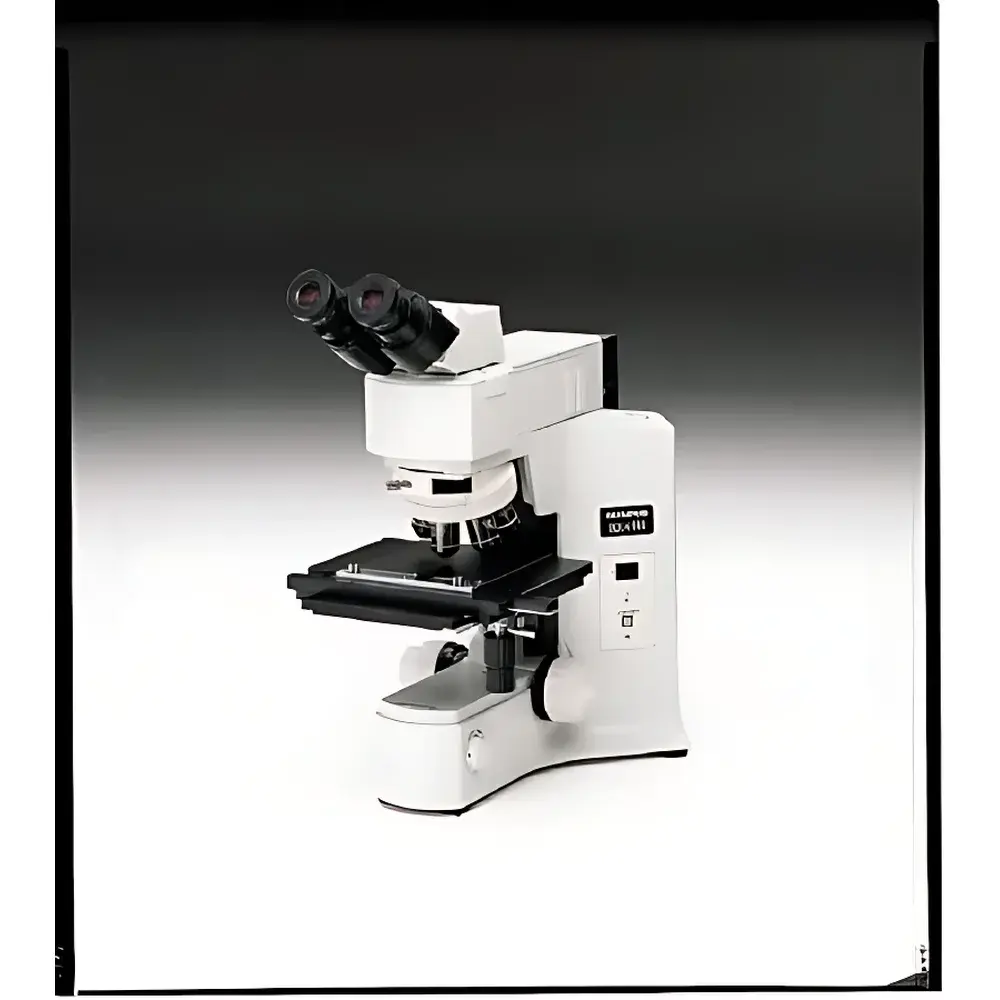
Olympus BX43M-LED Advanced Upright Metallurgical Microscope
| Brand | Olympus |
|---|---|
| Origin | Japan |
| Manufacturer | Olympus Corporation |
| Product Type | Upright Metallurgical Microscope |
| Model | BX43M-LED |
| Optical System | UIS2 Infinity-Corrected |
| Illumination | 3 W White LED Reflected Light |
| Observation Modes | Brightfield, Simple Polarization, Differential Interference Contrast (DIC) |
| Focus Travel | 35 mm |
| Fine Focus Sensitivity | 0.1 mm per revolution |
| Max. Specimen Height | 65 mm |
| Objective Turret | Manual 5- or 6- or 7-Position (ESD-Compatible Options Available) |
| Stage Travel | 76 × 52 mm or 100 × 105 mm |
| Eyepiece Field Number | 22 or 26.5 |
| Weight | 14 kg |
| Dimensions (W×D×H) | 283 × 455 × 480 mm |
Overview
The Olympus BX43M-LED is a high-precision upright metallurgical microscope engineered for routine and advanced microstructural analysis of opaque, reflective specimens—particularly metals, alloys, ceramics, composites, and electronic packaging materials. Built upon the UIS2 (Universal Infinite System 2) optical platform, it delivers diffraction-limited resolution, chromatic aberration correction across the full visible spectrum, and consistent contrast fidelity essential for quantitative metallography, failure analysis, and quality control in manufacturing and R&D environments. Unlike conventional halogen-illuminated systems, the BX43M-LED integrates a solid-state 3 W white LED illumination module with ESD-safe design, eliminating electrostatic discharge risks during inspection of sensitive semiconductor components, PCBs, and MEMS devices. Its reflected-light-only configuration ensures optimal signal-to-noise ratio for surface topography assessment without interference from substrate transparency artifacts.
Key Features
- ESD-Safe LED Illumination: Integrated 3 W white LED provides stable, flicker-free output with <1% intensity drift over 20,000 hours; eliminates static charge accumulation on optical surfaces and specimen stages, critical for electronics inspection under ISO 14644 cleanroom or IPC-A-610-compliant workflows.
- Dual Reflected-Light Path Options: Standard BX-KMA-LED brightfield illuminator and optional BX-AKMA-LED unit featuring integrated oblique illumination mechanism—enabling rapid contrast enhancement without mechanical realignment or external accessories.
- UIS2 Infinity-Optimized Optics: All objectives (including strain-free BD, PL, and DIC-compatible series) maintain flatness of field, high NA, and minimal wavefront distortion across magnifications from 5× to 100×, supporting ASTM E3–22 and ISO 4497 metallographic standard compliance.
- Modular Mechanical Design: Manual 5-, 6-, or 7-position objective turrets—including ESD-hardened variants—allow seamless switching between brightfield, polarization, and DIC imaging modalities. Precision-machined coarse/fine focus assembly offers 35 mm vertical travel and 0.1 mm fine-focus increment resolution.
- Ergonomic Stage & Viewing Configurations: Dual-stage options (76 × 52 mm or 100 × 105 mm travel) accommodate large wafers, cross-sectioned castings, or multi-site samples; interchangeable observation tubes include wide-field FN22 and ultra-wide FN26.5 trinocular configurations compatible with digital camera integration and beam-splitter-based photomicrography.
Sample Compatibility & Compliance
The BX43M-LED is optimized for polished, etched, or as-cut metallic and ceramic specimens up to 65 mm in height—covering standard metallographic mounts (e.g., 30 mm diameter epoxy-embedded samples), thin-film coatings, solder joints, and fracture surfaces. Its ESD-safe construction meets IEC 61340-5-1 requirements for electrostatic protected areas (EPAs), making it suitable for use in semiconductor fabrication QA labs, automotive component validation centers, and aerospace material certification facilities. The UIS2 optical path supports traceable calibration via NIST-traceable stage micrometers and certified reference standards (e.g., SRM 2822), facilitating GLP-compliant documentation for ISO/IEC 17025-accredited testing laboratories.
Software & Data Management
While the BX43M-LED operates as a standalone optical instrument, its trinocular port and standardized C-mount interface enable seamless integration with Olympus cellSens digital imaging software or third-party platforms compliant with TWAIN and GenICam protocols. Full audit trail functionality—including timestamped image metadata, objective identification, illumination settings, and user log entries—is supported when paired with cellSens Dimension for measurement annotation, grain size analysis per ASTM E112, and phase fraction quantification. System logs comply with FDA 21 CFR Part 11 requirements when deployed with validated software configurations and networked authentication servers.
Applications
- Metallographic evaluation of heat-treated steels, aluminum alloys, and titanium grades per ASTM E3, E407, and ISO 643.
- Failure analysis of solder interconnects, wire bonds, and die attach integrity in microelectronics packaging.
- Coating thickness verification and delamination detection in thermal barrier and wear-resistant overlays.
- Grain boundary characterization and inclusion rating in cast and forged components for ASME BPVC Section II and EN 10204 compliance.
- Research-grade DIC imaging of surface relief and crystallographic orientation contrast in single-crystal superalloys and additive-manufactured microstructures.
FAQ
Is the BX43M-LED compatible with DIC accessories from previous Olympus BX series models?
Yes—the UIS2 optical pathway maintains mechanical and optical backward compatibility with DIC sliders, prisms, and analyzers designed for BX51/BX61 systems, provided they are specified for reflected-light DIC.
Can the LED illumination intensity be calibrated against a photometric standard?
The BX43M-LED includes factory-set intensity linearity across its 0–100% dimming range; absolute irradiance calibration requires an NIST-traceable photodiode sensor placed at the specimen plane, with values documented per ISO/IEC 17025 procedures.
Does the microscope support motorized Z-axis or automated stage functions?
No—the BX43M-LED is manually operated; however, Olympus offers the BX53M-LED and BX63M-LED variants with optional motorized focus and XY stages for semi-automated workflows.
What is the maximum working distance achievable with the highest-magnification objective?
With the 100× BD (brightfield/darkfield) objective, working distance is 0.52 mm; for extended-depth applications, the 50× LCAchN objective provides 5.1 mm WD while maintaining DIC compatibility.
Are replacement LEDs user-serviceable?
The LED module is sealed and not field-replaceable; service must be performed by authorized Olympus service centers to preserve ESD certification and optical alignment integrity.




