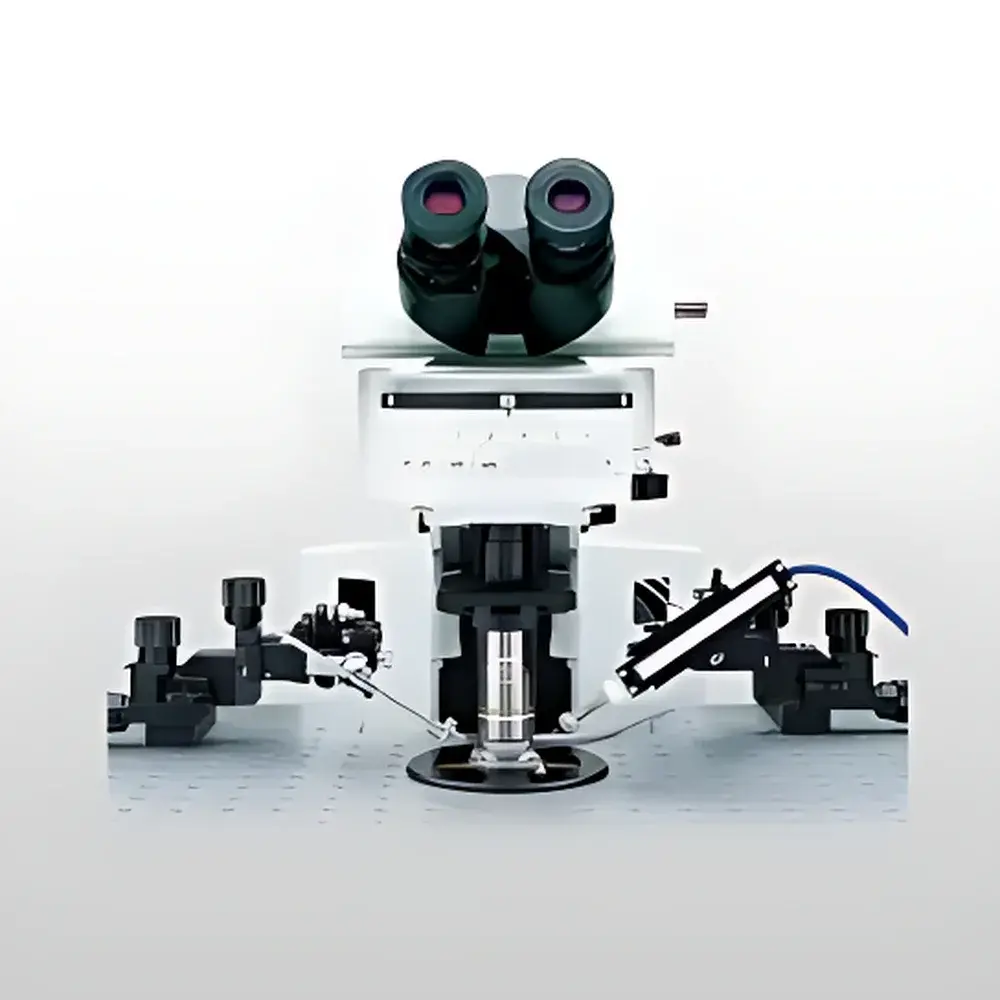
OLYMPUS BX51WI Upright Fluorescence Microscope with Fixed Stage
| Brand | OLYMPUS |
|---|---|
| Origin | Japan |
| Manufacturer | OLYMPUS Corporation |
| Product Type | Upright Fluorescence Microscope |
| Excitation Source | 100 W Mercury Arc Lamp |
| Illumination | Fiber-Optic Light Guide |
| Observation Head | Trinocular |
| Focus Mechanism | Manual Coarse/Fine Adjustment |
| Stage Type | Fixed Mechanical Stage |
| DIC Capability | Nomarski Differential Interference Contrast (DIC) Enabled |
| Fluorescence Filter Turret | 6-Position Motorized or Manual Turret with Click-Stop Release |
| Objective Mount | WI-SRE3 Swing-Out, U-SLRE Slide-Out, or WI-SNPXLU2 Single-Objective Nosepiece |
| Objective Compatibility | High-NA Water-Immersion (e.g., XLUMPLFLN20xW), XLFLUOR Series (2x/340, 4x/340), and Standard RMS-thread Objectives |
| Condenser Options | Multiple DIC-Compatible Condensers (e.g., U-UCD8) |
| Vibration-Damping Frame | Integrated Anti-Vibration Optical Bench Architecture |
| IR Transmission | Optimized for Near-Infrared (NIR) Imaging up to ~900 nm |
| Compliance | Designed for GLP/GMP-aligned electrophysiology and in vivo imaging workflows |
Overview
The OLYMPUS BX51WI is a purpose-engineered upright fluorescence microscope optimized for demanding physiological and in vivo imaging applications—particularly patch-clamp electrophysiology, intravital microscopy, and live-tissue observation. Its defining architectural feature is the rigid, fixed-stage platform mounted on an anti-vibration optical bench, eliminating mechanical drift during prolonged recordings. Unlike conventional stage-moving microscopes, the BX51WI maintains specimen position while enabling precise, low-noise objective and condenser repositioning—critical for maintaining electrode alignment and minimizing thermal or mechanical perturbation of living preparations. The optical path is optimized for dual-wavelength performance: high-transmission visible excitation (via 100 W Hg lamp and dichroic filter sets) and deep-penetrating near-infrared (NIR) transmission (up to 900 nm), supporting both epifluorescence and infrared-DIC contrast modes without optical realignment. High-numerical-aperture (NA) water-immersion objectives—including the XLUMPLFLN20xW (NA 1.0, WD 2.0 mm)—are natively supported, delivering diffraction-limited resolution in aqueous environments while preserving cell viability through minimized phototoxicity and thermal load.
Key Features
- Vibration-Isolated Fixed Stage Design: The monolithic aluminum base and constrained-stage architecture suppress microvibrations (<0.5 µm RMS displacement under typical lab conditions), ensuring sub-micron positional stability over multi-hour experiments.
- Front-Access Ergonomic Controls: All primary adjustments—including fine focus knobs, fluorescence filter turret, and condenser aperture levers—are positioned at the front-facing panel, enabling operation without obstructing micromanipulators or patch-clamp rigs.
- Dedicated WI Objective Nosepieces: Three specialized nosepiece options support diverse experimental configurations: WI-SRE3 (swing-out for unobstructed electrode access), U-SLRE (horizontal slide-out for large-diameter XLFLUOR objectives), and WI-SNPXLU2 (single-position mount for XLUMPLFLN20xW with RMS adapter compatibility).
- Nomarski DIC Integration: Full Koehler-illuminated DIC optics with U-UCD8 condenser and strain-free prisms provide quantitative phase contrast across thick, unstained specimens—compatible with simultaneous fluorescence acquisition via beam-splitter configuration.
- IR-Optimized Optical Train: Broadband anti-reflection coatings (340–900 nm) and low-autofluorescence glass elements maximize signal-to-noise ratio in NIR-DIC and two-photon priming applications.
- Liquid-Spill Protection System: Magnetic-mount waterproof shield covers the stage periphery, condenser housing, and focusing mechanism—certified to IEC 60529 IPX2 standards for incidental liquid exposure.
Sample Compatibility & Compliance
The BX51WI accommodates live brain slices (300–500 µm), acute retinal explants, perfused organotypic cultures, and small-animal preparations (mouse, rat, zebrafish larvae). Its open-frame design permits integration with stereotaxic holders, temperature-controlled chambers (20–40 °C), and perfusion manifolds. The system complies with ISO 10993-5 (biocompatibility of contact materials) and meets electromagnetic compatibility (EMC) requirements per IEC 61326-1 for laboratory use. While not FDA-cleared as a medical device, its hardware and documentation architecture support audit readiness for GLP-compliant preclinical studies and internal SOPs aligned with USP Analytical Instrument Qualification guidelines.
Software & Data Management
The BX51WI operates as a hardware platform compatible with OLYMPUS cellSens Dimension software (v3.1+), supporting time-lapse fluorescence acquisition, multi-channel registration, Z-stack reconstruction, and DIC intensity quantification. All motorized components—including filter turrets and optional XY stage controllers—log timestamped operational metadata compliant with ALCOA+ principles (Attributable, Legible, Contemporaneous, Original, Accurate, Complete, Consistent, Enduring, Available). Audit trails, user access controls, and electronic signatures are configurable to meet 21 CFR Part 11 requirements when deployed with validated software modules and networked storage infrastructure.
Applications
- Patch-clamp electrophysiology with simultaneous Ca²⁺ or voltage-sensitive dye imaging
- Intravital imaging of cortical blood flow and neuronal activity in cranial window preparations
- High-resolution morphological analysis of dendritic spines using IR-DIC + GFP co-imaging
- Long-term viability assays in organotypic hippocampal slice cultures
- Multi-modal correlation of fluorescence lifetime (FLIM), FRET, and structural DIC contrast
- Developmental biology studies in zebrafish embryos under low-phototoxicity NIR illumination
FAQ
Can the BX51WI be integrated with third-party electrophysiology amplifiers and digitizers?
Yes—the microscope features standardized DIN-rail mounting points and shielded BNC breakout ports for synchronization signals (TTL trigger out, frame sync), enabling deterministic timing alignment with Axon Digidata, HEKA PatchMaster, or National Instruments DAQ systems.
Is the 100 W mercury lamp compatible with modern LED-based excitation alternatives?
While the BX51WI’s lamp housing is designed for 100 W Hg arcs, OLYMPUS offers the U-LH100LGA lamp adapter kit to retrofit high-power LED modules (e.g., SOLA SE, pE-4000) with spectral output matching standard DAPI/FITC/TRITC/Cy5 filter sets.
Does the fixed-stage design limit field-of-view navigation during live experiments?
No—optional motorized XY translation stages (U-SPM100) integrate seamlessly with the fixed-stage interface, providing programmable, backlash-free movement with 0.1 µm step resolution and closed-loop position feedback.
What maintenance protocols are recommended for long-term DIC prism alignment stability?
OLYMPUS recommends annual calibration of the U-UCD8 condenser centering mechanism and quarterly inspection of prism seating torque (0.15 N·m ± 0.02 N·m) using certified torque drivers—documented in the instrument’s maintenance log per ISO/IEC 17025 clause 6.4.10.
How is thermal management handled during extended NIR-DIC imaging sessions?
The BX51WI incorporates passive copper heat-sink channels within the objective collar and active fan-assisted airflow (≤28 dB(A)) directed away from the specimen plane, maintaining objective housing temperature within ±0.3 °C over 4-hour acquisitions.