
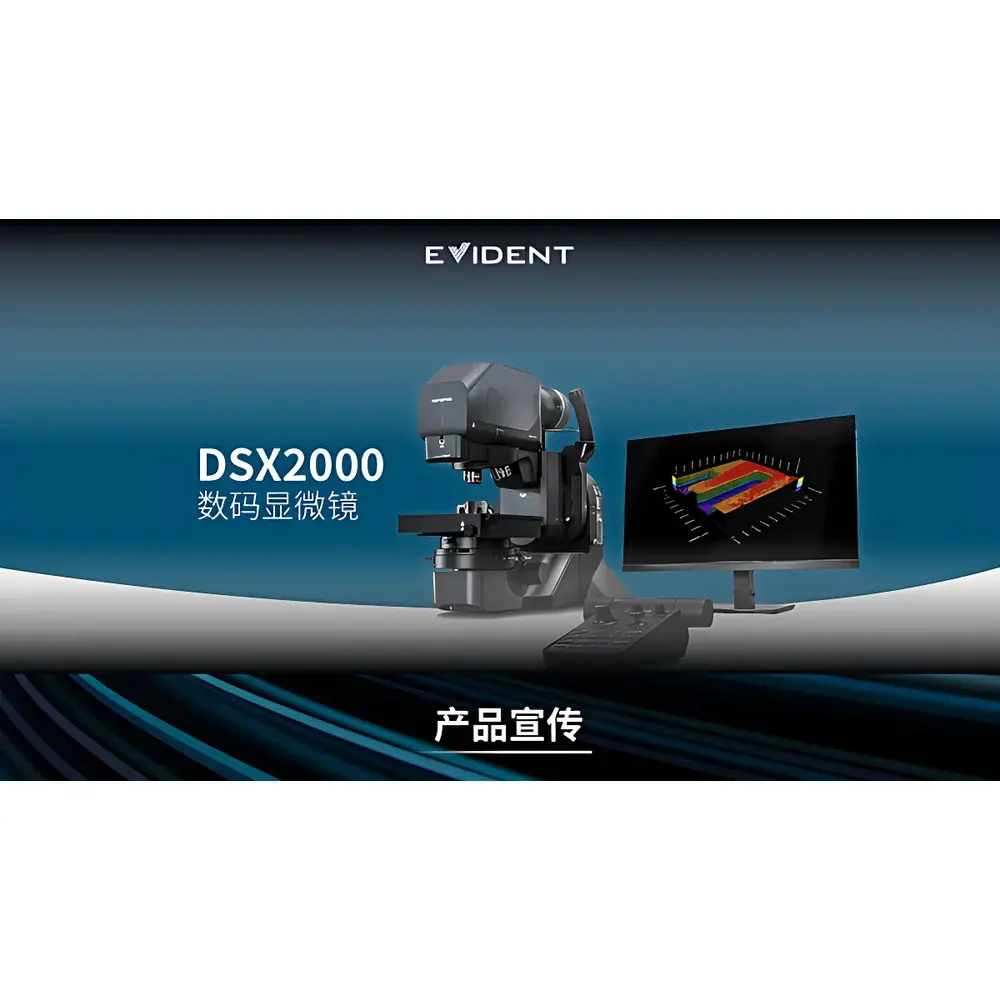
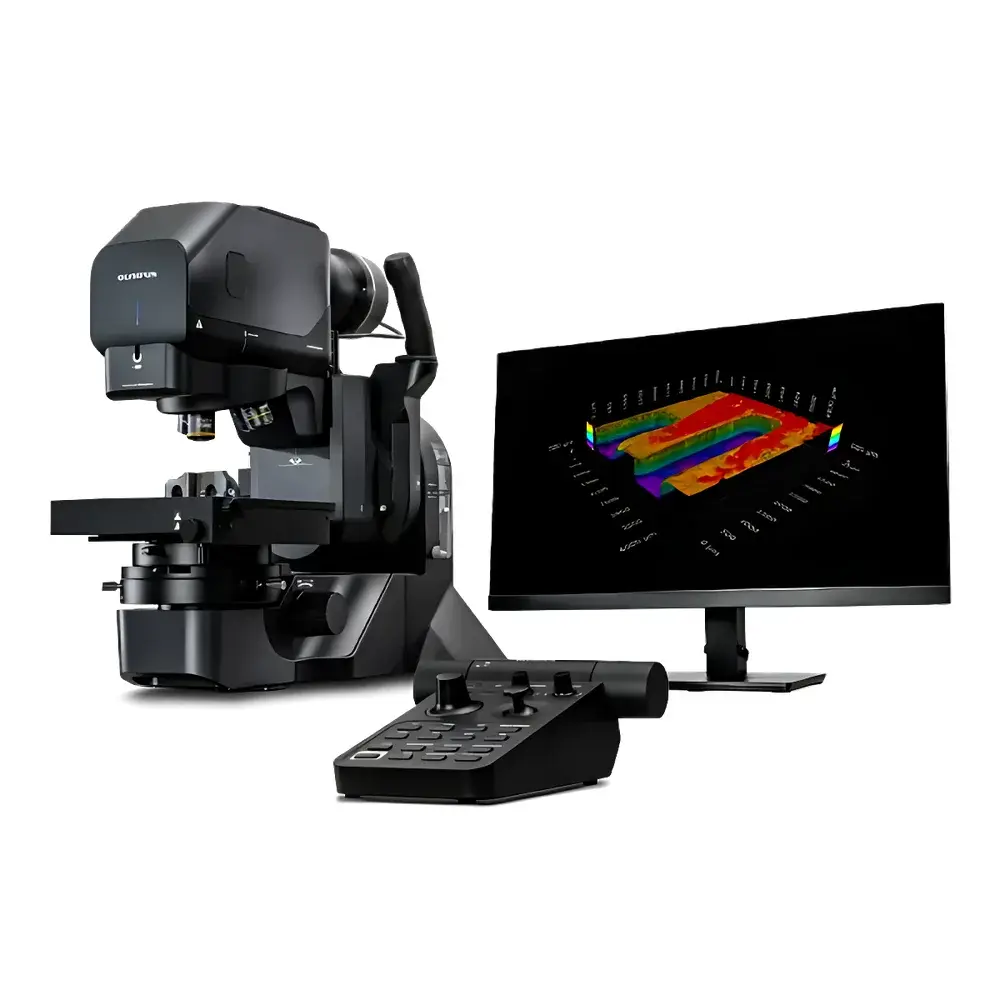
OLYMPUS DSX2000 Fully Motorized Digital Microscope
| Brand | OLYMPUS |
|---|---|
| Origin | Japan |
| Manufacturer | OLYMPUS Corporation |
| Product Type | Imported Instrument |
| Model | DSX2000 |
| Imaging Sensor | 12.37 MP Color CMOS |
| Focus Drive | Motorized Z-axis |
| XY Stage Options | Multiple Standard Sizes (e.g., 100 × 100 mm, 200 × 200 mm) |
| Frame Rate | Up to 60 fps at Full HD |
| 3D Image Comparison | Yes |
| Zoom Ratio | 1×–10× Optical Zoom |
| Total Magnification Range | 26×–7300× (with Objective Lenses & Digital Zoom) |
Overview
The OLYMPUS DSX2000 Fully Motorized Digital Microscope is an integrated optical inspection platform engineered for precision, repeatability, and workflow efficiency in industrial quality control, failure analysis, materials science, and R&D laboratories. Unlike conventional compound or stereo microscopes, the DSX2000 employs a dual-path optical architecture combining high-fidelity optical zoom with calibrated digital magnification—enabling seamless transition from macro-scale sample overview (26×) to sub-micron surface detail (7300×) without changing objectives or repositioning. Its core measurement principle relies on telecentric optical design, motorized parfocal zoom optics, and pixel-registered image capture to ensure geometric fidelity across magnifications. The system eliminates mechanical parallax and focus drift through synchronized motorized Z-drive, objective turret, and stage control—all coordinated via the PRECiV software platform. Designed for ISO/IEC 17025-compliant environments, the DSX2000 supports traceable calibration routines and audit-ready metadata logging.
Key Features
- Fully motorized operation: Integrated motorized zoom head, objective revolver (up to 6 positions), Z-axis focus drive, and programmable XY stage enable fully repeatable positioning and automated multi-point acquisition.
- Seven observation modes: Simultaneous hardware-based illumination control for brightfield, darkfield, MIX (brightfield + darkfield), polarized light, oblique illumination, differential interference contrast (DIC), and proprietary Shadow Contrast mode—each optimized for specific surface topography or reflectivity characteristics.
- Real-time Shadow Contrast imaging: A patented optical technique that enhances subtle height variations and edge discontinuities without post-processing; ideal for detecting micro-scratches, coating delamination, solder voids, or grain boundary anomalies during live inspection.
- 4K-resolution imaging: 12.37 MP color CMOS sensor delivers >3840 × 2160 pixel output with 12-bit dynamic range, enabling high-fidelity documentation and metrology-grade measurements.
- Intelligent image optimization: One-click Auto-Tune function analyzes scene luminance, contrast, and sharpness to automatically select optimal exposure, gamma, and sharpening parameters—reducing operator dependency and inter-user variability.
- Calibrated measurement suite: Built-in tools for length, angle, radius, area, particle count, and profile height—with NIST-traceable calibration certificates available per lens and stage configuration.
Sample Compatibility & Compliance
The DSX2000 accommodates diverse sample geometries—from wafers and PCBs to metallographic mounts, ceramic substrates, and polymer components—via interchangeable stage modules (standard, large-area, tilting, and heated options). Its modular lighting engine supports incident and transmitted illumination paths, compatible with both reflective and semi-transparent specimens. All optical components comply with JIS B 7153 (microscope performance standards) and IEC 61000-6-3 (EMC emissions). System firmware and PRECiV software are validated for GLP/GMP environments and support FDA 21 CFR Part 11 compliance when configured with electronic signatures, audit trails, and role-based access control.
Software & Data Management
PRECiV software serves as the unified interface for acquisition, annotation, measurement, reporting, and data export. It records full metadata—including magnification, illumination mode, exposure time, lens ID, stage coordinates, and user credentials—for every captured image. Batch processing workflows support automated stitching of large-area scans (up to 100 mm × 100 mm), multi-focus Z-stacking, and comparative side-by-side 3D surface rendering. Export formats include TIFF (with embedded calibration data), PDF reports (customizable templates), CSV measurement logs, and DICOM-compatible files for integration into LIMS or ELN systems. Software updates follow OLYMPUS’ documented change control process per ISO 13485.
Applications
- Electronics manufacturing: Solder joint inspection, BGA void analysis, flex circuit trace integrity verification, and conformal coating uniformity assessment.
- Materials characterization: Grain size distribution (ASTM E112), inclusion rating (ASTM E45), phase identification in alloys, and fracture surface morphology analysis.
- Automotive component QA: Surface defect mapping on injection-molded parts, wear scar evaluation on bearings, and coating thickness estimation via edge profiling.
- Academic research: Teaching microscopy fundamentals, correlative imaging with SEM/EDS datasets, and time-lapse surface evolution studies under environmental stressors.
- Medical device validation: Visual inspection of laser-cut stents, surface roughness screening of orthopedic implants, and biocompatibility test sample documentation.
FAQ
Does the DSX2000 support automated focus stacking and extended depth of field (EDF) synthesis?
Yes—the PRECiV software includes a programmable Z-stack acquisition module with user-defined step size and number of slices, followed by real-time EDF fusion using gradient-based weighting algorithms.
Can measurement data be exported directly to statistical process control (SPC) platforms?
Yes—CSV exports include timestamp, operator ID, sample ID, and all measured parameters, enabling direct import into Minitab, JMP, or custom SPC dashboards.
Is remote operation supported for lab-wide deployment?
The DSX2000 supports secure remote desktop access via Windows Remote Desktop Protocol (RDP) and offers optional web-based monitoring through OLYMPUS’ DSX Link server application.
What calibration documentation is provided with the system?
Each delivered system includes a factory calibration certificate for magnification accuracy, stage linearity, and Z-axis repeatability, traceable to national standards (JCSS in Japan). On-site recalibration services are available annually.
How does the DSX2000 ensure long-term imaging consistency across operators?
Through saved “Observation Recipes”—which encapsulate illumination settings, focus parameters, measurement protocols, and report templates—and enforced via password-protected user profiles with configurable permission levels.






