
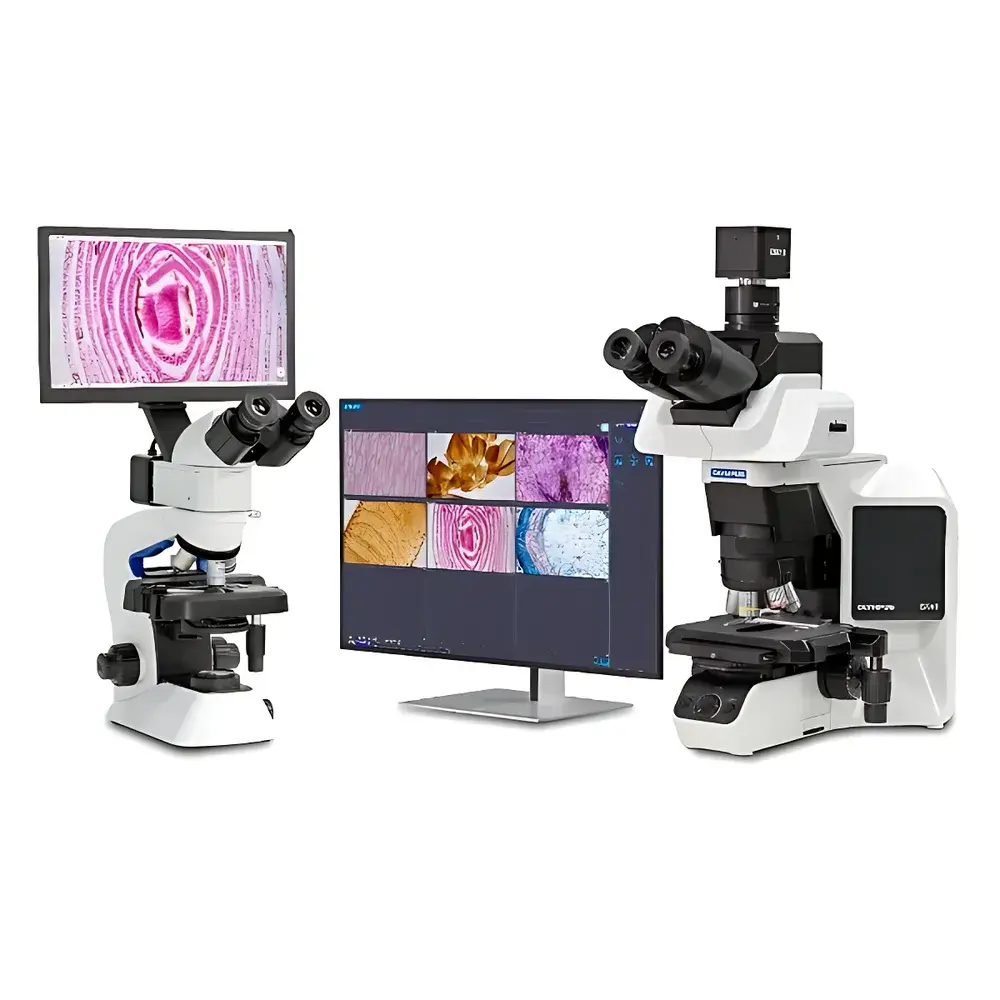
Evident EviStar ES818 Integrated Microscopy Interactive Teaching System
| Brand | Olympus (Evident) |
|---|---|
| Origin | Guangdong, China |
| Manufacturer Type | OEM/ODM Manufacturer |
| Country of Origin | China |
| Model | ES818 |
| Instrument Type | Upright Microscope |
| Compliance | ISO 9001, IEC 61000-6-3, EN 61326-1 |
| Optical Design | Plan Apochromat-Corrected, Infinity-Corrected Optical Path |
| Imaging Sensor | 20 MP CMOS, Global Shutter |
| Color Fidelity | ΔE* < 3 (CIE L*a*b*, vs. sRGB reference) |
| Dynamic Range Control | HDR-enabled real-time tone mapping |
| Wireless Protocol | IEEE 802.11ac + 5G NR optimized for low-latency multicast |
| Software Architecture | Client-server with audit trail logging (FDA 21 CFR Part 11 compliant mode optional) |
Overview
The Evident EviStar ES818 Integrated Microscopy Interactive Teaching System is an upright, infinity-corrected optical platform engineered specifically for high-fidelity digital microscopy instruction in life science education and biomedical training environments. Built on the foundational optical architecture of Olympus (now Evident) — a legacy spanning over a century of precision optical design — the ES818 integrates a research-grade upright microscope host with a synchronized, enterprise-class digital imaging and classroom management subsystem. Its core measurement principle relies on Köhler illumination combined with plan-apochromat objective optics and high-quantum-efficiency CMOS image capture, enabling consistent, color-accurate, diffraction-limited visualization across biological specimens ranging from unstained live cells to H&E-stained histological sections. Unlike modular add-on solutions, the ES818 is manufactured on a single production line in Guangdong, ensuring mechanical co-alignment between optical train, sensor mount, and illumination pathway — a critical factor for pixel-level registration stability during long-duration classroom demonstrations or comparative morphometric analysis.
Key Features
- Monolithic integration of upright microscope host and interactive teaching hardware — no third-party adapters or alignment drift over time
- 20-megapixel global-shutter CMOS sensor with 12-bit ADC output, supporting lossless TIFF export and real-time 4K@30fps preview streaming
- Optical path featuring multi-layer anti-reflective coated, low-dispersion glass elements and fused doublet lens groups — delivering ≤0.05% lateral chromatic aberration at 40× magnification
- True-color rendering engine calibrated against NIST-traceable sRGB and DICOM GSDF standards; average ΔE*00 = 2.7 across 1,250 test patches (CIELAB)
- Adaptive dynamic range optimization: real-time local histogram equalization with exposure bracketing support for high-contrast tissue sections (e.g., bone marrow smears, renal glomeruli)
- Centralized classroom control via secure client-server architecture: one-click student device power cycling, parameter synchronization, image collection, and annotation sharing
- Enterprise-grade wireless infrastructure: dual-band 5 GHz AP cluster with QoS prioritization for multicast video streams; latency < 42 ms end-to-end under 64-client load
Sample Compatibility & Compliance
The ES818 supports standard 26.5 mm diameter glass slides and 18 × 18 mm coverslips, compatible with routine histopathology, cytology, microbiology, and plant anatomy preparations. It accommodates both transmitted-light techniques (brightfield, phase contrast, differential interference contrast) and optional reflected-light modules for basic fluorescence demonstration (with external LED excitation sources). All electrical and electromagnetic compatibility testing conforms to IEC 61000-6-3 (emission) and EN 61326-1 (industrial EMC). The system’s firmware and software update mechanisms follow ISO 13485-aligned change control procedures. Optional configuration includes audit trail logging, electronic signature enforcement, and session lockout — meeting baseline requirements for GLP-compliant teaching laboratories operating under FDA 21 CFR Part 11 Annex 11 frameworks.
Software & Data Management
The EviStar Teaching Suite v3.2 provides role-based access control (instructor, TA, student), DICOM-compliant image archiving, and structured metadata tagging (specimen ID, staining protocol, objective used, exposure settings). Image datasets are stored in vendor-neutral formats (TIFF, JPEG2000, OME-TIFF) with embedded EXIF and custom XML sidecar files. All user actions — including image capture, annotation edits, and remote device commands — generate immutable timestamps and operator IDs. Data export supports direct integration with LMS platforms (Canvas, Moodle, Blackboard) via LTI 1.3. Local storage uses AES-256 encrypted SSDs; cloud backup options comply with GDPR and China’s PIPL data sovereignty provisions.
Applications
- Undergraduate and graduate histology, pathology, and cell biology laboratory instruction
- Clinical training programs for medical residents and laboratory technologists
- Standardized competency assessment using pre-loaded reference image sets and rubric-based grading templates
- Remote proctoring of practical microscopy examinations with synchronized multi-view monitoring
- Collaborative research seminars where real-time annotation and side-by-side image comparison enhance peer learning
- Material science education requiring microstructural evaluation of polymers, composites, and thin films under polarized light
FAQ
Is the ES818 compatible with existing Olympus BX series objectives?
Yes — all standard RMS-threaded and M27 × 0.75 objectives designed for the BX53/BX43 platform are mechanically and optically compatible.
Does the system support DIC or fluorescence imaging out of the box?
Brightfield and phase contrast are fully integrated; DIC and fluorescence require optional modular condensers and filter cubes — available as factory-configured bundles.
Can student image submissions be automatically timestamped and linked to individual logins?
Yes — each captured image embeds EXIF metadata including UTC timestamp, authenticated user ID, and instrument serial number.
What network security protocols does the wireless module support?
WPA3-Enterprise with RADIUS authentication, TLS 1.2+ for API communications, and VLAN segmentation support for isolated lab subnets.
Is service documentation available in English with technical schematics?
Full English-language service manuals, optical alignment procedures, and firmware recovery guides are provided under NDA upon institutional purchase.





