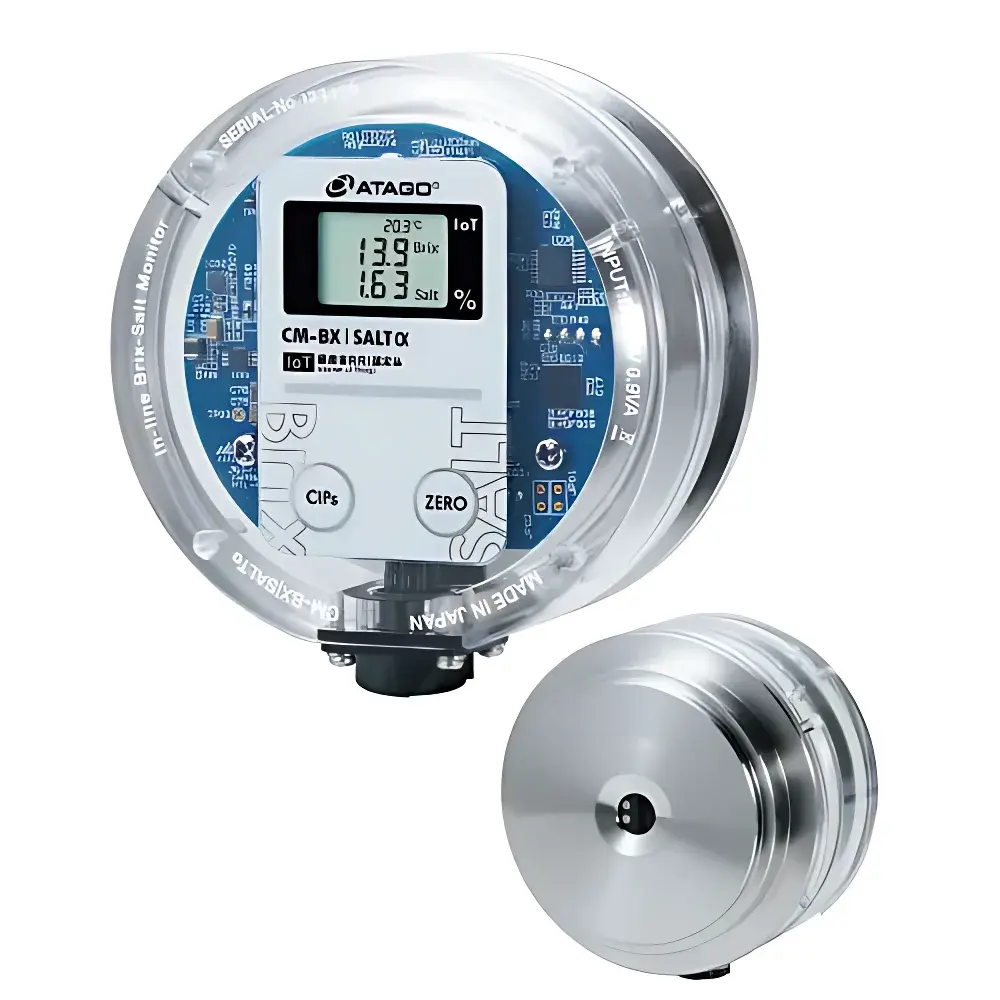
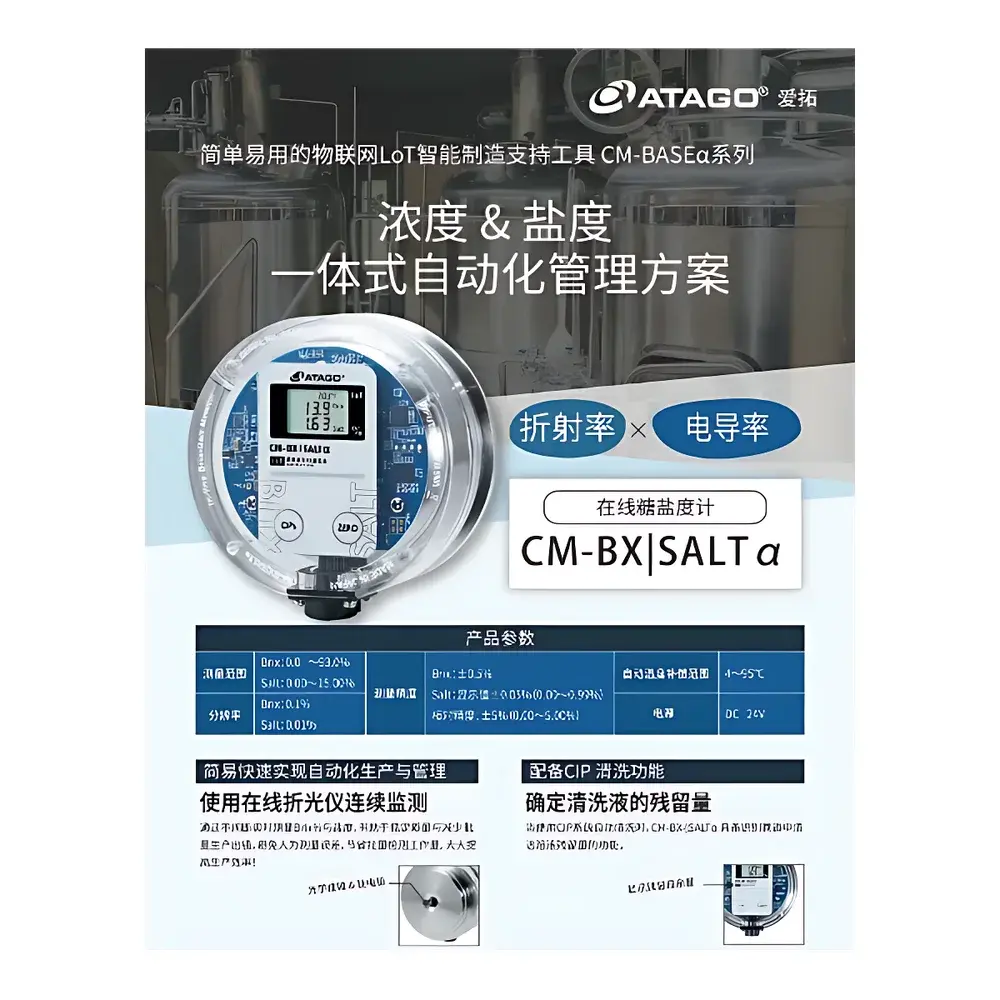
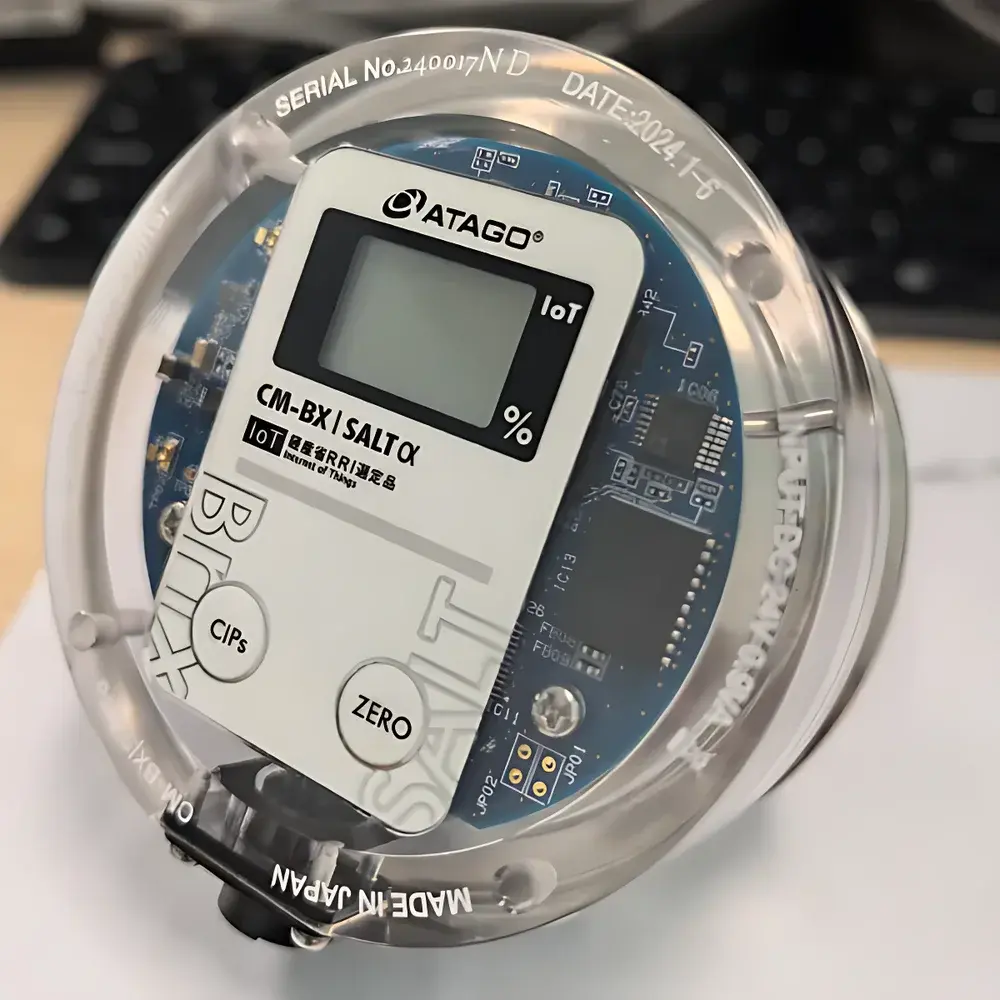
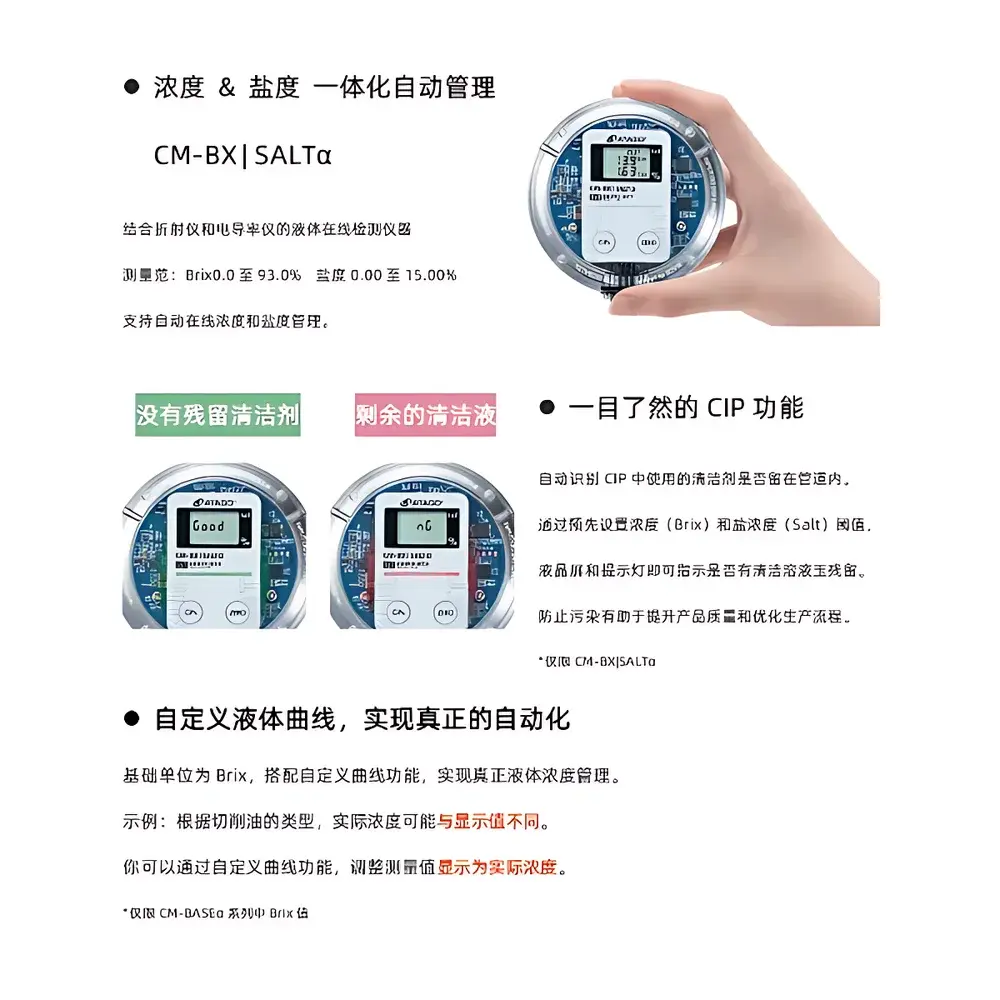
ATAGO CM-BX/SALT α Online Refractometer & Conductivity-Based Salinity Analyzer
| Brand | ATAGO |
|---|---|
| Origin | Japan |
| Model | CM-BX/SALT α |
| Measurement Range | Brix 0.0–93.0%, Salt 0.00–15.00% |
| Resolution | Brix 0.1%, Salt 0.01% |
| Accuracy | Brix ±0.5% |
| Temperature Control Range | 4–95 °C |
| Wetted Materials | SUS 316L stainless steel + synthetic sapphire prism |
Overview
The ATAGO CM-BX/SALT α is a dual-parameter, in-line process refractometer engineered for continuous, non-invasive monitoring of soluble solids concentration (Brix) and aqueous salt concentration (NaCl mass %) in industrial fluid streams. Unlike conventional single-mode refractometers, the CM-BX/SALT α integrates optical refractometry with conductivity-based salinity calculation—leveraging the well-established correlation between electrical conductivity and NaCl content in dilute to moderately concentrated aqueous solutions. This hybrid measurement architecture eliminates manual sampling, reduces operator intervention, and ensures real-time data integrity across dynamic production environments. The instrument operates on the principle of total internal reflection at the sapphire–process fluid interface; incident light undergoes critical angle shift proportional to the fluid’s refractive index, which is then converted to Brix via temperature-compensated calibration curves traceable to NIST-certified sucrose standards. Simultaneously, integrated platinum electrodes measure solution conductivity, and proprietary algorithms apply empirically validated temperature-dependent conversion models to derive salt concentration. Designed for permanent installation in pressurized or recirculating lines, the CM-BX/SALT α delivers stable performance under continuous flow conditions without drift or recalibration requirements typical of batch-style analyzers.
Key Features
- Simultaneous dual-output measurement: Brix (0.0–93.0%) and Salt (0.00–15.00%) reported independently in real time
- High-stability optical path featuring a synthetic sapphire measuring prism (Mohs hardness 9), resistant to abrasion, chemical attack, and thermal shock
- Wetted parts constructed entirely from ASTM A276 Grade 316L stainless steel and sapphire—compliant with FDA 21 CFR 178.3570 and EHEDG EL Class I guidelines for food-contact surfaces
- Integrated Peltier-assisted temperature control (4–95 °C) with ±0.1 °C stability, enabling precise refractive index compensation per ISO 2173 and AOAC 932.12
- Automatic temperature compensation (ATC) applied across full operating range for both Brix and Salt outputs, referenced to 20 °C standard
- Dual analog output (4–20 mA, isolated) configurable for either parameter or ratio mode; RS-232C serial interface supports Modbus RTU protocol for SCADA integration
- IP65-rated enclosure with NEMA 4X compatibility; suitable for washdown environments in food, beverage, and pharmaceutical manufacturing
Sample Compatibility & Compliance
The CM-BX/SALT α is validated for use with clear to mildly turbid aqueous solutions containing sucrose, glucose, fructose, sodium chloride, and common food-grade acids or buffers. It is not intended for opaque slurries, emulsions, or highly viscous fluids (>500 mPa·s) where light scattering or laminar flow disruption compromises optical signal fidelity. The instrument meets IEC 61000-6-2 (immunity) and IEC 61000-6-4 (emission) for industrial electromagnetic environments. Calibration verification follows ASTM D1074 (refractometric sugar analysis) and ASTM D1125 (conductivity-based salinity determination). Data logging and configuration changes are audit-trail enabled, supporting GLP/GMP documentation requirements under 21 CFR Part 11 when paired with compliant host systems.
Software & Data Management
Configuration, diagnostics, and trend visualization are managed via ATAGO’s PC-based CM-Config software (Windows 10/11 compatible), which provides secure password-protected access levels (Operator, Technician, Administrator). All calibration events, parameter changes, and system errors are timestamped and stored locally with optional export to CSV or XML. The RS-232C interface supports direct connection to PLCs or DCS platforms using standard ASCII command sets; no proprietary drivers required. Firmware updates preserve user-defined setpoints and historical calibration coefficients. For enterprise integration, the device supports OPC UA server compatibility through third-party gateway middleware certified per OPC Foundation conformance testing.
Applications
- Continuous Brix control in juice concentration, syrup blending, and dairy evaporation processes
- Real-time salt concentration monitoring in brine preparation, pickling baths, and seafood processing lines
- In-line quality assurance during fermentation (e.g., soy sauce, miso, fish sauce) where both sugar depletion and salt accumulation must be tracked
- Concentration verification in cleaning-in-place (CIP) return streams to confirm detergent or acid concentration compliance
- Process validation in biopharmaceutical buffer preparation where NaCl and excipient concentrations impact downstream filtration efficiency
- Raw material receipt inspection for syrups, molasses, and brine solutions prior to tank storage
FAQ
Does the CM-BX/SALT α require periodic recalibration?
No routine recalibration is needed under stable process conditions. However, ATAGO recommends annual verification using certified reference standards (e.g., NIST-traceable sucrose solutions and KCl conductivity standards) to maintain measurement traceability.
Can it measure salt in non-aqueous or mixed-solvent systems?
No. The conductivity-based salt algorithm assumes aqueous NaCl dominance. Performance degrades significantly in ethanol-water blends, glycol solutions, or organic solvents due to altered conductivity-per-concentration relationships.
What is the minimum flow rate required for accurate measurement?
A laminar flow velocity of ≥0.3 m/s is recommended to ensure consistent prism wetting and eliminate boundary layer effects. Optional flow cells with integrated turbulence promoters are available for low-flow applications.
Is the sapphire prism replaceable in the field?
Yes. The prism assembly is modular and serviceable without disassembling the entire sensor body. Replacement kits include torque-controlled mounting hardware and optical coupling gel pre-applied per ATAGO specification.
How does temperature control affect long-term stability?
Active temperature regulation mitigates thermal lensing and refractive index drift, extending calibration interval stability to ≥12 months in controlled ambient environments (4–40 °C).
Related Products