
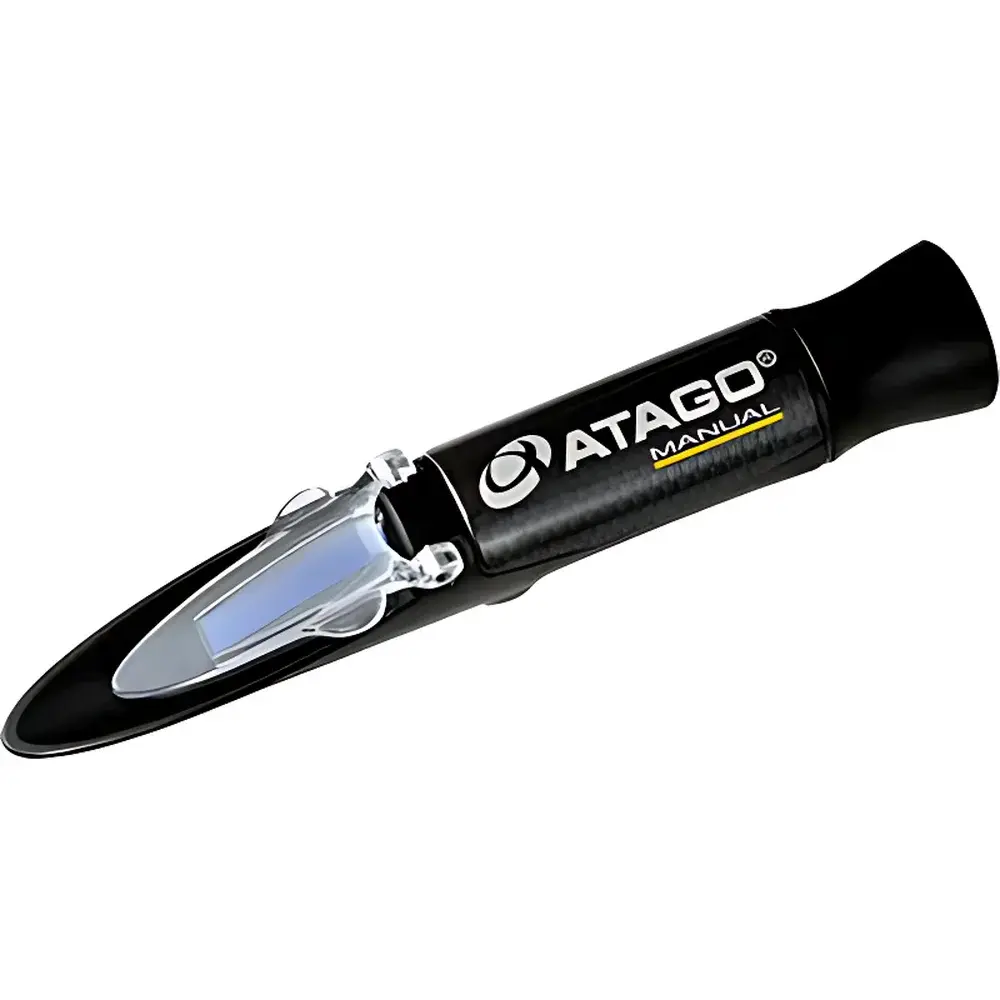
ATAGO MASTER-RI Handheld Refractometer
| Brand | ATAGO |
|---|---|
| Origin | Japan |
| Model | MASTER-RI |
| Type | Analog Handheld Refractometer |
| Measurement Range (Refractive Index) | 1.435–1.520 |
| Minimum Scale Division | 0.001 RI |
| Dimensions | 3.2 × 3.4 × 16.8 cm |
| Weight | 130 g |
| Temperature Control | None |
| Digital Display | None |
| Compliance | ISO 21747 (Refractometry — General principles and practice), ASTM D1218 (Standard Test Method for Refractive Index of Hydrocarbon Liquids) |
Overview
The ATAGO MASTER-RI Handheld Refractometer is a precision optical instrument engineered for rapid, field-deployable measurement of refractive index (RI) in transparent to semi-transparent liquid samples—particularly optimized for plant oils, polymer solutions, and hydrocarbon-based fluids. Based on the fundamental principle of total internal reflection at the prism-sample interface, the MASTER-RI utilizes ambient light (via integrated daylight plate) to generate a sharp shadowline on a calibrated glass scale, enabling direct visual reading of refractive index values from 1.435 to 1.520 with 0.001 RI resolution. Unlike digital or temperature-compensated units, this analog instrument operates without batteries or electronics, ensuring long-term reliability, zero drift, and immunity to electromagnetic interference—critical attributes for marine environmental monitoring, QC labs with limited infrastructure, and routine factory-floor verification where traceability and mechanical simplicity are prioritized.
Key Features
- Optical-grade BK7 glass prism with anti-scratch coating for extended durability and consistent optical performance
- Fixed-scale analog readout eliminates calibration drift associated with electronic sensors or LCD aging
- Compact ergonomic design (130 g, 16.8 cm length) enables one-handed operation in confined or mobile environments—including shipboard oil spill investigations
- Daylight plate (RE-2311-57M, optional) enhances contrast under variable lighting conditions; compatible with standard illumination sources including LED and natural daylight
- Micro-sample prism cover (RE-2311-58M, optional) reduces required sample volume and improves containment for viscous or volatile oils
- Factory-calibrated using NIST-traceable reference standards; verification supported by ATAGO Standard Liquid LB (RE-2100-83N)
Sample Compatibility & Compliance
The MASTER-RI is validated for use with non-aqueous, low-to-moderate viscosity liquids including vegetable oils (e.g., soybean, rapeseed, palm), synthetic lubricants, resin precursors, and hydrocarbon distillates. It is not suitable for aqueous emulsions, suspensions, or highly fluorescent/UV-absorbing media. In maritime regulatory contexts, its RI readings support preliminary classification of spilled oils per IMO MEPC.1/Circ.721 guidelines, aiding source identification when correlated with reference databases. The instrument conforms to ISO 21747 for refractometric methodology and meets the physical robustness requirements outlined in ASTM D1218 for hydrocarbon liquid analysis. While it does not provide automated data logging or audit trails, its mechanical design supports GLP-aligned manual recordkeeping when used with standardized SOPs and controlled calibration intervals.
Software & Data Management
As a fully analog instrument, the MASTER-RI requires no firmware, drivers, or software integration. All measurements are recorded manually—enabling full transparency and eliminating risks associated with software validation, cybersecurity vulnerabilities, or proprietary file formats. Laboratories operating under FDA 21 CFR Part 11 or EU Annex 11 may implement paper-based or LIMS-integrated manual entry workflows, with calibration logs, operator signatures, and environmental notes maintained per GLP/GMP documentation protocols. Optional accessories—including calibrated standard liquid LB and replacement daylight plates—are supplied with batch-specific certification documents traceable to ATAGO’s JIS Z 8015-accredited metrology lab.
Applications
- Routine quality control of edible oil refining processes (e.g., detecting adulteration with lower-RI mineral oils)
- Marine pollution response: rapid on-site differentiation between crude oil, bunker fuel, and vegetable-based biofuels during spill characterization
- Research laboratories studying polymer solubility, solvent compatibility, or phase behavior in non-aqueous systems
- Food processing facilities verifying consistency of oil-based marinades, dressings, or frying medium degradation (via RI shift trends)
- Educational settings demonstrating optical principles of refraction, Snell’s law, and dispersion effects in organic media
FAQ
What sample volume is required for an accurate reading?
Approximately 0.3–0.5 mL is sufficient to fully cover the prism surface; the optional micro-sample cover (RE-2311-58M) reduces this requirement further and minimizes evaporation for volatile oils.
Can the MASTER-RI measure Brix or concentration directly?
No—it measures only refractive index. Conversion to concentration (e.g., % w/w) requires a validated correlation curve specific to each analyte-solvent system, derived from reference methods such as gravimetry or HPLC.
Is temperature compensation available?
No. Measurements must be performed at stable ambient temperature (15–30 °C recommended); for applications requiring thermal control, users should pair the MASTER-RI with a calibrated water bath and apply published temperature correction coefficients for the target oil.
How often should calibration verification be performed?
Before each measurement session and after any physical shock or prism cleaning; verification using Standard Liquid LB (RE-2100-83N) is mandatory prior to critical compliance assessments.
Is the prism resistant to corrosion from plant oils?
Yes—the BK7 prism features a chemically inert, hardened surface compatible with common triglyceride-based oils; however, residual fatty acids or oxidation byproducts should be removed promptly using lint-free tissue and analytical-grade isopropanol.




