
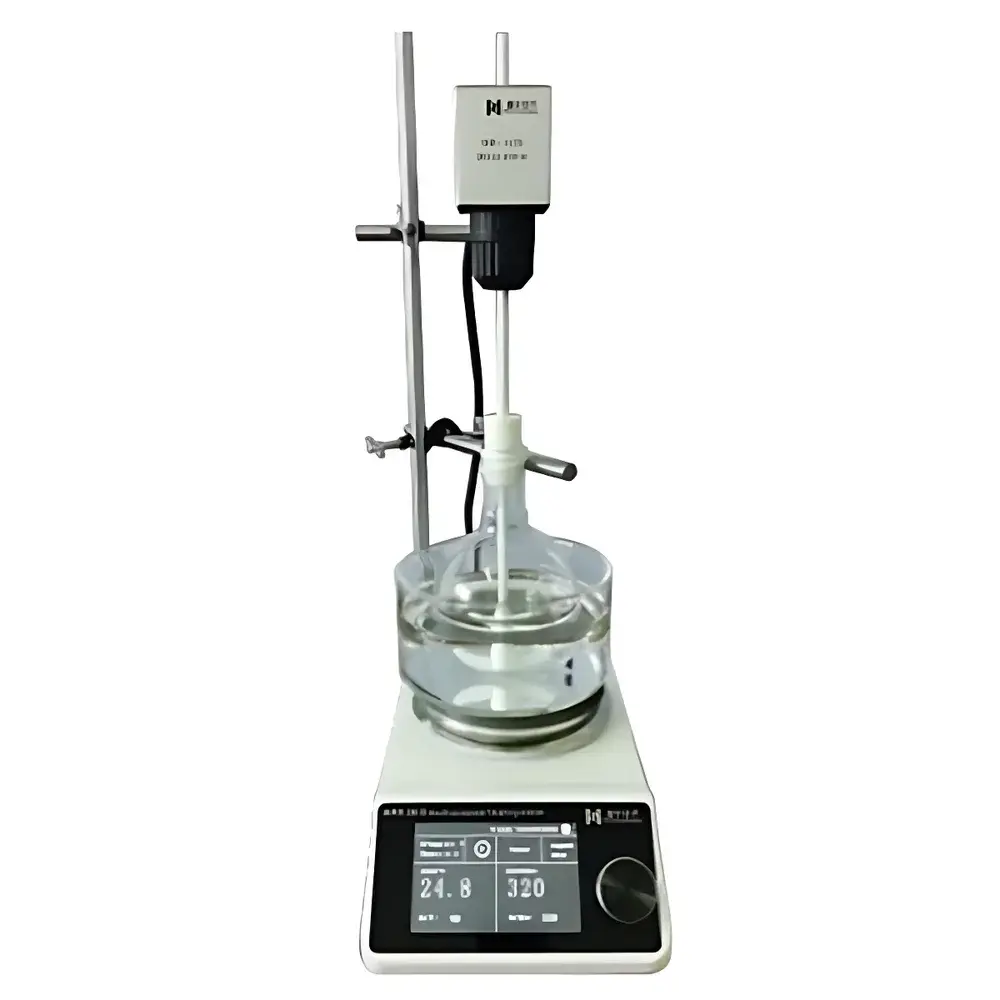
Hanking MRS Series Multipurpose Magnetic Hotplate Stirrer
| Brand | Hanking |
|---|---|
| Origin | Shanghai, China |
| Model | MRS Series |
| Stirrer Type | Magnetic + Mechanical Hybrid Stirrer |
| Temperature Control Range | −40 °C to 350 °C |
| Heating Plate Material | Corrosion-Resistant High-Thermal-Conductivity Ceramic-Coated Alloy |
| Control Interface | Capacitive Touchscreen + Precision Rotary Encoder |
| Temperature Control Modes | 6 Preset Algorithms (2 Rapid Ramp, 2 Precision Ramp, 2 Programmable Ramp/Soak Profiles) |
| Safety Features | Dual Insulation Leakage Protection, Overcurrent Cut-off, Real-Time Self-Diagnosis, Overheat Alarm (>50 °C post-shutdown), Anti-Runaway Temperature Limiting |
| Compliance | Designed for GLP-compliant laboratories |
Overview
The Hanking MRS Series Multipurpose Magnetic Hotplate Stirrer is an engineered solution for laboratories requiring simultaneous high-fidelity thermal control and robust mechanical agitation across diverse chemical synthesis and materials processing applications. Unlike conventional single-mode hotplate stirrers, the MRS platform integrates two independent agitation systems—high-gradient magnetic stirring and adjustable-speed mechanical stirring—within a unified thermal management architecture. Its operational principle relies on eddy-current–assisted induction heating of the ceramic-coated aluminum alloy plate, coupled with closed-loop PID temperature regulation enhanced by adaptive fusion algorithms that dynamically suppress thermal overshoot and improve ramp reproducibility. The system supports cryogenic operation down to −40 °C when interfaced with external recirculating chillers, enabling seamless transition between exothermic reaction quenching and endothermic polymerization initiation—all within a single instrument footprint.
Key Features
- Dual-Mode Agitation Architecture: Switch instantly between high-torque magnetic stirring (up to 1500 rpm, ≥1000 G field gradient) and variable-speed mechanical stirring (0–1200 rpm, 0.5–10 Nm torque range) via touchscreen or rotary encoder input.
- Ceramic-Enhanced Heating Surface: A corrosion-resistant, thermally uniform plate with ≤±0.3 °C spatial temperature deviation across 180 mm diameter active zone; rated for continuous operation at 350 °C with thermal shock resistance up to ΔT = 200 °C/min.
- Six-Profile Temperature Control Engine: Includes two rapid-ramp modes (optimized for solvent reflux setup), two precision-ramp modes (≤0.1 °C/min resolution for crystallization studies), and two programmable multi-step profiles (up to 10 segments per program, each with independent ramp rate, hold time, and endpoint action).
- Intelligent Safety Framework: Complies with IEC 61010-1:2010 safety standards; features dual-redundant isolation monitoring, real-time current draw analytics, automatic fault logging with timestamped event codes, and hardware-enforced upper temperature limit (user-configurable, factory default: 360 °C).
- Modular Mechanical Stirrer Integration: Standardized Ø10–16 mm shaft port with quick-lock coupling; accepts standard PTFE-, glass-, or Hastelloy-coated impellers; optional vertical position adjustment (±25 mm) for optimized shear distribution in tall reactors.
Sample Compatibility & Compliance
The MRS Series accommodates vessels from 10 mL vials to 5 L jacketed reactors, supporting both open-beaker and sealed-system configurations. Its magnetic stirring performance remains stable under viscosities up to 20,000 cP (measured with 10 mm PTFE-coated stir bar in glycerol at 25 °C), while the mechanical module maintains laminar-to-turbulent transition control in Newtonian and pseudoplastic media. The unit is designed to meet ISO 17025 calibration traceability requirements for temperature and rotational speed verification. It supports audit-ready operation in GMP environments through optional firmware-enabled electronic logbook (21 CFR Part 11–compliant signature fields and immutable session records available upon configuration).
Software & Data Management
Local operation requires no software installation—parameters are set and monitored via the integrated capacitive touchscreen with haptic feedback and IP54-rated front panel. For extended data capture, the RS-485 (Modbus RTU) and USB-C interfaces enable direct integration into LabVantage, Thermo Fisher SampleManager, or custom SCADA systems. Optional PC software provides real-time graphing of temperature/stir speed vs. time, CSV export with metadata tagging (operator ID, vessel ID, protocol version), and automated report generation aligned with ASTM E29–22 rounding conventions.
Applications
The MRS Series serves as a primary thermal-agitation platform in organic synthesis (Grignard, Suzuki, and Heck couplings), pharmaceutical process development (API crystallization, solvent-mediated polymorph screening), fine chemical manufacturing (azo dye synthesis, surfactant sulfonation), and polymer science (step-growth polycondensation, radical emulsion polymerization). Its low-temperature capability enables controlled lithiation reactions and cryo-organometallic workups, while its high-end thermal stability supports catalyst sintering studies and ceramic precursor gelation.
FAQ
Can the MRS Series operate under inert atmosphere conditions?
Yes—the base unit is compatible with glovebox integration; mechanical stirrer feedthroughs and heating plate ventilation paths can be sealed using standard Swagelok fittings and nitrogen purge manifolds.
Is calibration certificate included with shipment?
A factory-issued NIST-traceable calibration report for temperature (−40 °C to 350 °C) and rotational speed (0–1500 rpm) is provided; ISO/IEC 17025 accredited third-party calibration is available as an add-on service.
What is the maximum recommended vessel weight for mechanical stirring?
For optimal torque transmission and bearing longevity, the supported load is ≤8 kg including vessel, contents, and stirrer assembly; heavier loads require optional reinforced support column.
Does the system support remote start/stop via PLC signal?
Yes—digital I/O terminals accept 24 VDC dry-contact signals for external run/halt commands, with configurable delay timers and interlock validation logic.
How often does the magnetic stir bar alignment need manual verification?
Under normal use with standardized bar geometry and centered vessel placement, alignment drift is negligible over 12 months; visual inspection is recommended during quarterly preventive maintenance.



