
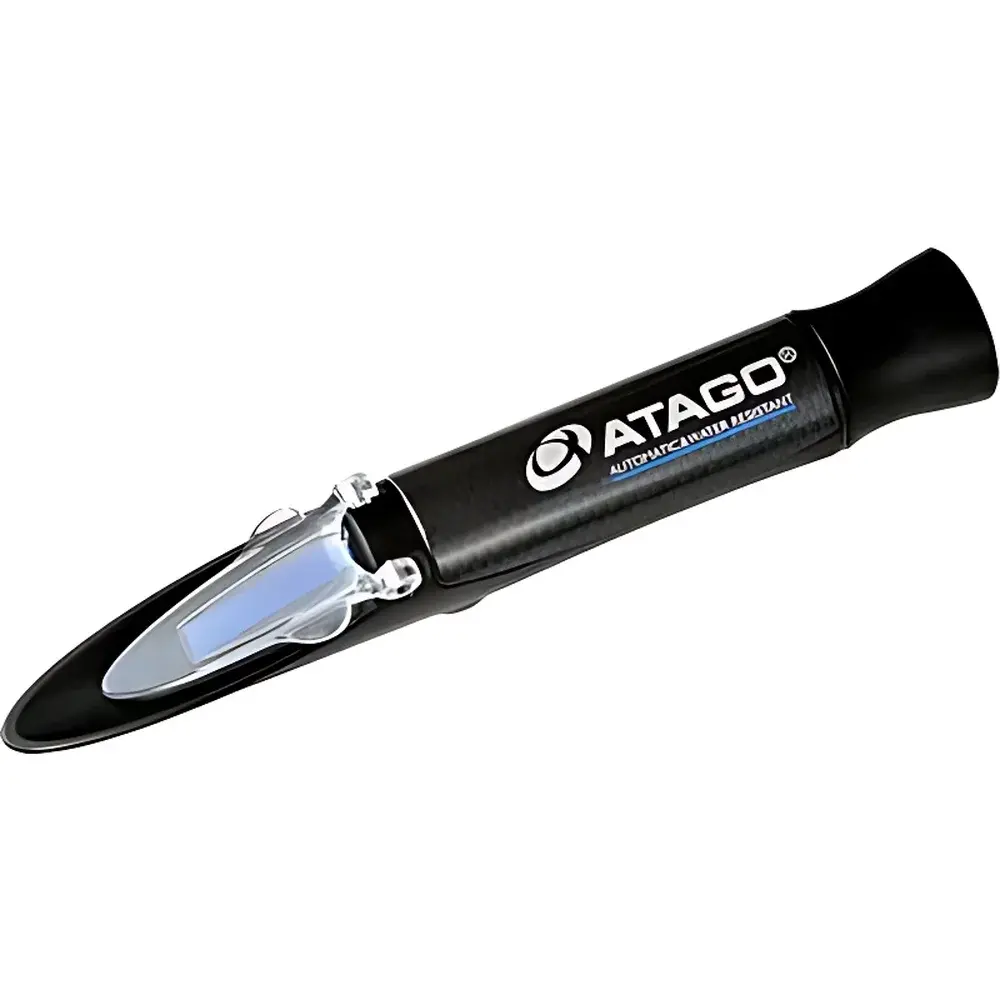
ATAGO MASTER-S28α Waterproof Sodium Chloride Refractometer
| Origin | Japan |
|---|---|
| Manufacturer Type | Authorized Distributor |
| Origin Category | Imported Instrument |
| Model | MASTER-S28α |
| Price Range | USD 140–420 (FOB) |
| Measuring Principle | Abbe Refractometry |
| Scale Range | NaCl 0.0–28.0% w/w |
| Resolution | 0.2% NaCl |
| Accuracy | ±0.2% NaCl (at 10–30°C) |
| Automatic Temperature Compensation (ATC) | Built-in bimetallic compensator (5–35°C range) |
| IP Rating | IP65 |
| Dimensions | 3.2 × 3.4 × 16.8 cm |
| Weight | 90 g |
Overview
The ATAGO MASTER-S28α is a handheld, analog optical refractometer engineered for rapid, field-deployable quantification of sodium chloride (NaCl) concentration in aqueous salt solutions—specifically optimized for food processing environments involving brined vegetables, fermented seafood, pickling solutions, and marine aquaculture monitoring. It operates on the fundamental principle of Abbe refractometry: light refraction at the prism–sample interface is directly correlated to solution density and solute concentration via the Gladstone–Dale relationship. The instrument employs a high-stability BK7 glass prism with precision-ground surface finish and an integrated daylight illumination system, eliminating dependence on external lighting. Its optical path design conforms to ISO 21748:2017 (Refractometry — Guidelines for the use of refractometers in the determination of refractive index) and supports traceable calibration using certified NaCl standard solutions (e.g., NIST SRM 1921b). Unlike digital alternatives, this analog unit requires no batteries or firmware, ensuring operational continuity in humid, saline, or power-constrained settings.
Key Features
- IP65-rated housing constructed from corrosion-resistant polycarbonate and stainless-steel fasteners, providing full protection against dust ingress and low-pressure water jets—critical for washdown environments in food production facilities.
- Integrated automatic temperature compensation (ATC) mechanism utilizing a bimetallic strip calibrated to offset thermal expansion effects across 5–35°C, maintaining measurement fidelity without manual correction.
- Dual-scale reticle viewfinder displaying % NaCl (w/w) directly, with parallax-free optical alignment and engraved reference marks for repeatable eye positioning.
- Prism surface treated with hydrophobic fluoropolymer coating to minimize residue adhesion and accelerate cleaning between high-salinity samples.
- Zero-adjustment screw accessible via recessed port; calibration verified using ATAGO’s certified 0.0% and 10.0% NaCl reference fluids (sold separately, Cat. No. 2482 & 2483).
Sample Compatibility & Compliance
The MASTER-S28α is validated for use with homogeneous, non-viscous, non-turbid aqueous NaCl solutions. It is not suitable for emulsions, suspensions, or solutions containing ethanol, glycerol, or organic acids above 0.5% v/v—such matrices induce refractive index deviations exceeding ±0.5% error. In food safety contexts, it complies with HACCP prerequisite programs for brine verification and aligns with Codex Alimentarius Standard CXS 212–1995 (Standard for Salt) for routine lot-release testing. While not FDA 21 CFR Part 11 compliant (as it generates no electronic records), its mechanical design meets GMP Annex 15 requirements for “simple, well-understood measurement devices” where manual entry into batch records is permitted.
Software & Data Management
This is a standalone analog instrument with no embedded electronics, connectivity, or data logging capability. All measurements are recorded manually in laboratory notebooks or digital quality management systems (QMS) such as TrackWise or MasterControl. For audit readiness, users are advised to document: date/time, operator ID, sample identifier, ambient temperature, observed scale reading, and calibration verification status (per ATAGO Calibration Certificate Form R-28α). Traceability is maintained through serial-numbered instruments and annual recalibration by ATAGO-authorized service centers (certificates issued per ISO/IEC 17025).
Applications
- Real-time monitoring of brine concentration during kimchi, sauerkraut, and olive fermentation processes to ensure microbial stability and texture development.
- Verification of salting baths used in surimi, salted roe, and dried fish preparation—critical for water activity (aw) control per ISO 21807:2021.
- On-site validation of seawater dilution ratios in hatchery operations and recirculating aquaculture systems (RAS).
- QC release testing of industrial-grade table salt and de-icing salt solutions prior to packaging or application.
- Educational use in food science laboratories for teaching fundamental principles of solution thermodynamics and colligative properties.
FAQ
Can the MASTER-S28α measure seawater salinity in parts per thousand (ppt)?
No—it is calibrated exclusively for % NaCl (w/w) and does not account for the full ionic composition of natural seawater (e.g., Mg²⁺, Ca²⁺, SO₄²⁻). For oceanographic applications, use ATAGO’s PAL-SE series or a dedicated conductivity-based salinometer.
Is calibration required before each use?
Daily calibration is recommended when operating across temperature gradients >5°C or after exposure to extreme humidity; otherwise, pre-shift verification with 0.0% and 10.0% standards suffices per ISO 8655-6.
How often should the prism be cleaned?
After every sample—especially viscous or protein-rich brines—using distilled water followed by lens-grade tissue; avoid acetone or abrasive cleaners that degrade the prism coating.
Does IP65 rating permit submersion?
No—IP65 indicates protection against water jets only; immersion beyond 1 m depth voids warranty and risks prism seal failure.
Can accuracy be improved beyond ±0.2%?
No—the tolerance is inherent to optical resolution and ATC mechanics; higher precision requires digital refractometers (e.g., RX-5000α) with Peltier-controlled prisms and CCD detection.





