
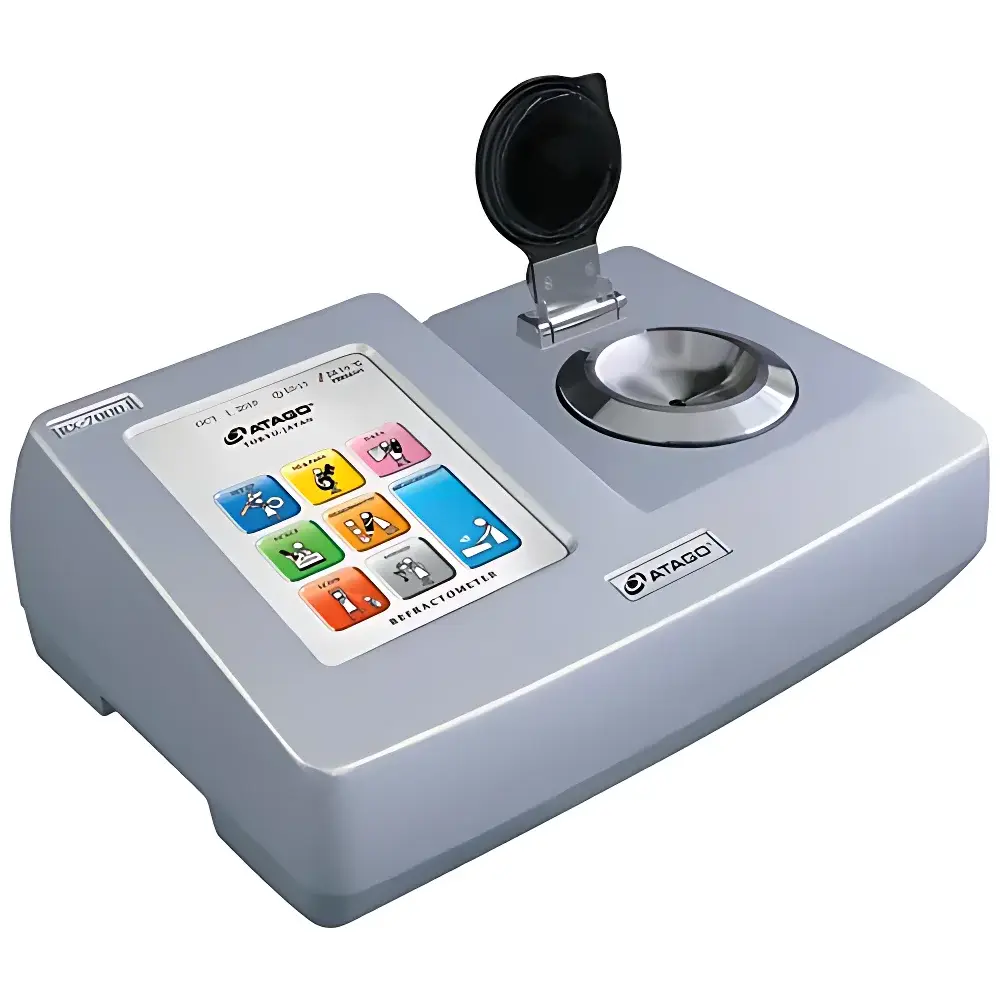
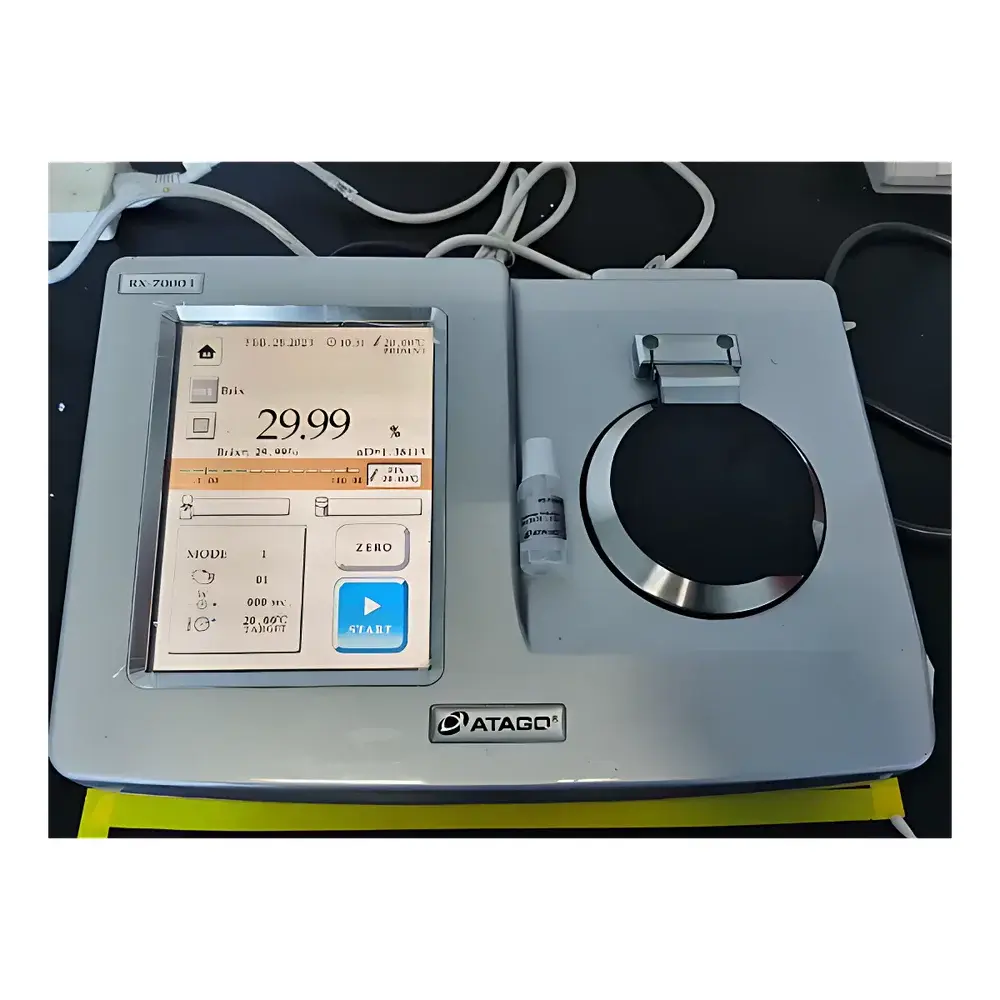
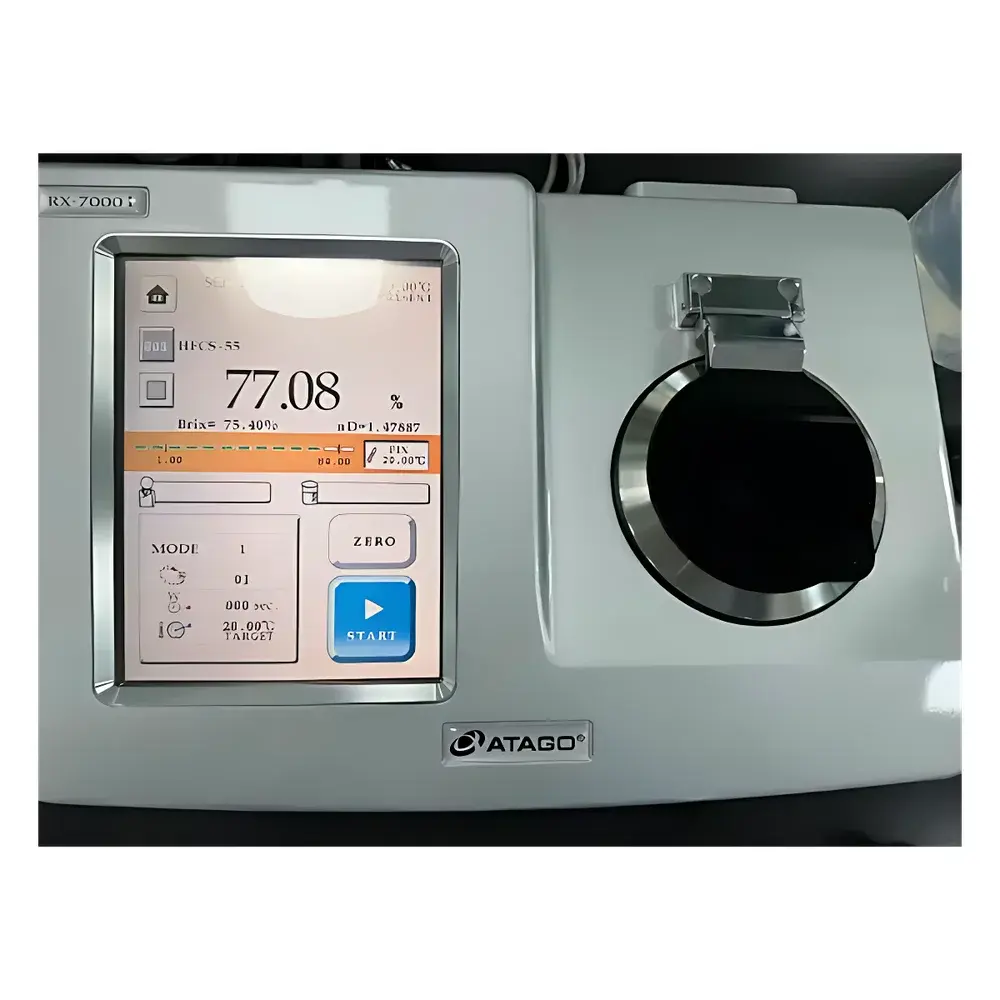
ATAGO RX-7000i High-Precision Wide-Range Digital Abbe Refractometer
| Brand | ATAGO |
|---|---|
| Origin | Japan |
| Model | RX-7000i |
| Sample Type | Liquid |
| Instrument Type | Benchtop Refractometer |
| Temperature Control | Peltier-based (5.00–75.00 °C) |
| Display | Touchscreen LCD |
| Measurement Range | Refractive Index (nD): 1.299800–1.715000 |
| Brix | 0.00–100.00% |
| Accuracy | nD: ±0.000100 |
| Brix | ±0.1% |
| Resolution | nD: 0.000001 |
| Brix | 0.01% |
| Temperature Resolution | 0.01 °C |
| Prism Material | Synthetic Sapphire |
| Sample Stage Material | SUS316 Stainless Steel |
| Interface | RS-232C, USB, Optional Thermal Printer |
| Power Supply | AC 100–240 V, 50/60 Hz |
| Power Consumption | 90 VA |
| Dimensions (W×D×H) | 370 × 260 × 140 mm |
| Weight | 7.0 kg |
Overview
The ATAGO RX-7000i is a high-precision benchtop Abbe refractometer engineered for rigorous quantitative analysis of liquid samples across industrial quality control, R&D, and regulatory-compliant laboratories. It operates on the principle of critical angle measurement using monochromatic sodium D-line illumination (589.3 nm), enabling direct determination of refractive index (nD) and temperature-compensated Brix concentration. Its wide dynamic range—spanning nD 1.299800 to 1.715000 and Brix 0.00–100.00%—accommodates diverse media including low-refractive-index solvents (e.g., ethanol, acetone), highly concentrated sugar syrups, glycol-based antifreezes, optical coupling fluids, and high-index polymer precursors. The integrated Peltier thermoelectric module ensures precise, stable sample temperature control from 5.00 to 75.00 °C without external chillers or water baths—critical for minimizing thermal drift and achieving ASTM D1218 and ISO 21600-compliant repeatability.
Key Features
- High-resolution touchscreen interface with intuitive one-finger operation and responsive graphical navigation
- Peltier-driven active temperature control with ±0.01 °C stability and automatic measurement initiation upon thermal equilibration
- Optical system featuring synthetic sapphire prism and SUS316 stainless steel sample stage for chemical resistance and long-term dimensional stability
- Measurement resolution of 0.000001 for nD and 0.01% for Brix, supporting trace-level formulation verification and process endpoint detection
- Onboard self-diagnostic routines—including prism surface inspection, light source intensity calibration, and temperature sensor validation—to maintain metrological integrity between scheduled maintenance
- Five selectable measurement modes: Standard, Auto-Repeat, Continuous Monitoring, Temperature Ramp, and User-Defined Protocol Execution
Sample Compatibility & Compliance
The RX-7000i is validated for use with aqueous solutions, organic solvents, emulsions, and viscous liquids up to ~500 mPa·s (measured at 25 °C). Its sapphire prism resists scratching and corrosion from aggressive reagents including strong acids, alkalis, and halogenated hydrocarbons—enabling direct analysis of cleaning agents, etchants, and plating baths common in semiconductor and electroplating manufacturing. The instrument supports GLP/GMP workflows through audit-trail-capable data logging (500+ measurements retained with timestamp, temperature, operator ID, and method tag). While not FDA 21 CFR Part 11–certified out-of-the-box, its RS-232C and USB interfaces allow integration with validated LIMS or ELN platforms that enforce electronic signature and change-control requirements per USP <1058> and ISO/IEC 17025:2017.
Software & Data Management
Internal firmware stores up to 100 user-defined calibration curves alongside 24 preloaded scales (e.g., sucrose, sodium chloride, ethylene glycol, propylene glycol, methanol, glycerol, and pharmaceutical excipients). All measurements include embedded metadata: date/time, sample temperature, selected scale, operator code (configurable), and measurement mode. Export is supported via ASCII-formatted RS-232C serial output or USB mass-storage emulation—compatible with Excel, LabArchives, and custom Python/Matlab ingestion scripts. Optional PC software (ATAGO WinCT-Refracto) enables real-time graphing, statistical process control (SPC) charting, multi-instrument fleet monitoring, and PDF report generation compliant with ISO 17025 documentation standards.
Applications
- Food & Beverage: Brix quantification in fruit juices, concentrates, dairy blends, and fermentation broths; refractive index verification of flavor oils and carrier solvents
- Pharmaceuticals: Excipient concentration checks (e.g., PEG, polysorbates), solvent recovery validation in API synthesis, and osmolality proxy assessment
- Chemical Manufacturing: Glycol content monitoring in heat-transfer fluids, acid/base concentration tracking in pickling baths, and monomer purity screening
- Electronics & Optics: Refractive index matching of photoresist developers, anti-reflective coating solvents, and encapsulation resins
- Academic Research: Thermodynamic characterization of binary/ternary liquid mixtures, polymer solution behavior, and colloidal dispersion stability studies
FAQ
What temperature accuracy does the Peltier system achieve during measurement?
The built-in thermoelectric controller maintains sample temperature within ±0.01 °C of the setpoint, verified by an embedded platinum RTD sensor calibrated traceably to NIST standards.
Can the RX-7000i measure turbid or particulate-laden samples?
It is designed for optically clear or mildly hazy liquids; samples with suspended solids >5 µm or high opacity require centrifugation or filtration prior to analysis to avoid prism contamination and signal noise.
Is calibration traceable to national metrology institutes?
Yes—ATAGO provides optional NIST-traceable calibration certificates (ISO/IEC 17025 accredited) for both nD and temperature sensors, valid for 12 months under standard operating conditions.
How is data integrity ensured during power interruption?
All measurement records are written to non-volatile flash memory; unsaved data in buffer is preserved for ≥72 hours after power loss, and auto-recovery resumes upon reboot.
Does the instrument support custom Brix-to-concentration conversion for non-sucrose matrices?
Yes—users may input polynomial or tabular correlation functions for any solute, with full validation against reference titration or HPLC data stored in the method profile.




