
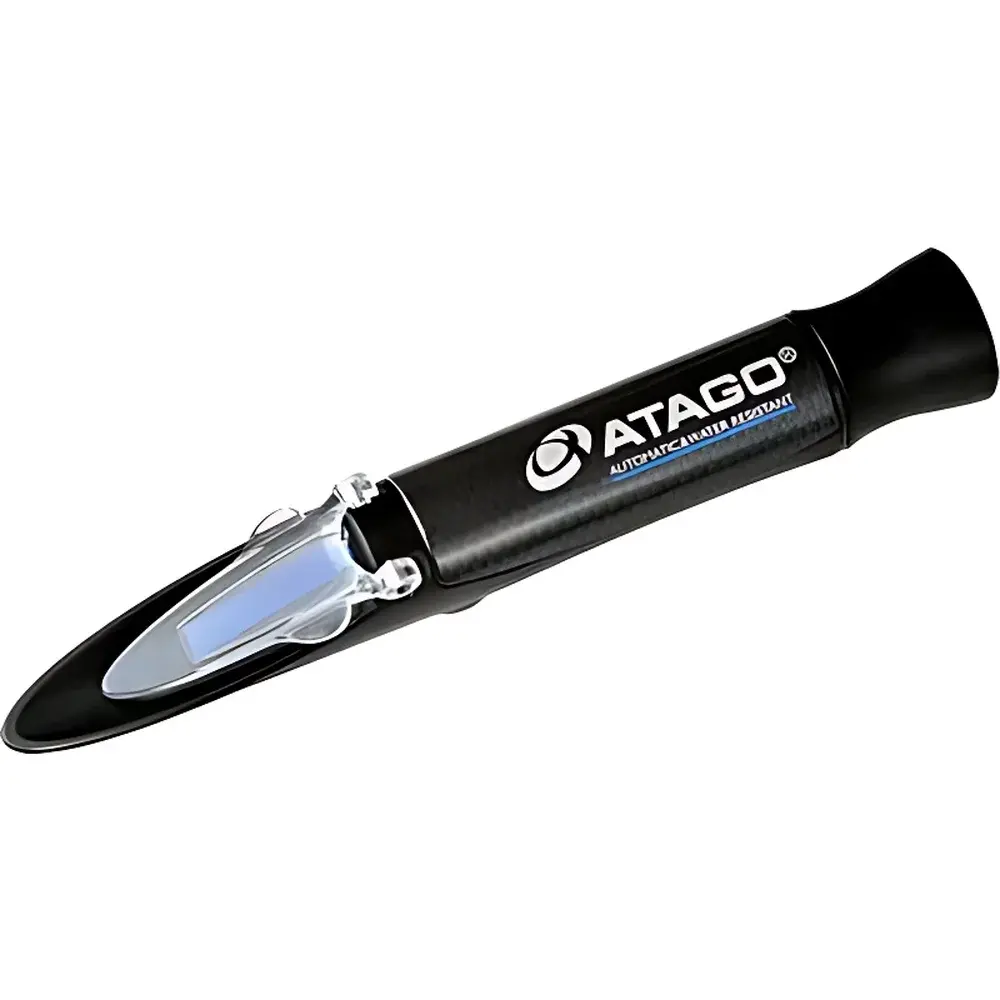
ATAGO MASTER-S/Millα Portable Analog Salinity Refractometer
| Brand | ATAGO |
|---|---|
| Origin | Japan |
| Model | MASTER-S/Millα |
| Product Type | Handheld Refractometer |
| Temperature Compensation | Automatic (ATC) |
| Display Type | Analog Scale (Non-digital) |
| Measurement Range | Salinity 0–100‰ (parts per thousand), Specific Gravity 1.000–1.070 |
| Accuracy | ±1‰ for salinity, ±0.001 for specific gravity (within 10–30°C) |
| IP Rating | IP65 (excluding eyepiece) |
| Scale Division | 1‰ salinity, 0.001 SG |
| Dimensions | 3.2 × 3.4 × 20.7 cm |
| Weight | 110 g |
| Compatible Prism Plate | RE-2471-56M |
Overview
The ATAGO MASTER-S/Millα is a precision-engineered, portable analog refractometer designed specifically for rapid, field-deployable measurement of seawater salinity and specific gravity. It operates on the fundamental optical principle of refractive index determination: as light passes from air into a saline solution, its velocity changes proportionally to the solution’s solute concentration—enabling direct correlation between measured refraction angle and salt content. Unlike digital instruments requiring batteries or calibration software, this model employs a robust Abbe-type optical system with fixed-scale reading, delivering immediate visual results without power dependency. Its automatic temperature compensation (ATC) mechanism—integrated via bimetallic thermal expansion elements—ensures consistent accuracy across ambient conditions from 10°C to 30°C, eliminating manual correction tables or external thermometers. Engineered for marine environmental monitoring, the MASTER-S/Millα meets the operational demands of oceanographic surveys, aquaculture management, aquarium maintenance, and industrial brine storage control—where reliability, portability, and resistance to harsh environments are non-negotiable.
Key Features
- True analog optical design: No batteries, no firmware, no screen failure—ideal for extended field use in remote or resource-constrained settings.
- Automatic Temperature Compensation (ATC): Built-in bimetallic compensator maintains measurement integrity across 10–30°C without recalibration or user intervention.
- IP65-rated housing (excluding eyepiece): Dust-tight and protected against water jets from any direction—validated for marine deck use, wet laboratories, and coastal processing facilities.
- Dual-scale calibrated prism: Simultaneous readout of salinity (0–100‰) and specific gravity (1.000–1.070) on a single high-contrast scale with 1‰ and 0.001 resolution respectively.
- Lightweight ergonomic form factor: 110 g total mass and compact 3.2 × 3.4 × 20.7 cm footprint enable one-handed operation and secure pocket carry during vessel-based sampling.
- Field-serviceable optics: Interchangeable RE-2471-56M illumination prism plate allows for routine cleaning, replacement, or verification against traceable standards.
Sample Compatibility & Compliance
The MASTER-S/Millα is optimized for aqueous sodium chloride solutions—particularly natural and artificial seawater, brine tanks, and cryopreservation media. It accepts 0.3–0.5 mL sample volumes applied directly to the prism surface; measurements stabilize within 3–5 seconds after application. While not intended for highly viscous, turbid, or strongly colored samples (e.g., algal blooms or concentrated glycerol solutions), it performs reliably across standard marine salinity ranges (15–40‰) and hypersaline conditions up to 100‰. The instrument complies with ISO 2173:2003 (fruit juice refractometry) for optical methodology fundamentals and aligns with ASTM D1152–18 (standard test method for methanol in formaldehyde solutions) in terms of refractive index traceability. Its mechanical construction adheres to JIS Z 8013 (Japanese Industrial Standard for optical measuring instruments), and IP65 certification satisfies IEC 60529 requirements for ingress protection in industrial marine environments.
Software & Data Management
As a fully analog, non-electronic instrument, the MASTER-S/Millα does not incorporate onboard memory, Bluetooth connectivity, or data logging capabilities. This architecture intentionally excludes software dependencies, firmware updates, or cybersecurity considerations—making it inherently compliant with environments governed by strict IT governance policies (e.g., GLP-compliant QA labs or offshore regulatory inspection zones). Users record readings manually in field notebooks or LIMS-compatible log sheets. For audit trails, the device supports optional traceable calibration using certified NaCl reference standards (e.g., NIST SRM 999b), with calibration verification documented per ISO/IEC 17025 clause 7.7. No FDA 21 CFR Part 11 electronic signature requirements apply due to absence of electronic records.
Applications
- Oceanographic and limnological fieldwork: Real-time salinity profiling during coastal transects, estuarine mixing studies, and coral reef health assessments.
- Aquaculture operations: Daily monitoring of hatchery tanks, recirculating aquaculture systems (RAS), and shrimp pond management to maintain osmotic stability.
- Public and private aquariums: Routine verification of synthetic seawater batches prior to introduction into life-support systems.
- Seafood post-harvest handling: Quantification of brine concentration for frozen fish storage—critical for preventing ice crystal formation and microbial proliferation.
- Marine education and training: Pedagogical tool for teaching principles of optical density, colligative properties, and seawater chemistry in undergraduate labs.
FAQ
Does the MASTER-S/Millα require battery power or charging?
No—it is a purely optical, analog instrument with no electronic components.
Can it measure salinity in freshwater or low-salinity estuaries?
Yes; its 0–100‰ range covers freshwater (0‰) through hypersaline lagoons (>40‰), with optimal resolution at marine-relevant concentrations (15–40‰).
How often should the prism be cleaned, and what cleaning agents are recommended?
Clean immediately after each use with distilled water and lens tissue; avoid acetone or ethanol, which may degrade prism coatings.
Is calibration traceable to national standards?
Yes—calibration verification can be performed using NIST-traceable NaCl standard solutions (e.g., 10‰, 35‰, 50‰); full calibration certificates available upon request.
What is the service life expectancy under daily marine field use?
With proper prism maintenance and storage in the supplied protective case, typical service life exceeds 10 years—consistent with ATAGO’s industrial-grade optical instrument warranty framework.




