
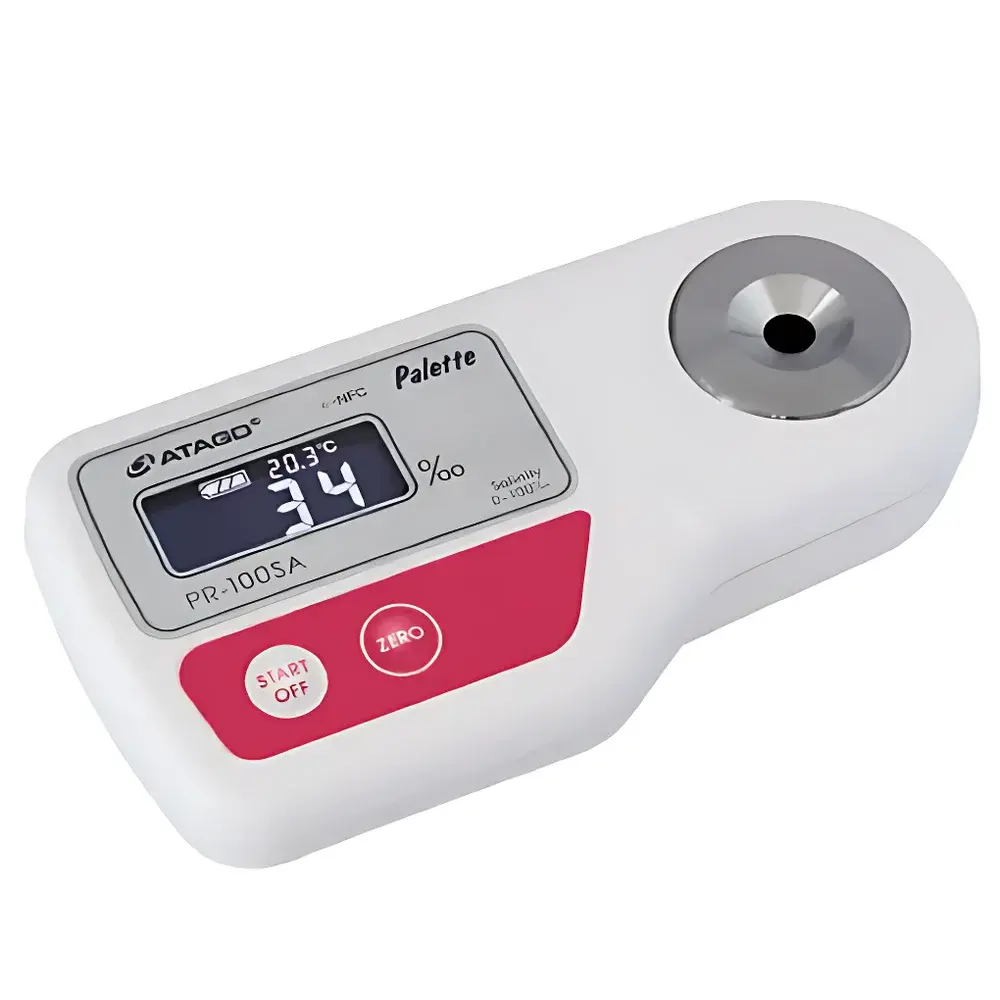
ATAGO PR-100SA Seawater Salinometer
| Brand | ATAGO |
|---|---|
| Origin | Japan |
| Model | PR-100SA |
| Measurement Range | 0–100‰ (w/w) |
| Accuracy | ±0.2‰ |
| Temperature Range (Sample) | 5–40°C |
| Resolution | 1‰ |
| Ambient Operating Temperature | 5–40°C |
| Power Supply | 9V Alkaline Battery (006P) |
| IP Rating | IP64 |
| Dimensions & Weight | 17 × 9 × 4 cm, 300 g (instrument only) |
| Application-Specific Design | Dedicated seawater and artificial seawater salinity measurement |
Overview
The ATAGO PR-100SA Seawater Salinometer is a handheld, digital refractometer engineered for rapid, field-deployable determination of salinity in natural seawater, artificial seawater formulations, and brine solutions used in marine aquaculture, aquarium management, and oceanographic research. It operates on the principle of critical-angle refractometry: light passing through a prism-sample interface undergoes refraction proportional to the solution’s refractive index, which correlates directly with dissolved salt concentration (expressed as mass fraction ‰, or parts per thousand). Unlike conductivity-based salinometers, the PR-100SA requires no calibration against standard seawater or temperature compensation algorithms—its optical design incorporates built-in temperature compensation (ATC) across 5–40°C, ensuring consistent readings without manual correction. The instrument is optimized exclusively for NaCl-dominated aqueous systems typical of marine environments, delivering high reproducibility under variable ambient conditions.
Key Features
- Dedicated seawater scale: calibrated to report salinity directly in ‰ (w/w), eliminating unit conversion errors common with generic Brix or refractive index instruments.
- Integrated Automatic Temperature Compensation (ATC): compensates for sample temperature drift between 5°C and 40°C using a thermistor embedded in the prism block, maintaining measurement integrity without external probes or software input.
- Rugged, portable architecture: IP64-rated enclosure resists dust ingress and water splashing—suitable for humid coastal labs, vessel decks, hatchery tanks, and outdoor sampling sites.
- One-button operation: single START/OFF actuation initiates measurement; results stabilize within <3 seconds and display with three-digit resolution (1‰).
- Low-power design: powered by a single 9V alkaline battery (006P), supporting >5,000 measurements per set—ideal for extended field campaigns without access to mains power.
- Prism-surface optimization: sapphire-coated measuring surface enhances scratch resistance and chemical durability against saline corrosion and frequent cleaning with ethanol or mild detergents.
Sample Compatibility & Compliance
The PR-100SA is validated for use with natural seawater, synthetic seawater (e.g., Instant Ocean®, Reef Crystals®), and NaCl-based brines up to 100‰. It is not intended for non-aqueous solvents, viscous suspensions, or solutions containing significant concentrations of non-NaCl electrolytes (e.g., KCl-rich brines, CaCl₂ de-icing fluids), which may introduce systematic bias due to differing refractive index–concentration relationships. While not certified to ISO/IEC 17025 or ASTM D1141 (Standard Practice for Preparation of Artificial Sea Water), its performance aligns with routine quality control requirements specified in FAO Technical Paper No. 586 (Aquaculture Feed and Fertilizer Use Manual) and NOAA NMFS Hatchery Manuals for larval rearing salinity monitoring. Instrument traceability is maintained via factory calibration against NIST-traceable NaCl reference standards.
Software & Data Management
The PR-100SA is a standalone, firmware-embedded instrument with no Bluetooth, USB, or data logging capability. All measurements are displayed locally and must be manually recorded. This design prioritizes operational simplicity, electromagnetic immunity, and compliance with environments where wireless transmission is restricted (e.g., biosecure aquaculture facilities, GLP-aligned marine labs). For laboratories requiring audit trails, integration into electronic lab notebooks (ELNs) or LIMS is achieved via manual entry or optional third-party barcode-scanning workflows using printed log sheets. No FDA 21 CFR Part 11 compliance features are included, as the device falls outside the scope of regulated analytical instrumentation requiring electronic signature or audit trail functionality.
Applications
- Marine aquaculture: real-time verification of broodstock conditioning tanks, larval rearing systems, and post-harvest chilling brines to maintain osmotic stability.
- Aquarium husbandry: routine checks of display tank salinity, top-off water preparation, and RO/DI system validation prior to remineralization.
- Oceanographic fieldwork: rapid profiling of surface salinity gradients during coastal surveys, estuarine mixing studies, or coral reef health assessments.
- Seafood processing: monitoring of ice slurry salinity for chilled transport of live shellfish and finfish, ensuring microbial inhibition without tissue damage.
- Research laboratories: screening of experimental media formulations for marine microbiology, phytoplankton culture, or benthic invertebrate physiology studies.
FAQ
Does the PR-100SA measure electrical conductivity or refractive index?
No—it measures refractive index optically and converts the result directly to salinity (‰ w/w) using a NaCl-specific calibration curve. It does not output raw RI values or conductance data.
Can it be used for freshwater or low-salinity estuarine samples?
Yes, but accuracy degrades below 5‰ due to reduced signal-to-noise ratio at the lower detection limit; for precise low-salinity work (<10‰), a dedicated low-range refractometer (e.g., PR-32α) with Brix-to-salinity conversion is recommended.
How often does it require recalibration?
ATAGO recommends annual verification using a certified 35‰ NaCl reference standard; field users should perform a zero check with distilled water before each session and a full standard check after exposure to extreme temperatures or physical shock.
Is the prism surface resistant to corrosion from repeated seawater exposure?
Yes—the sapphire-coated glass prism exhibits exceptional resistance to chloride pitting and abrasion; routine cleaning with lint-free tissue and deionized water is sufficient for long-term optical fidelity.
What is the warranty coverage for the PR-100SA?
ATAGO provides a 12-month limited warranty covering defects in materials and workmanship under normal use; consumables (batteries, protective caps) and damage from improper handling or unauthorized modification are excluded.




