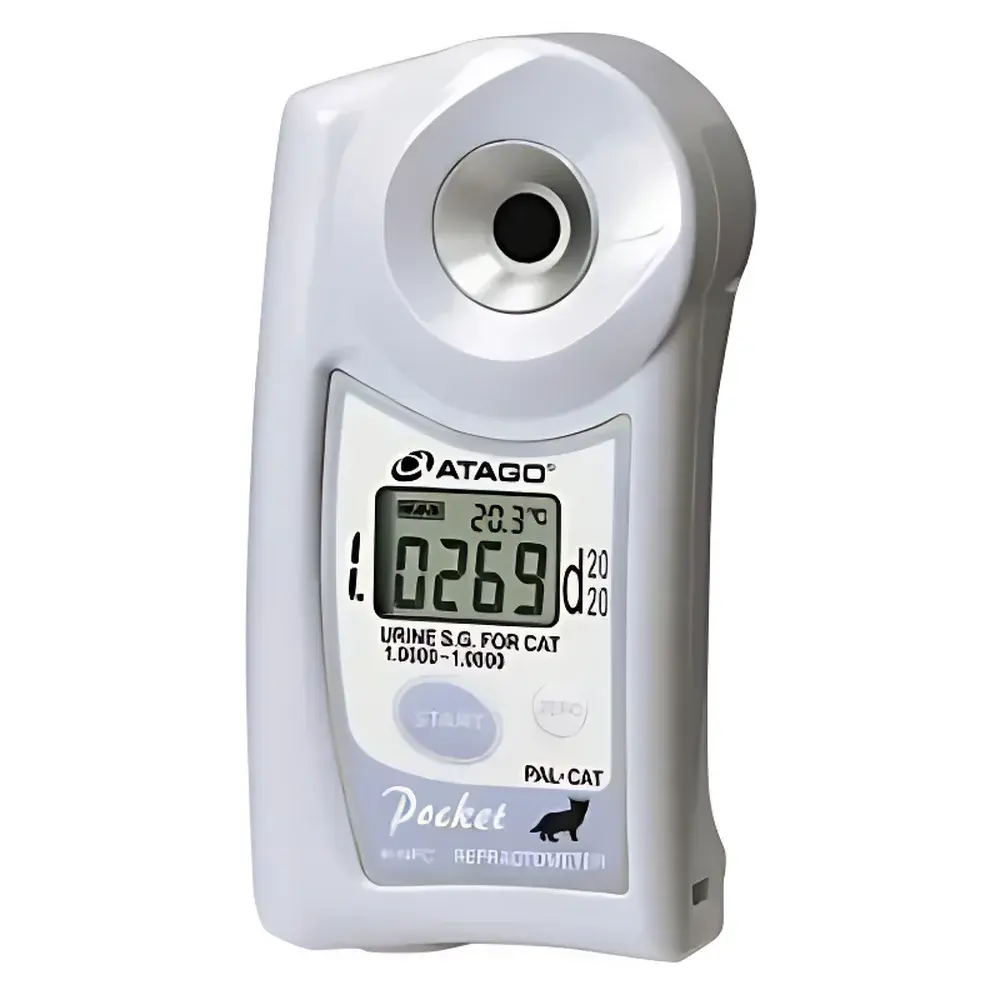
ATAGO PAL-CAT Veterinary Refractometer for Feline Urine Specific Gravity Measurement
| Brand | ATAGO |
|---|---|
| Origin | Japan |
| Model | PAL-CAT |
| Urine Specific Gravity Range | 1.0000–1.0800 |
| Resolution | 0.0001 |
| Accuracy | ±0.0010 |
| Temperature Compensation | Automatic, 10–35°C |
| Sample Volume | 0.3 mL |
| Measurement Time | 3 seconds |
| Power Supply | 2 × AAA batteries |
| Ingress Protection Rating | IP65 |
| Dimensions | 55(W) × 31(D) × 109(H) mm |
| Weight | 100 g (without accessories) |
Overview
The ATAGO PAL-CAT is a handheld, temperature-compensated clinical refractometer engineered exclusively for the quantitative measurement of urine specific gravity (USG) in feline patients. It operates on the principle of critical-angle refractometry: light passing through a urine sample undergoes angular deviation proportional to the solute concentration, which correlates directly with specific gravity. Unlike general-purpose refractometers, the PAL-CAT employs a custom optical calibration curve optimized for the narrow but clinically critical USG range observed in cats (1.0000–1.0800), where subtle shifts—such as those between 1.012 and 1.020—can indicate early renal concentrating defects or prerenal azotemia. Its compact form factor, rapid 3-second measurement cycle, and automatic temperature compensation (10–35°C) ensure consistent performance across varied clinic environments—from examination rooms to mobile veterinary units—without requiring manual correction or recalibration.
Key Features
- Species-specific optical scale calibrated for feline urine matrix, minimizing interferences from urea, creatinine, and electrolyte profiles unique to cats
- High-resolution digital display with 0.0001 resolution and ±0.0010 accuracy, meeting analytical requirements for serial monitoring of renal function
- Automatic temperature compensation (ATC) using integrated thermistor, eliminating manual correction and reducing operator-dependent error
- IP65-rated enclosure: fully dust-tight and protected against low-pressure water jets—suitable for use in high-traffic clinical settings with frequent surface disinfection
- Low sample volume requirement (0.3 mL) minimizes patient stress during collection and conserves precious diagnostic specimens
- Portable design (100 g, 55 × 31 × 109 mm) with dual AAA battery operation enables point-of-care deployment without dependency on mains power or docking stations
Sample Compatibility & Compliance
The PAL-CAT is validated for use with fresh, uncentrifuged feline urine samples. It maintains measurement integrity across typical pH ranges (4.5–8.0) and common urological interferents—including moderate concentrations of glucose (<2.8%), bilirubin (<17 mg/dL), and protein (<30 mg/dL)—without requiring dilution or pretreatment. While not intended for human diagnostics, its performance aligns with veterinary laboratory best practices referenced in the American College of Veterinary Internal Medicine (ACVIM) Consensus Statement on Chronic Kidney Disease and the World Small Animal Veterinary Association (WSAVA) Global Renal Guidelines. The device complies with IEC 61010-1:2010 for electrical safety in laboratory equipment and carries CE marking under the EU Medical Device Regulation (MDR 2017/745) for Class I non-invasive diagnostic instruments.
Software & Data Management
The PAL-CAT is a standalone analog-digital hybrid instrument with no embedded memory or wireless connectivity. All measurements are displayed in real time and must be manually recorded into electronic medical records (EMR) or laboratory information systems (LIS). This architecture intentionally avoids data storage or transmission functions, thereby exempting the device from regulatory requirements associated with software validation, audit trails, or FDA 21 CFR Part 11 compliance—making it suitable for GLP-aligned clinics that prioritize simplicity, traceability via handwritten logs, and minimal IT integration overhead. Calibration verification is performed using ATAGO-certified standard solutions (e.g., 1.010 and 1.040 USG reference fluids), documented per ISO 15197:2013 Annex B for point-of-care testing quality assurance.
Applications
- Early detection of impaired urinary concentrating ability in geriatric cats and those with suspected chronic kidney disease (CKD)
- Differentiation between prerenal (e.g., dehydration-induced hemoconcentration) and intrinsic renal causes of azotemia via serial USG tracking
- Monitoring response to fluid therapy in acute kidney injury (AKI) or post-obstructive diuresis
- Assessment of tubular function during endocrine evaluations (e.g., diabetes insipidus, hyperadrenocorticism)
- Supporting urinalysis interpretation in conjunction with dipstick protein, pH, and sediment analysis per ASVCP Urinalysis Guidelines
- Field use in shelter medicine and feral cat TNR (Trap-Neuter-Return) programs where portability and battery independence are essential
FAQ
Is the PAL-CAT suitable for canine or human urine samples?
No. Its optical scale and calibration algorithm are strictly optimized for feline urine composition and osmolality distribution; use with other species may yield non-linear or biased results.
Does the PAL-CAT require periodic recalibration by the user?
It does not require field recalibration, but daily verification with certified reference standards (e.g., ATAGO 1.010 and 1.040 USG solutions) is recommended prior to clinical use per CLSI EP15-A3 guidelines.
Can the device be cleaned with alcohol-based disinfectants?
Yes—its IP65-rated housing and optical prism coating are resistant to 70% isopropyl alcohol and quaternary ammonium compounds commonly used in veterinary clinics.
What is the expected battery life under typical clinical use?
Approximately 10,000 measurements per set of two AAA alkaline batteries, assuming average ambient temperature (22°C) and standard duty cycle (5–10 measurements/day).
Is there a service or repair program available outside Japan?
ATAGO authorizes certified service centers in North America, EMEA, and APAC regions for prism alignment verification, ATC sensor validation, and factory recalibration—contact ATAGO Technical Support for regional center details.