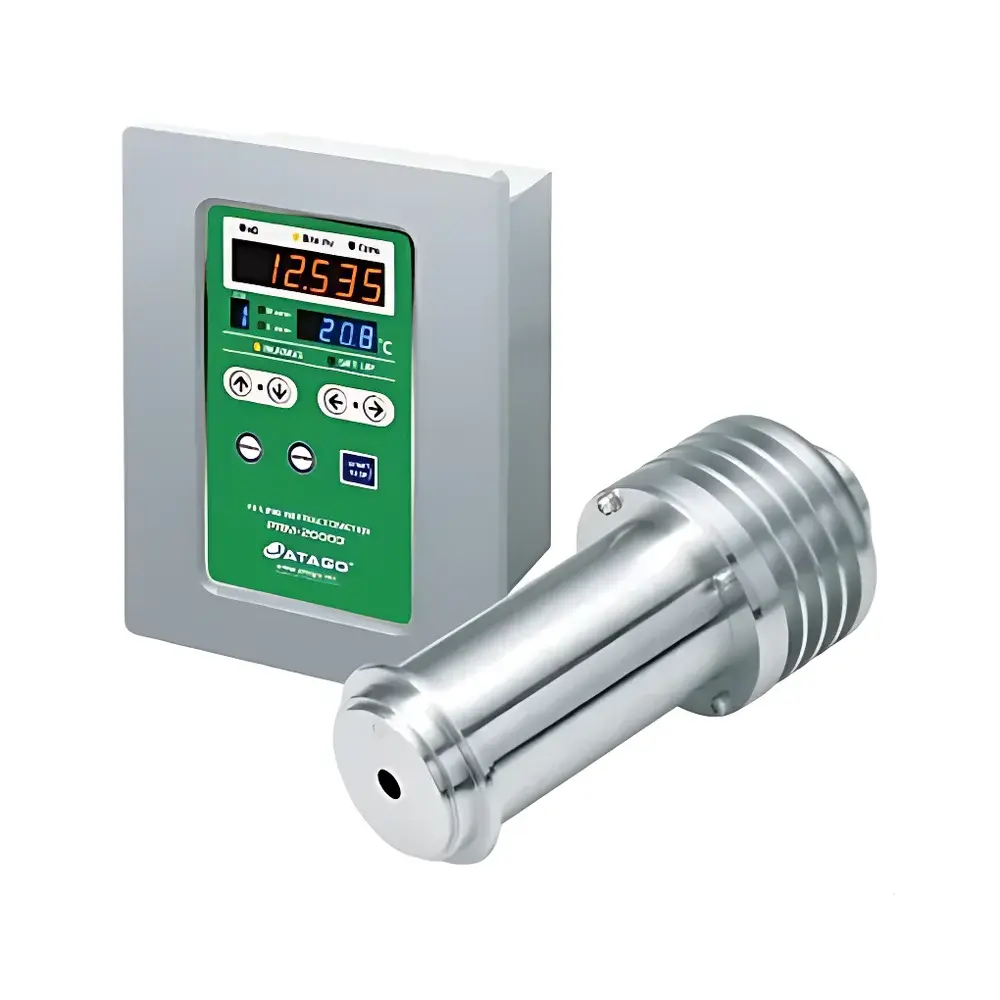
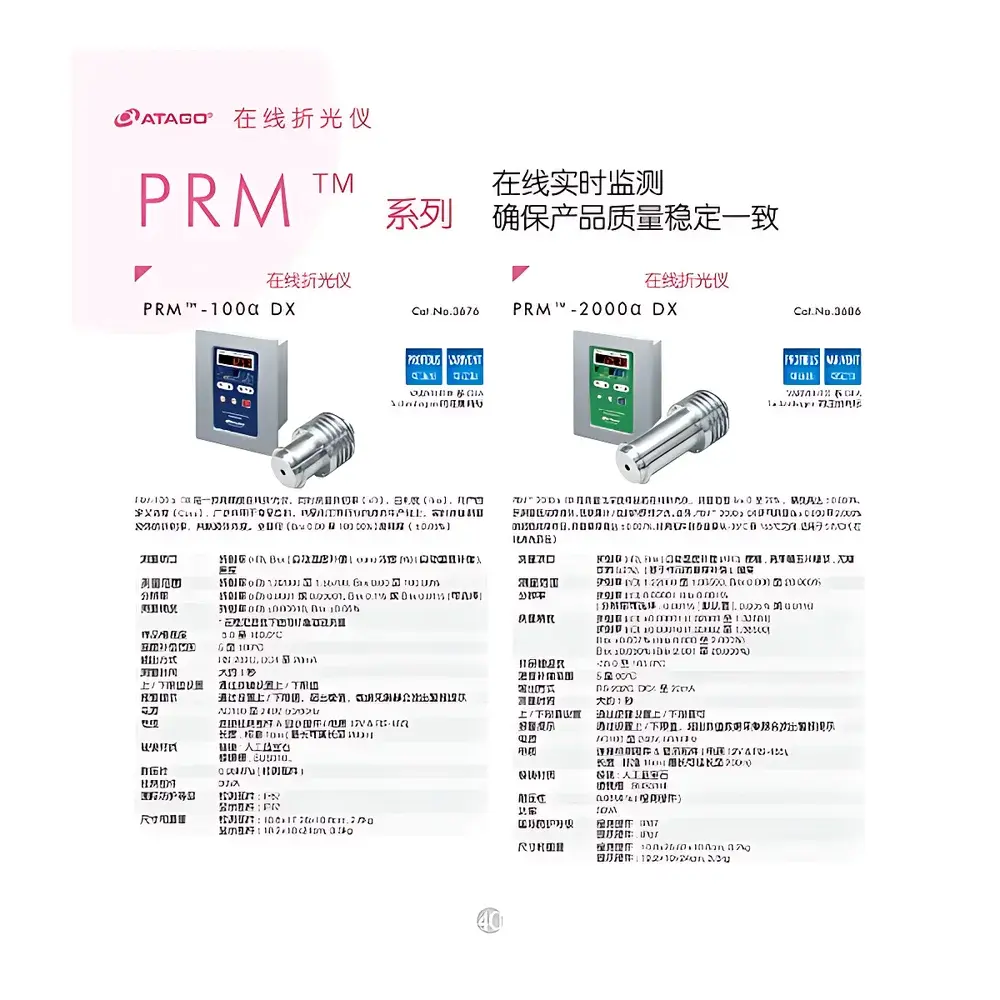
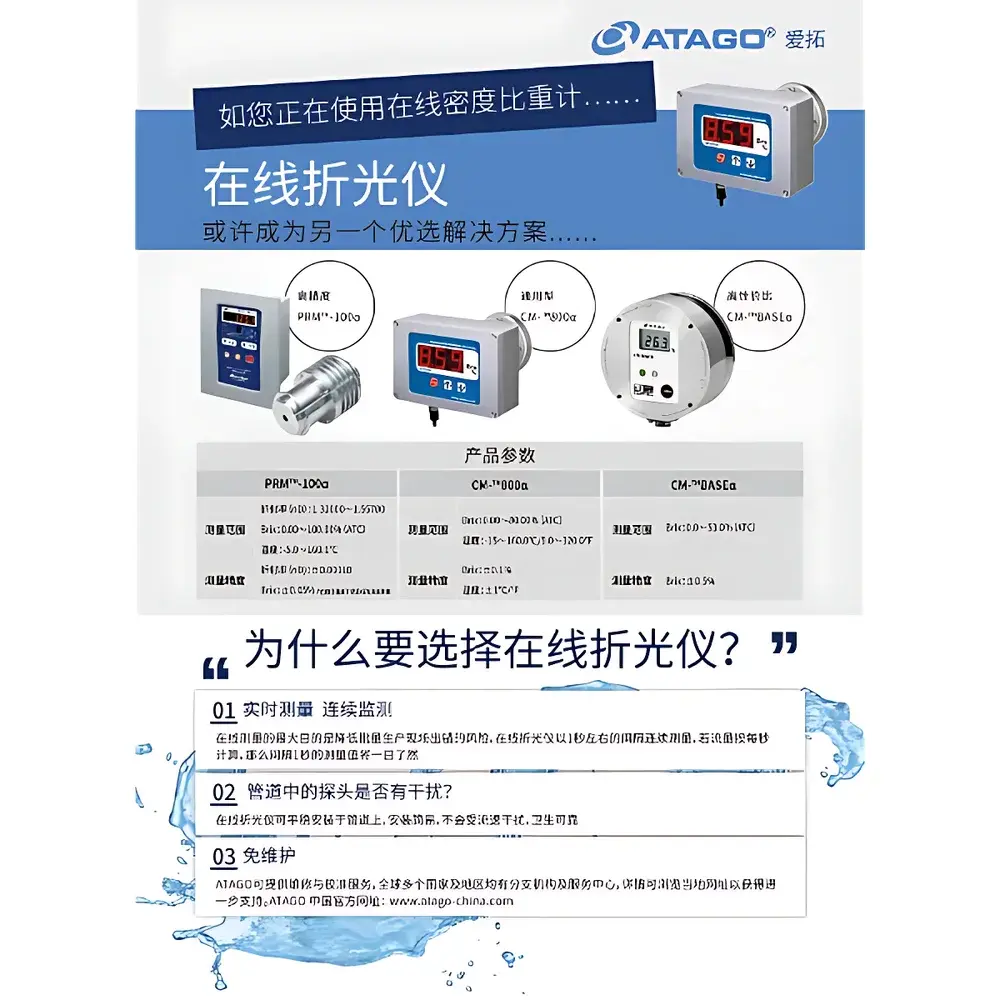
ATAGO PRM-2000α DX Online Refractometer
| Brand | ATAGO |
|---|---|
| Origin | Japan |
| Model | PRM-2000α DX |
| Refractive Index (nD) Range | 1.32069–1.36500 |
| Brix Range | 0.000–20.000% |
| Refractive Index Accuracy | ±0.00001 (1.32069–1.33681), ±0.00010 (>1.33682) |
| Brix Accuracy | ±0.007% (0.000–2.000%), ±0.050% (>2.001%) |
| Automatic Temperature Compensation Range | 5–90°C |
| Wetted Part Temperature Rating | −30 to +165°C |
| Output Signals | RS-232C, DC 4–20 mA |
| Alarm Function | Configurable High/Low Limits |
| Sensor-to-Display Cable Length | Standard 15 m (extendable up to 200 m) |
| Power Supply | 12 V DC (sensor & display unit via RS-485 link) |
Overview
The ATAGO PRM-2000α DX Online Refractometer is an industrial-grade, in-line process analyzer engineered for continuous, real-time measurement of refractive index (nD) and derived concentration parameters—including Brix (% w/w sucrose equivalent)—in flowing liquid streams. Based on the principle of critical-angle refractometry, the instrument employs a high-stability sapphire prism interface and temperature-compensated optical detection to deliver traceable, repeatable measurements under dynamic process conditions. Designed for integration into sanitary and industrial piping systems, it operates without sample extraction or flow interruption, minimizing maintenance, calibration drift, and cross-contamination risk. Its compact, corrosion-resistant silver-finished housing—constructed from lightweight yet robust materials—enables flexible mounting in space-constrained environments while maintaining full compliance with IP65-rated ingress protection and chemical compatibility requirements across food, pharmaceutical, and chemical manufacturing settings.
Key Features
- High-resolution refractive index measurement with ±0.00001 accuracy in the low-nD range (1.32069–1.33681), enabling precise monitoring of dilute aqueous solutions such as cleaning agents, rinse waters, and buffer preparations.
- Multi-parameter output: simultaneous real-time calculation and transmission of nD, Brix (0.000–20.000%), and user-defined concentration units (e.g., % NaCl, % ethanol) via factory or field-configurable algorithms.
- Integrated automatic temperature compensation (ATC) across 5–90°C, using a high-precision Pt100 sensor embedded directly at the prism interface to eliminate thermal lag and ensure metrological traceability per ISO 21542 and ASTM D1218 standards.
- Wetted components rated for continuous exposure from −30°C to +165°C, supporting CIP/SIP cycles and compatibility with aggressive media including caustic soda, nitric acid, and hot peracetic acid solutions.
- Dual-output architecture: isolated analog 4–20 mA signal for PLC/DCS integration and bidirectional RS-232C serial communication for configuration, diagnostics, and raw data logging.
- Configurable alarm logic with independent upper/lower setpoints for nD or Brix; triggers visual indicators and relay outputs (via optional I/O module) to initiate process interlocks or corrective actions.
Sample Compatibility & Compliance
The PRM-2000α DX is validated for use with homogeneous, non-particulate, optically transparent liquids—including aqueous sugar solutions, organic solvents, acids, alkalis, and formulated cleaning agents. It is not intended for slurries, emulsions, or highly turbid media where light scattering compromises critical-angle detection. The device conforms to electromagnetic compatibility (EMC) requirements per IEC 61326-1 and carries CE marking for industrial use within the European Economic Area. In regulated environments, its fixed calibration architecture, audit-ready parameter logging (via external SCADA), and deterministic response time support alignment with FDA 21 CFR Part 11 data integrity expectations when deployed with compliant data acquisition systems. It meets hygienic design principles outlined in EHEDG Doc. Type A and 3-A Sanitary Standards 74-01 for dairy and beverage applications.
Software & Data Management
Configuration and diagnostics are performed via ATAGO’s proprietary PC-based setup utility (PRM-Tool), which supports firmware updates, sensor zeroing, span calibration verification, and alarm threshold definition. All operational parameters—including timestamped nD, Brix, temperature, and status flags—are accessible through ASCII protocol over RS-232C at configurable baud rates (up to 115.2 kbps). The instrument does not feature onboard memory or web server functionality; instead, it is designed for seamless integration into existing MES, LIMS, or historian platforms via standard Modbus RTU (over RS-485, with optional converter) or analog signal mapping. Calibration records, maintenance logs, and alarm event timestamps can be archived externally to satisfy GLP/GMP documentation requirements.
Applications
- Continuous Brix control in juice concentration, syrup blending, and dairy evaporation lines.
- Real-time monitoring of cleaning-in-place (CIP) solution strength and rinse water purity in biopharmaceutical facilities.
- Concentration verification during solvent recovery, acid reclamation, and electroplating bath management.
- Process endpoint detection in dilution/mixing skids for formulation consistency (e.g., vaccine adjuvant preparation, cosmetic emulsion base adjustment).
- Quality gatekeeping for incoming raw material verification (e.g., glycerin, propylene glycol, ethanol deliveries) prior to storage or use.
FAQ
What is the maximum allowable suspended solids content for reliable measurement?
The PRM-2000α DX requires optically clear media; particulate load should remain below 10 ppm (w/w) and particle size under 5 µm to avoid signal attenuation or prism fouling. For higher solids content, inline filtration or bypass sampling with automated backflush is recommended.
Can the unit be calibrated against NIST-traceable sucrose standards?
Yes—calibration is performed using certified aqueous sucrose reference solutions traceable to NIST SRM 84d or equivalent national metrology institute standards. ATAGO provides calibration certificates upon request, specifying uncertainty budgets per ISO/IEC 17025.
Is explosion-proof certification available?
The standard PRM-2000α DX is not intrinsically safe or ATEX-certified. For hazardous area installation, consult ATAGO’s engineering team for compatible barrier-isolated configurations or alternative models with IECEx/ATEX ratings.
How often is recalibration required under continuous operation?
Under stable process conditions and routine prism cleaning, recalibration intervals typically extend to 3–6 months. Frequency should be determined by risk assessment per ICH Q7 and verified through periodic reference standard checks.