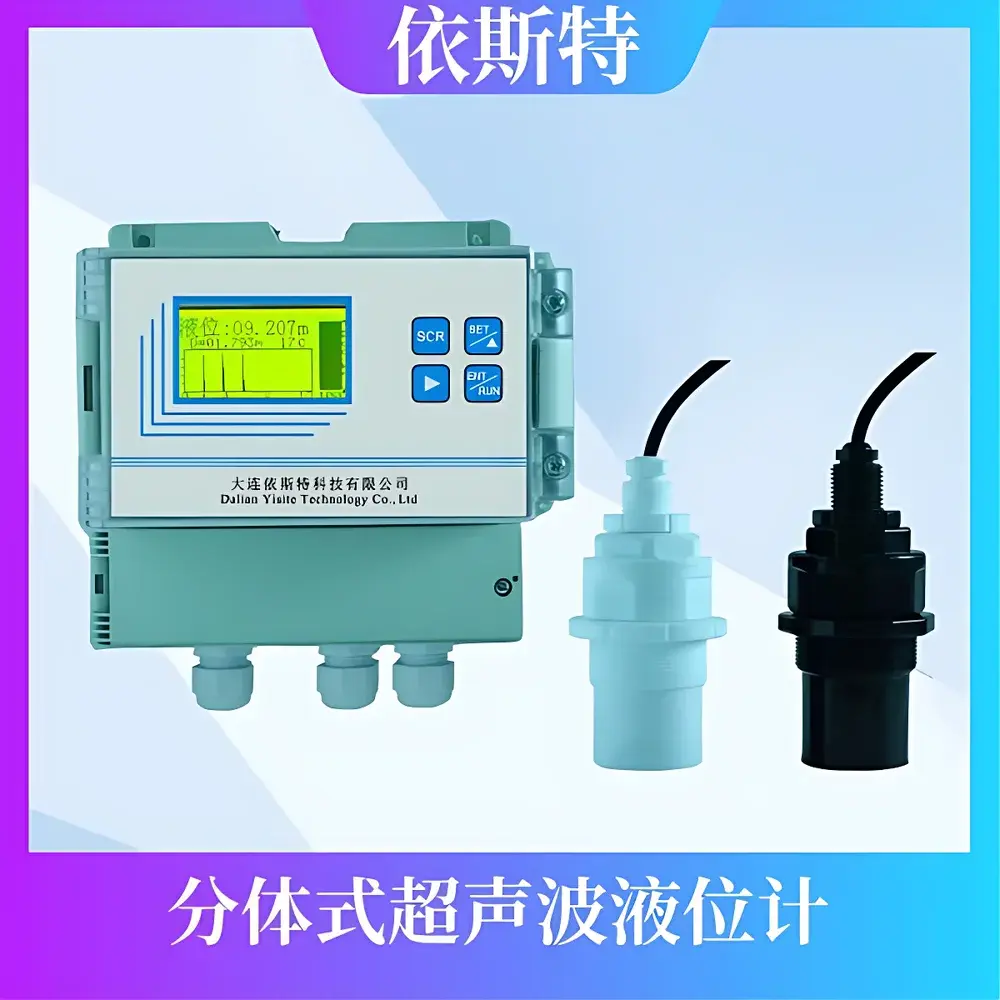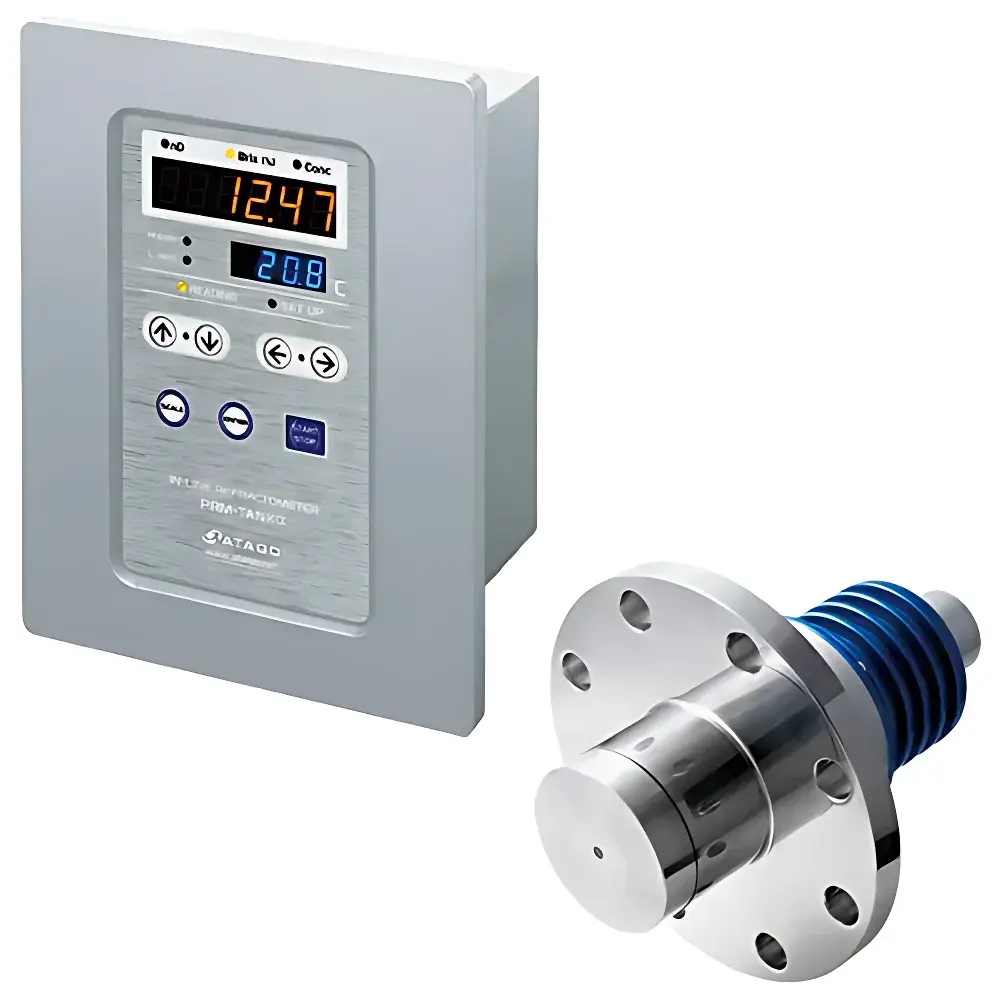
ATAGO PRM-TANKα Wall-Mounted In-Line Refractometer
| Brand | ATAGO |
|---|---|
| Origin | Japan |
| Model | PRM-TANKα (Wall-Mounted) |
| Measuring Parameters | Refractive Index (nD), Brix (% w/w, ATC), Concentration (%), Temperature |
| Measurement Range | nD 1.31700–1.51000, Brix 0.00–85.00% |
| Resolution | nD 0.0001 or 0.00001 (selectable), Brix 0.1% or 0.01% (selectable) |
| Accuracy | nD ±0.0001, Brix ±0.01% (measured with certified sucrose standard at stable temperature) |
| Temperature Range | –5 to 110.0°C |
| ATC Range | 5 to 100°C |
| Output | DC 4–20 mA (optional cable), RS-232C (optional cable) |
| Response Time | ~1 second |
| Power Supply | AC 100–240 V, 50/60 Hz |
| Detection Unit Pressure Rating | 0.98 MPa |
| Enclosure Rating | IP67 (both sensor and display unit) |
| Ambient Operating Temperature | 5–40°C |
| Power Consumption | 30 VA |
| Sensor Dimensions | 25 × 29.7 × 25 cm, 12.3 kg |
| Display Unit Dimensions | 19.2 × 10 × 24 cm, 3.3 kg |
| Cable Length | Standard 15 m (extendable up to 200 m) |
| Display | 7-segment LED |
Overview
The ATAGO PRM-TANKα is a wall-mounted in-line refractometer engineered for continuous, real-time measurement of refractive index (nD), Brix (% w/w), concentration (%), and process temperature directly through the wall of tanks, vessels, and reactors. It operates on the principle of critical-angle refractometry: a collimated light beam is directed onto the internal surface of a sapphire prism mounted flush with the vessel wall; the angle at which total internal reflection occurs is precisely measured and converted into refractive index—then algorithmically compensated to Brix or concentration values using built-in ATC (Automatic Temperature Compensation) calibrated per ISO 21527-1 and AOAC Official Method 932.12. Designed for integration into sanitary, hygienic, and high-pressure industrial environments—including breweries, biopharmaceutical fermenters, food extraction lines, and chemical synthesis reactors—the PRM-TANKα eliminates sampling delays, reduces operator intervention, and delivers metrologically traceable data compliant with GLP and GMP documentation requirements.
Key Features
- True wall-mount design with integrated sapphire prism—no flow cell, no bypass loop, no wetted moving parts
- High-pressure-rated detection unit (0.98 MPa) compatible with pressurized fermentation tanks and jacketed reactors
- Dual-resolution mode: selectable nD resolution of 0.0001 or 0.00001 and Brix resolution of 0.1% or 0.01% for application-specific precision
- Robust IP67-rated housing for both sensor and display units—suitable for washdown environments per FDA 21 CFR Part 11 Annex 11 guidelines
- Real-time response time of ≤1 second enables closed-loop feedback control when interfaced with PLCs or DCS systems
- Factory-calibrated against NIST-traceable sucrose standards; calibration verification supported via optional digital audit trail logging
- Wide operational temperature range (–5 to 110.0°C) with ATC spanning 5–100°C ensures stability across steam-in-place (SIP) and cold-fill processes
Sample Compatibility & Compliance
The PRM-TANKα is validated for direct measurement in opaque, viscous, and particulate-laden process streams—including mash, wort, yeast slurry, plant extracts, condensate, and fermentation broth—without requiring filtration or dilution. Its sapphire prism resists abrasion, chemical corrosion (including caustic cleaning agents up to 2.5 M NaOH and nitric acid passivation), and thermal shock. The instrument meets IEC 61000-6-2 (EMC immunity) and IEC 61000-6-4 (EMC emission) standards. All firmware and configuration changes are logged with timestamped, user-identifiable entries—supporting compliance with FDA 21 CFR Part 11 electronic records and signatures, as well as EU Annex 11 computerized system validation requirements.
Software & Data Management
The display unit features a local 7-segment LED interface for immediate parameter readout and status indication (e.g., temperature alarm, signal loss, calibration due). For enterprise integration, analog 4–20 mA output supports legacy PLC architectures, while RS-232C provides ASCII-based serial communication for direct connection to SCADA, MES, or LIMS platforms. Optional ATAGO Data Logger software (Windows-compatible) enables trend visualization, export to CSV/PDF, and automated report generation—including batch-level summary statistics (mean, SD, min/max) aligned with ISO 80000-1 and ASTM E29 rounding conventions. Audit trails include operator ID, action type, timestamp, and pre-/post-value—retained for ≥12 months per GAMP 5 data retention recommendations.
Applications
- Fermentation monitoring: Real-time tracking of sugar depletion and ethanol accumulation in beer, wine, bioethanol, and monoclonal antibody production
- Extraction & concentration control: Optimization of juice evaporation, herbal decoction, and dairy ultrafiltration based on solids content
- Chemical synthesis: In-situ monitoring of reaction progress via solute concentration in batch and semi-batch reactors
- Cleaning validation: Verification of CIP rinse endpoint by detecting residual caustic or acid concentration
- Distillation & condensate analysis: Continuous assessment of distillate purity and boiler blowdown composition
FAQ
Can the PRM-TANKα be installed on insulated or lined tanks?
Yes—provided the tank wall material is non-metallic (e.g., stainless steel with internal glass or PTFE lining) and the installation port allows optical coupling between the prism and process medium. A site survey and refractive index matching assessment are recommended prior to mounting.
Is periodic recalibration required?
Calibration verification using a certified sucrose standard is recommended every 30 days for GMP-critical applications; full recalibration is performed only if verification fails or after mechanical impact or extreme thermal cycling.
Does the device support Modbus RTU or Profibus protocols?
No—native communication is limited to 4–20 mA analog and RS-232C ASCII. Protocol conversion requires an external gateway (e.g., HMS Anybus or Wago 750 series) configured per IEC 61158.
How is prism fouling mitigated during long-term operation?
The sapphire prism surface is polished to Ra < 0.02 µm and may be cleaned in situ using automated CIP cycles or manually with lint-free wipes and deionized water—no solvents or abrasives permitted.
What is the maximum cable distance between sensor and display unit?
Standard cabling supports 15 m; extended configurations up to 200 m are achievable using shielded twisted-pair cable with proper grounding and voltage drop compensation per IEC 60204-1.