
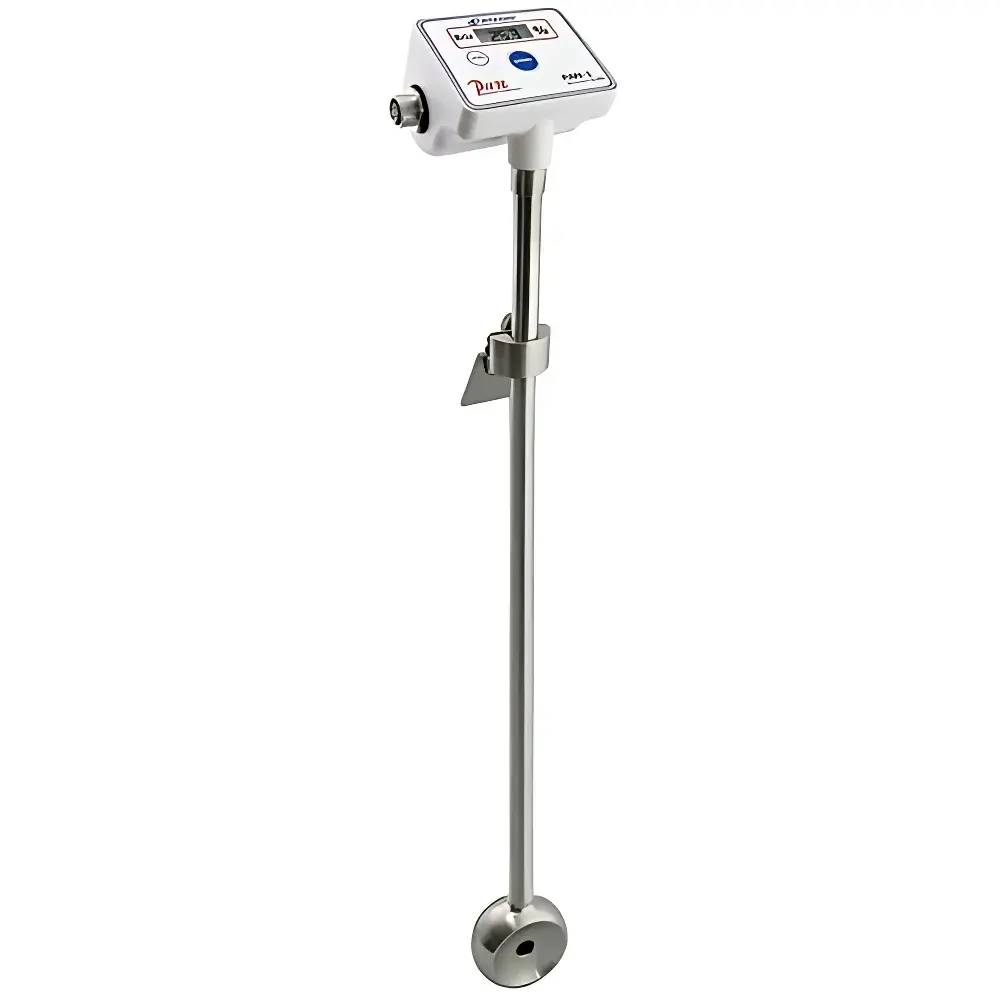
ATAGO PAN-1DC(L) Immersion Refractometer
| Brand | ATAGO |
|---|---|
| Origin | Japan |
| Model | PAN-1DC(L) |
| Type | Benchtop & In-Line Refractometer |
| Temperature Control | Yes |
| Digital Display | Yes |
| Brix Range | 0.0–42.0% |
| Temperature Range | 10.0–99.9°C |
| Brix Accuracy | ±0.2% |
| Temperature Accuracy | ±0.5°C |
| Brix Resolution | 0.1% |
| Temperature Resolution | 0.1°C |
| Temperature Compensation Range | 10.0–95.0°C |
| Environmental Operating Temp | 10–45°C |
| Output Interface | RS-232C (2400 bps, 8N1, no parity) |
| Power Supply | DC 24 V (±10%) |
| Power Consumption | 0.6 VA |
| IP Rating (Sensing Head) | IP67 |
| Dimensions (H×W×D) | 600×80×72 mm |
| Weight | 780 g (main unit only) |
| Customizable Probe Length | 10–120 cm |
Overview
The ATAGO PAN-1DC(L) Immersion Refractometer is a precision-engineered, temperature-compensated inline refractometer designed for continuous, real-time monitoring of aqueous solution concentration—primarily expressed as Brix (% w/w sucrose equivalent)—in industrial process environments. Based on the fundamental optical principle of critical angle refraction, the instrument measures the refractive index of a liquid sample in direct contact with its sapphire prism sensing surface. The integrated Pt1000 temperature sensor enables automatic temperature compensation per ISO 2173 and AOAC 932.12 standards, ensuring measurement stability across dynamic thermal conditions. Unlike benchtop or handheld refractometers requiring manual sampling, the PAN-1DC(L) is engineered for permanent immersion installation inside tanks, pipes, or mixing vessels—eliminating sampling delay, operator variability, and contamination risk. Its compact, robust stainless-steel housing and IP67-rated immersion section meet stringent hygienic and operational requirements in food, beverage, pharmaceutical, and chemical manufacturing.
Key Features
- Direct immersion probe design with customizable stem length (10–120 cm) for flexible integration into tanks, reactors, or recirculation loops
- High-stability sapphire prism interface offering long-term optical consistency and resistance to abrasion and chemical corrosion
- Simultaneous dual-parameter measurement: Brix (0.0–42.0%) and temperature (10.0–99.9°C), both displayed digitally with 0.1% and 0.1°C resolution respectively
- Automatic temperature compensation (10.0–95.0°C) compliant with international refractometric standardization protocols
- RS-232C serial output supporting ASCII-based data streaming (e.g., “20.3,19.5”) at 2400 bps, enabling seamless integration with PLCs, SCADA systems, or LIMS
- Low-power DC 24 V operation (±10% tolerance) with minimal heat generation—suitable for continuous duty in controlled ambient environments (10–45°C)
- Self-contained mechanical architecture: no moving parts, no consumables, no recalibration required under stable operating conditions
Sample Compatibility & Compliance
The PAN-1DC(L) is optimized for homogeneous, non-particulate, low-turbidity aqueous solutions including sugar syrups, fruit juice concentrates, dairy permeates, brines, glycol mixtures, and mild acidic or alkaline process streams (pH 2–12). It is not intended for suspensions, emulsions, or highly viscous media (>1000 mPa·s) where light scattering or boundary layer formation may compromise optical path integrity. The device conforms to IEC 60529 (IP67 for immersed section), meets CE marking requirements for electromagnetic compatibility (EMC Directive 2014/30/EU), and supports audit-ready data capture when interfaced with validated control systems compliant with FDA 21 CFR Part 11 and EU Annex 11 guidelines. While not intrinsically safe, it may be deployed in Zone 2 classified areas when installed with appropriate barrier-certified power supplies.
Software & Data Management
The PAN-1DC(L) operates as a smart analog-to-digital transducer, delivering calibrated Brix and temperature values via standardized ASCII strings over RS-232C. No proprietary software is bundled; instead, the device is fully compatible with industry-standard industrial communication frameworks—including Modbus RTU (via optional protocol converter), OPC UA gateways, and custom LabVIEW or Python-based acquisition scripts. Timestamped data logs can be ingested into MES platforms such as Siemens SIMATIC IT or Rockwell FactoryTalk for real-time SPC charting, batch deviation alerts, and trend analysis. Built-in zero-point stability ensures <0.05% Brix drift over 30-day intervals under constant thermal load, minimizing recalibration frequency in GMP-aligned production environments.
Applications
- Continuous Brix monitoring during evaporation, blending, and pasteurization in juice and soft drink concentrate lines
- In-process concentration control of sugar-based pharmaceutical excipients (e.g., sucrose, dextrose) in API purification stages
- Real-time density tracking of cleaning-in-place (CIP) return streams to verify rinse completeness and chemical recovery efficiency
- Concentration verification of antifreeze glycol solutions in HVAC and battery coolant circuits
- Inline quality assurance for fermentation broth density in ethanol or organic acid production
- Automated feedback control input for PID-regulated dilution valves in syrup standardization systems
FAQ
Is the PAN-1DC(L) suitable for sterilization-in-place (SIP) cycles?
No—the device is rated for continuous immersion up to 99.9°C but is not designed for repeated exposure to saturated steam at >121°C or aggressive caustic cycles exceeding pH 13.
Can the probe be calibrated onsite without returning to ATAGO?
Yes—two-point calibration using certified sucrose reference standards (e.g., 10.00% and 30.00% Brix at 20.0°C) is supported via the front-panel menu; calibration coefficients are retained in non-volatile memory.
What maintenance is required for long-term reliability?
Routine inspection of the sapphire prism for fouling or scratches; gentle cleaning with deionized water and lint-free cloth; annual verification against traceable standards is recommended for regulated environments.
Does the unit support 4–20 mA analog output?
Not natively—the PAN-1DC(L) provides RS-232C digital output only; external signal converters are required for analog integration.
How is the immersion depth verified during installation?
A laser-etched depth marker on the probe stem and optional mounting flange with adjustable stop collar ensure repeatable positioning of the sensing prism at the optimal flow cross-section.




