
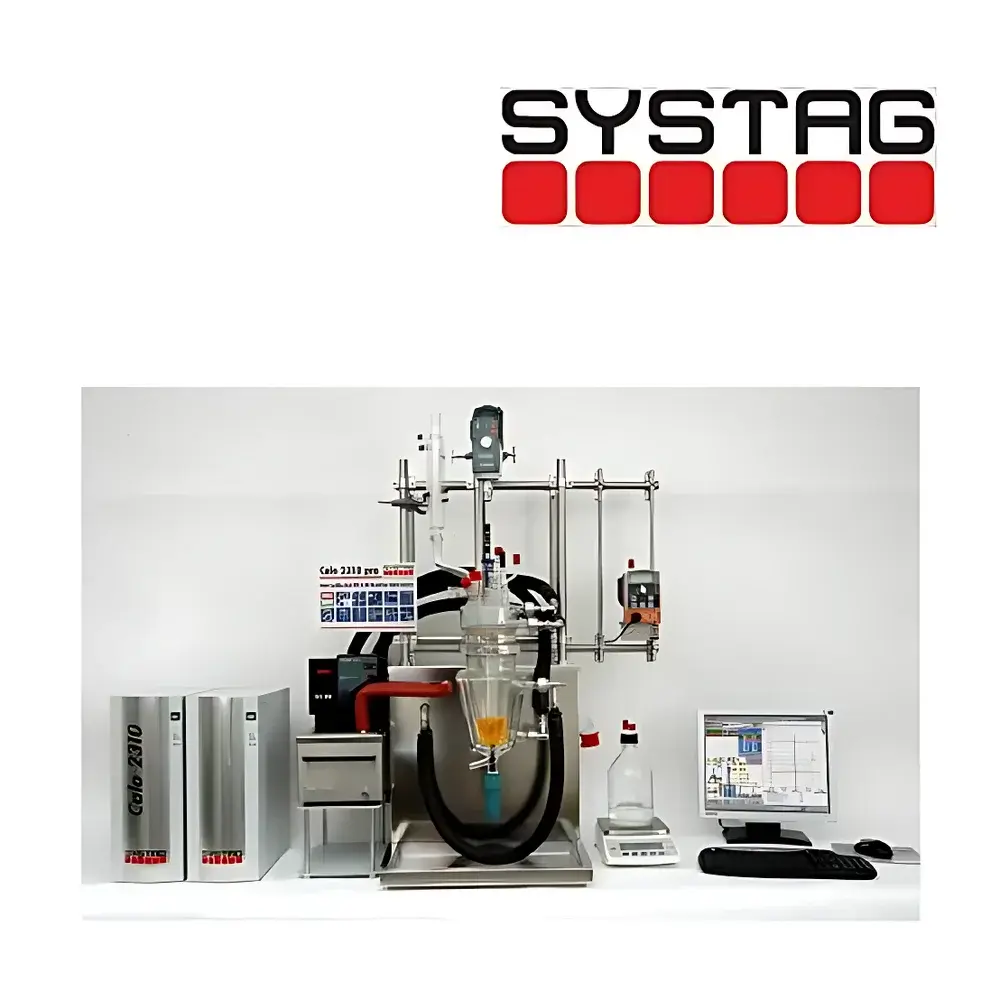
Systag Calo2310 Automated Reaction Calorimeter
| Brand | Systag |
|---|---|
| Origin | Norway |
| Manufacturer Type | Authorized Distributor |
| Origin Category | Imported |
| Model | Calo2310 |
| Vessel Volume | Small-scale |
| Construction Material | Stainless Steel (316L) with Hastelloy C-276 wetted parts |
| Operating Pressure | Up to 100 bar (g) |
| Calorimetric Principle | Dual-mode — Heat-Flow and Heat-Balance Calorimetry |
| Temperature Control Range | −40 °C to +250 °C (via Huber or Julabo external circulators) |
| pH Control | Integrated auto-titrator with dynamic or setpoint control |
| Agitation | Variable-speed overhead stirrer with real-time torque measurement |
| Vapor Handling | Integrated reflux, distillation, and condensate return modules |
| Safety | Role-based user authentication (username/password), audit trail compliant with ALCOA+ principles |
Overview
The Systag Calo2310 Automated Reaction Calorimeter is an industrial-grade, benchtop reaction calorimetry platform engineered for precise, real-time thermal profiling of exothermic and endothermic chemical processes under controlled process conditions. As the successor to Systag’s pioneering Calo series—originating from the world’s first commercially deployed reaction calorimeter—the Calo2310 implements a dual-calorimetric architecture combining high-fidelity heat-flow calorimetry (HFC) and dynamic heat-balance calorimetry (HBC). This hybrid approach enables quantitative determination of reaction enthalpy (ΔHr), heat release rate (dQ/dt), adiabatic temperature rise (ΔTad), and thermal accumulation—critical parameters for process safety assessment (e.g., RC1/RC2 equivalence), scale-up thermodynamics, and kinetic modeling. Designed for operation in pressurized, temperature-controlled, and pH-regulated environments, the system meets the rigorous demands of process R&D laboratories conducting API synthesis, polymerization kinetics, crystallization screening, biocatalytic fermentation, and energetic materials development.
Key Features
- Dual calorimetric mode: Switchable or concurrent heat-flow and heat-balance measurement—validated against ISO 11358-1 and ASTM E698 for thermal stability evaluation
- Integrated pressure-rated reactor: Small-volume (typically 100–1000 mL) glass-lined or Hastelloy C-276 vessel rated to 100 bar (g), compatible with aggressive reagents and high-temperature solvent systems
- Multi-parameter automation: Simultaneous closed-loop control of temperature (±0.1 °C), pressure (±0.2 bar), pH (±0.05 unit), liquid/gas dosing (peristaltic & mass flow controllers), and agitation (0–500 rpm with torque feedback)
- Advanced vapor management: Programmable reflux ratio control, condensate return tracking, and integrated distillation mode with vapor-phase temperature monitoring
- Reactor head heating: Electrically heated lid (up to 150 °C) prevents condensation and material deposition on sensors and ports—maintaining mass balance integrity
- Compliance-ready architecture: Full electronic lab notebook (ELN)-compatible data export, 21 CFR Part 11–compliant user access controls, and timestamped audit trails meeting GLP/GMP documentation requirements
Sample Compatibility & Compliance
The Calo2310 accommodates heterogeneous, multiphase, and gas-evolving reaction systems—including slurries, emulsions, viscous polymer melts, and aerobic/anaerobic fermentations. Its chemically resistant construction supports compatibility with halogenated solvents, strong acids/bases, and organometallic catalysts. All measurement subsystems are traceable to NIST-certified standards; calorimetric calibration is performed using Joule heating and certified reference reactions (e.g., HCl–NaOH neutralization per ISO 11358-2). The system conforms to IEC 61511 for functional safety in process hazard analysis (PHA) workflows and supports reporting aligned with CCPS Guidelines for Reactive Chemical Hazards.
Software & Data Management
Operation is managed via Systag’s proprietary ReactOne software—a deterministic, deterministic real-time OS-based platform supporting synchronized acquisition at ≥10 Hz across all sensors. Data streams include heat flow (W), accumulated energy (kJ), jacket temperature (°C), internal temperature (°C), pressure (bar), pH, dosing volume (mL), torque (N·m), and vapor condensate mass (g). Raw data are stored in HDF5 format with embedded metadata (sample ID, operator, SOP version, calibration status). Export options include CSV, Excel, and direct integration with MATLAB, Python (via PyCalo API), and commercial process simulation tools (AspenTech, gPROMS). All user actions—including method edits, manual overrides, and calibration events—are logged with digital signatures and immutable timestamps.
Applications
- Thermokinetic characterization of batch and semi-batch syntheses for pharmaceutical intermediates and active ingredients
- Safe scale-up of nitration, hydrogenation, and Grignard reactions via RC1-equivalent adiabatic simulation
- Crystallization process mapping—including supersaturation profiling, nucleation onset detection, and polymorph screening
- Free-radical and Ziegler–Natta polymerization studies with real-time viscosity tracking via torque correlation
- Enzyme-catalyzed biotransformations under controlled dissolved oxygen and pH setpoints
- Thermal hazard assessment per NFPA 484, UN Test Series H, and EU CLP Annex I criteria
FAQ
What calorimetric methods does the Calo2310 support?
It provides both heat-flow calorimetry (based on jacket temperature differential and calibrated heat transfer coefficients) and heat-balance calorimetry (using real-time mass and energy balances across jacket, vapor, and feed streams).
Can the system operate under inert or reactive gas atmospheres?
Yes—integrated mass flow controllers enable precise sparging, headspace purging, and stoichiometric gas addition (e.g., H₂, O₂, Cl₂, NH₃) with pressure compensation.
Is torque measurement used solely for viscosity estimation?
Torque data are correlated with rheological models to infer apparent viscosity trends; however, absolute viscosity requires independent validation (e.g., with inline viscometers) due to geometric and flow-field dependencies.
How is calibration traceability maintained?
Each system ships with a factory calibration certificate referencing NIST-traceable electrical standards and certified chemical reactions; field recalibration is supported using built-in Joule heating and standardized acid–base titrations.
Does the Calo2310 comply with FDA 21 CFR Part 11?
Yes—user authentication, electronic signatures, audit trail generation, and data integrity safeguards meet Part 11 requirements for regulated pharmaceutical and biotech environments.
Related Products



