
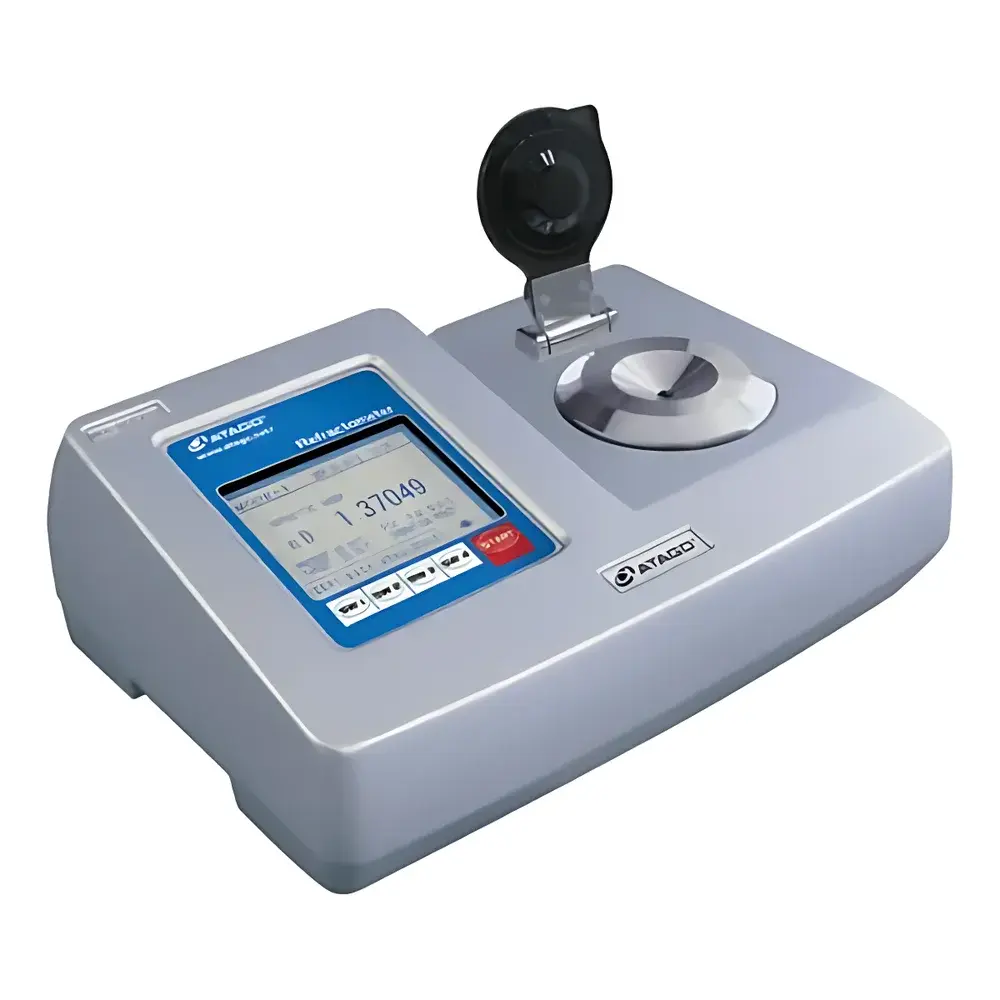
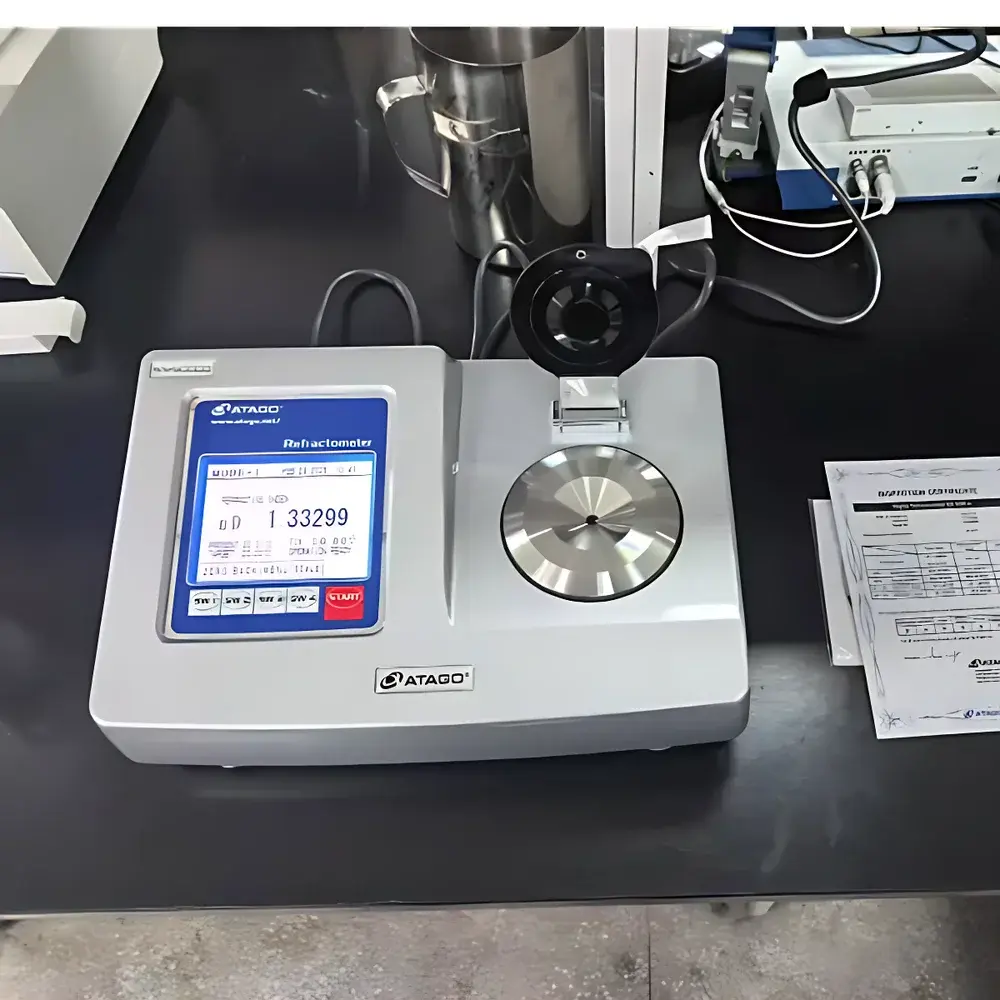
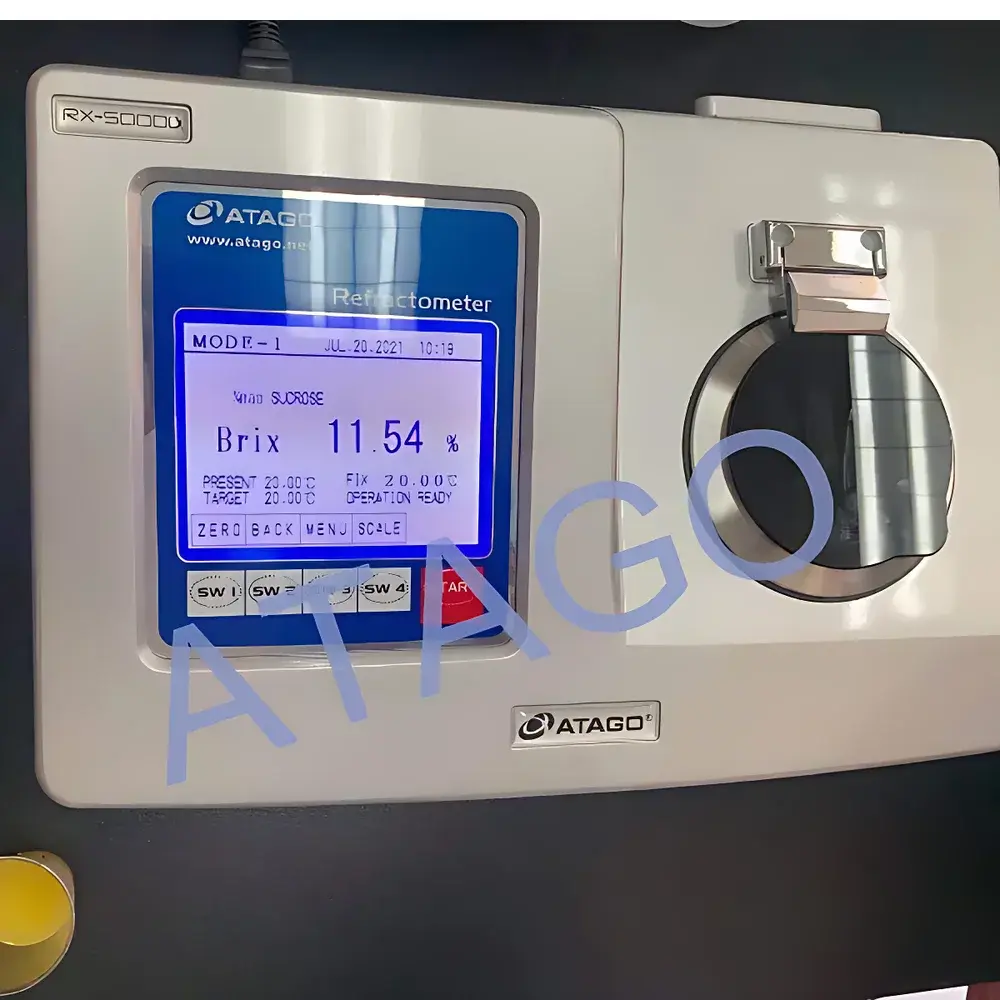
ATAGO RX-5000α Erythritol-Specific Digital Benchtop Refractometer
| Brand | ATAGO |
|---|---|
| Origin | Japan |
| Product Type | Benchtop Refractometer |
| Temperature Control | Peltier-controlled (ATC) |
| Display | High-resolution digital LCD |
| Measurement Range | Refractive Index (nD): 1.32700–1.58000 |
| Brix | 0.00–100.00% (ATC-compensated) |
| Accuracy | ±0.00004 (nD), ±0.03% (Brix) |
| Measurement Modes | 5 selectable modes (including custom scale) |
| Data Handling | Auto-storage of measurement records |
| Sample Interface | Precision-machined prism with smooth-surface option (RX-5000α-Bev variant available) |
Overview
The ATAGO RX-5000α Erythritol-Specific Digital Benchtop Refractometer is an application-optimized optical instrument engineered for high-precision, routine quantification of erythritol concentration in liquid formulations via refractive index (nD) measurement. Based on the fundamental principle of Snell’s Law, the instrument measures the angular deviation of monochromatic sodium-D light (589.3 nm) as it passes from air into a homogeneous sample layer in contact with a sapphire prism. The resulting refractive index is converted in real time to Brix-equivalent concentration using a pre-calibrated, erythritol-specific algorithm—distinct from generic sucrose-based Brix scales—ensuring metrological traceability for low-molecular-weight polyol solutions. Designed for QC laboratories in beverage R&D, functional food manufacturing, and nutraceutical formulation, the RX-5000α delivers ISO/IEC 17025-aligned repeatability under controlled thermal conditions, eliminating manual interpolation or external correction tables.
Key Features
- Peltier-based active temperature control (ATC) maintains prism surface at precisely 20.0 °C ±0.1 °C, compensating for ambient fluctuations and ensuring compliance with ASTM D1218 and ISO 2173 reference conditions.
- Erythritol-optimized calibration curve embedded in firmware—validated against gravimetrically prepared standards (0–40 wt% erythritol in aqueous matrix)—minimizes systematic bias inherent in sucrose-referenced instruments.
- Five configurable measurement modes: Standard Brix (erythritol), Refractive Index (nD), Custom Scale (user-defined linear/nonlinear conversion), % Solids (non-volatile), and Difference Mode (ΔBrix vs. reference batch).
- High-stability sapphire prism (Mohs 9) with optional smooth-surface variant (RX-5000α-Bev) for viscous or particulate-laden samples such as collagen hydrolysate suspensions or plant extract emulsions.
- Auto-zero function with dry-prism detection, drift compensation algorithm, and internal validation using certified refractive index standards (nD = 1.48900 ±0.00002).
Sample Compatibility & Compliance
The RX-5000α accommodates aqueous solutions, syrups, flavored waters, alcoholic beverages (up to 20% v/v ethanol), hydrolyzed protein dispersions, and botanical extracts—provided samples are optically clear or micro-filtered (≤5 µm). It meets key regulatory expectations for analytical instrumentation used in GMP environments: audit-trail-capable data logging (time-stamped, operator-ID-tagged records), password-protected method editing, and exportable CSV files compatible with LIMS integration. While not FDA 21 CFR Part 11–certified out-of-the-box, its firmware architecture supports electronic signature workflows when deployed with validated IT infrastructure per ICH Q7 and USP guidelines.
Software & Data Management
Measurements are stored internally (up to 1,000 records) with automatic timestamp, temperature reading, and mode identifier. Data export occurs via USB port to standard FAT32-formatted drives; no proprietary software required. Each record includes raw nD value, converted Brix, ATC status flag, and pass/fail indicator against user-defined specification limits (e.g., 28.5 ±0.2% erythritol). Optional PC connectivity enables batch reporting via ATAGO’s free “Refractometer Data Manager” utility, which generates PDF certificates compliant with ISO 17025 clause 7.8.2 (reporting of results).
Applications
- Quality control of erythritol-fortified beverages: verification of target sweetness intensity and thermal stability during pasteurization cycles.
- Formulation development for collagen-peptide drinks: monitoring erythritol’s masking effect on bitter amino acid notes without interference from protein turbidity (requires filtration prior to analysis).
- In-process verification in wine and spirits production: assessing erythritol’s impact on perceived body and ethanol integration via correlation with sensory panel data.
- Stability testing of plant-derived functional ingredients: tracking erythritol-induced solubilization shifts in curcumin or resveratrol suspensions over accelerated shelf-life studies.
- Raw material acceptance testing: rapid screening of erythritol purity (≥99.5% w/w) against supplier COA by comparing measured Brix to theoretical density-concentration tables.
FAQ
Is the RX-5000α calibrated specifically for erythritol, or does it use a generic Brix scale?
It employs a proprietary erythritol-specific calibration curve—not a sucrose-based Brix approximation—ensuring accuracy across the full 0–100% w/w range with minimal matrix effects.
Can it measure samples above 60 °C?
No. The Peltier system actively cools to maintain 20.0 °C at the prism interface; hot samples must be pre-cooled to ≤40 °C before loading to avoid thermal shock and measurement drift.
Does it support GLP-compliant data archiving?
Yes—when configured with operator authentication and enabled audit trail settings, all measurements include immutable metadata required for GLP audits per OECD Principles.
What maintenance is required for long-term accuracy?
Daily prism cleaning with lens-grade tissue and reagent-grade isopropanol; annual recalibration using ATAGO-certified nD reference fluids (Cat. No. 2312-00); no user-serviceable moving parts.
How does it handle samples with suspended solids or air bubbles?
Samples must be clarified by centrifugation or filtration (0.45 µm PVDF membrane); entrapped air must be removed by gentle degassing—refractive index measurement requires optical homogeneity at the prism-sample interface.



