
ATAGO DR-M2 Multi-Wavelength Abbe Refractometer for Thermal Stabilizer Analysis
| Brand | ATAGO |
|---|---|
| Origin | Japan |
| Model | DR-M2 |
| Product Type | Benchtop Refractometer |
| Temperature Control | Yes |
| Digital Display | Yes |
| Refractive Index Range | 1.3278–1.7379 (450 nm) |
| Measurement Accuracy | ±0.0002 RI (with 500–650 nm filter) |
| Minimum Display Resolution | 0.0001 RI / 0.1 Abbe Number |
| Wavelength Range | 450–1100 nm (filter-based) |
| Temperature Measurement Range | 5–50 °C |
| Power Supply | AC 100–240 V, 50/60 Hz, 160 VA |
| Dimensions & Weight | 13 × 29 × 31 cm, 6.0 kg (main unit) |
Overview
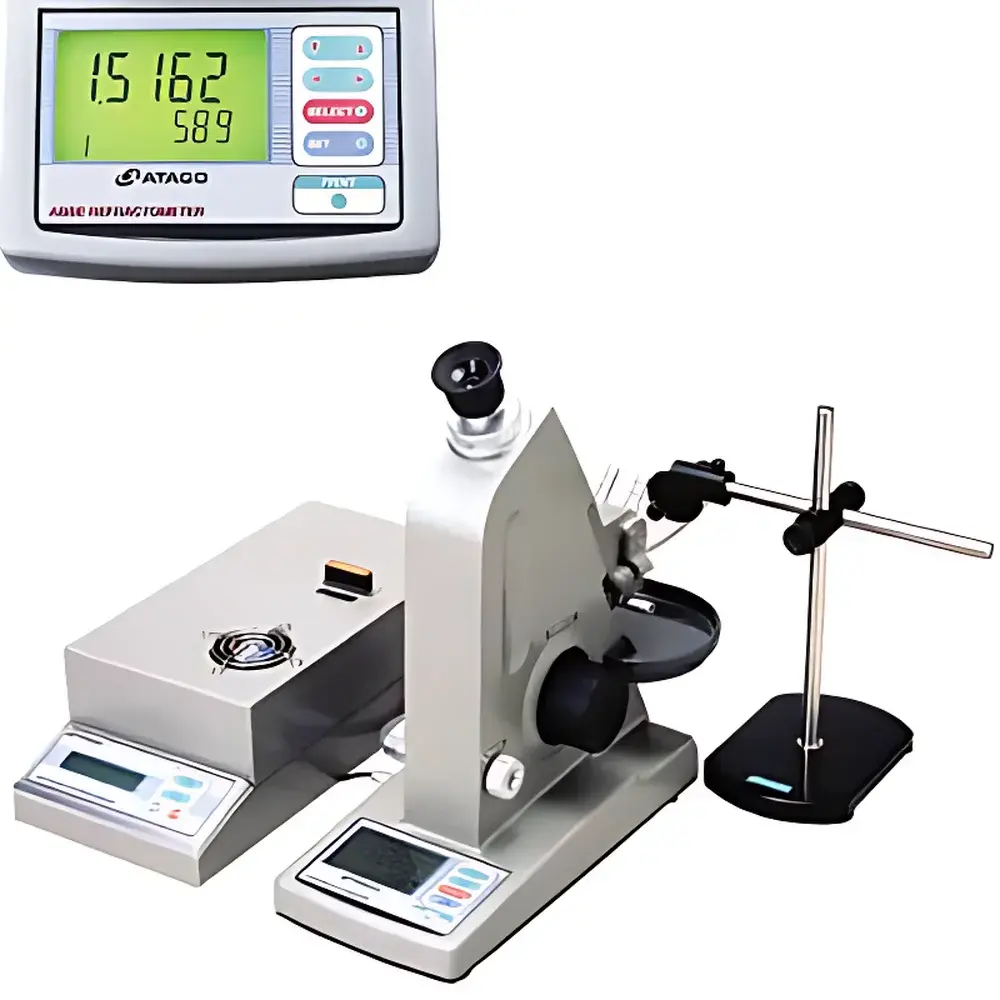
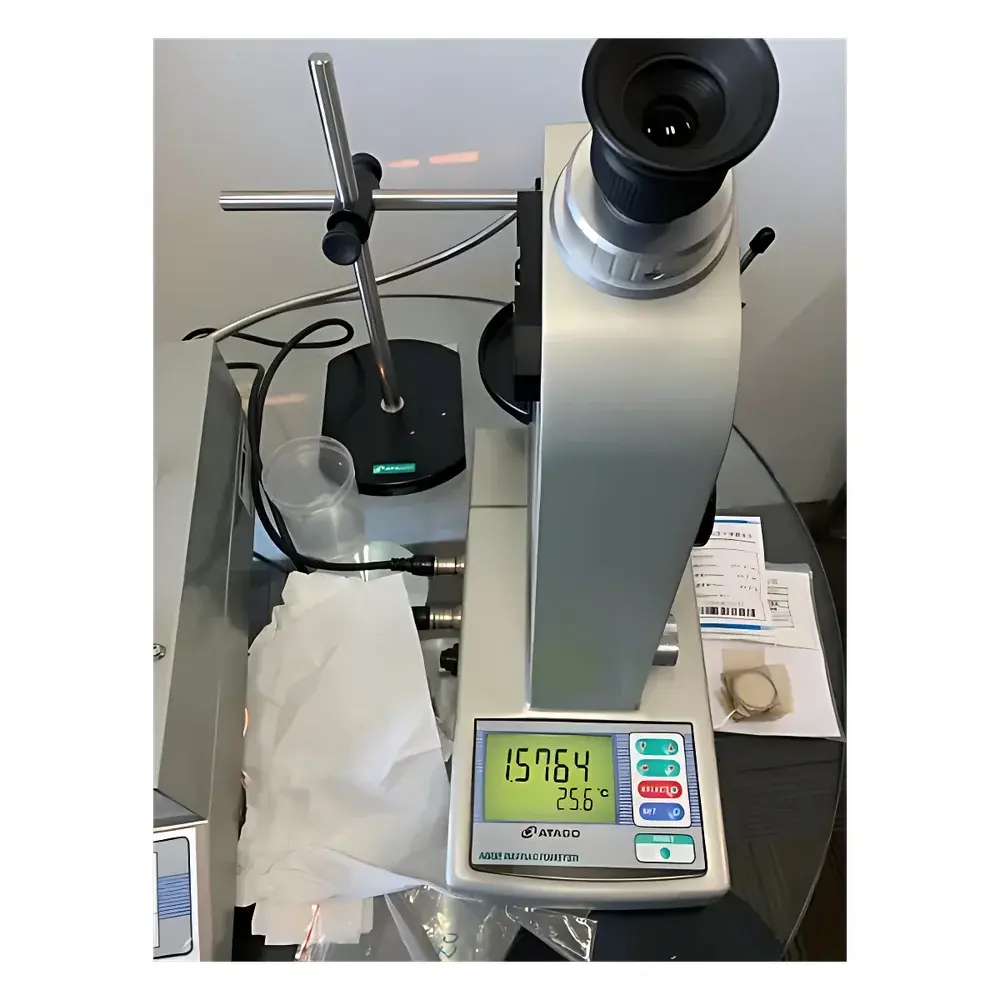
The ATAGO DR-M2 Multi-Wavelength Abbe Refractometer is a precision benchtop optical instrument engineered for high-accuracy refractive index (RI) measurement of transparent and semi-transparent liquids and solids across four discrete wavelengths—450 nm, 589 nm, 680 nm, and 1100 nm. Based on the critical angle principle of total internal reflection, the DR-M2 determines RI by precisely measuring the angular boundary at which incident light transitions from refraction to total internal reflection at the prism-sample interface. This fundamental optical method ensures traceable, repeatable, and matrix-independent measurements without chemical reagents or sample destruction. Designed specifically for demanding applications in polymer additives manufacturing, the DR-M2 delivers wavelength-specific RI data essential for characterizing thermal stabilizers—particularly liquid-phase organotin, calcium-zinc, and rare-earth compounds used in PVC processing—where compositional consistency, concentration, and purity directly correlate with optical dispersion behavior.
Key Features
- Four-wavelength capability (450 nm, 589 nm, 680 nm, 1100 nm) enabled by interchangeable interference filters and optional near-infrared observation module for extended spectral coverage up to 1100 nm
- Integrated Peltier temperature control system maintaining sample temperature between 5 °C and 50 °C with ±0.1 °C stability, critical for minimizing thermal drift in RI measurements
- Digital display resolution of 0.0001 RI units and 0.1 Abbe number, supporting high-fidelity differentiation between closely matched formulations
- Measurement accuracy of ±0.0002 RI when using 500–650 nm bandpass filters—validated per ISO 1042 and ASTM D1218 calibration protocols
- Benchtop architecture with rigid aluminum alloy chassis and anti-vibration optical baseplate, ensuring mechanical stability during long-duration measurements
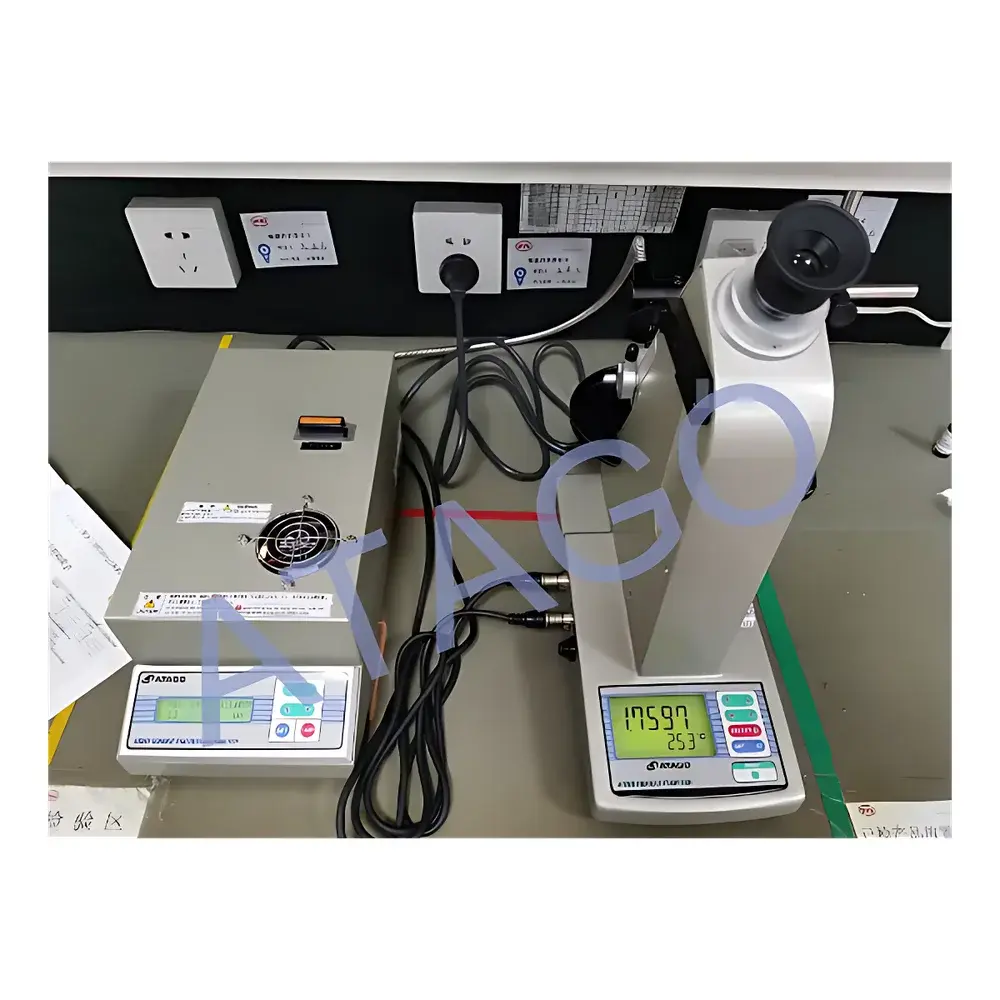
- Modular design allowing independent operation of main refractometer unit and external halogen light source (15 × 33 × 11 cm, 3.0 kg), facilitating alignment optimization and service accessibility
Sample Compatibility & Compliance
The DR-M2 accommodates standard 0.1–0.2 mL liquid samples—including organic solvent solutions, plasticizer blends, and thermally sensitive stabilizer concentrates—without requiring dilution or derivatization. Its high-RI range (up to 1.7379 at 450 nm) enables direct analysis of undiluted organotin chlorides and aromatic phosphite derivatives commonly employed as PVC co-stabilizers. Solid samples such as thin polymer films or crystalline stabilizer intermediates may be measured via contact prism technique after surface polishing. The instrument complies with international metrological standards including JIS K 0061, ISO 21147, and EN 14104 for refractometric analysis in industrial quality assurance. When configured with audit-trail-enabled printer output (optional), measurement records satisfy basic GLP documentation requirements for raw material release testing under ISO/IEC 17025-accredited laboratories.
Software & Data Management
While the DR-M2 operates as a standalone optical instrument without embedded firmware or touchscreen interface, it supports analog data capture via RS-232 or USB-to-serial adapter (sold separately) for integration into laboratory information management systems (LIMS). Output includes timestamped RI values, wavelength identifier, temperature reading, and Abbe number—formatted as ASCII text for direct import into Excel, MATLAB, or statistical process control (SPC) platforms. Users may configure automated pass/fail logic based on predefined specification limits (e.g., RI = 1.4820 ± 0.0003 at 589 nm for batch-certified dibutyltin dilaurate), enabling real-time deviation alerts during routine QC checks. All calibration certificates are traceable to NIST SRM 1484 (refractive index standard glasses) and include uncertainty budgets per GUM (Guide to the Expression of Uncertainty in Measurement).
Applications
- Batch-to-batch consistency verification of liquid thermal stabilizers in PVC compound manufacturing, detecting deviations arising from incomplete synthesis or solvent carryover
- Non-destructive concentration monitoring of organotin solutions using pre-established RI-concentration calibration curves (R² > 0.999 over 10–30 wt% ranges)
- Counterfeit detection through multi-wavelength dispersion profiling: adulterated products exhibit anomalous Δn/Δλ slopes compared to reference materials
- Formulation development support—tracking RI shifts during solvent exchange, aging studies, or compatibility screening with plasticizers like dioctyl phthalate (DOP)
- Stability assessment of heat-aged stabilizer stocks by quantifying RI drift correlated with hydrolytic degradation or oxidative dimerization
FAQ
What wavelength should be used for routine quality control of calcium-zinc stabilizers?
For aqueous or glycol-based calcium-zinc formulations, 589 nm (sodium D-line) is recommended as the primary measurement wavelength due to its alignment with established industry reference methods and optimal signal-to-noise ratio.
Is temperature control mandatory for accurate RI measurement?
Yes—refractive index exhibits temperature-dependent variation averaging −0.00045 RI/°C for organic solvents; the integrated Peltier system ensures measurement repeatability within ±0.0001 RI across ambient fluctuations.
Can the DR-M2 measure opaque or highly viscous stabilizer pastes?
No—the instrument requires optically homogeneous, non-scattering samples; turbid or particulate suspensions must be centrifuged or filtered prior to analysis.
How often does the DR-M2 require recalibration?
Annual calibration against certified reference standards (e.g., ATAGO SRM-1 series) is recommended; interim verification using distilled water (nD20 = 1.3330) and bromonaphthalene (nD20 = 1.6580) is advised before each shift.
Does the DR-M2 comply with FDA 21 CFR Part 11 requirements?
The base instrument does not include electronic signature or audit trail functionality; however, when paired with validated third-party LIMS software and controlled output logging, it may support Part 11 compliance in regulated environments.





