
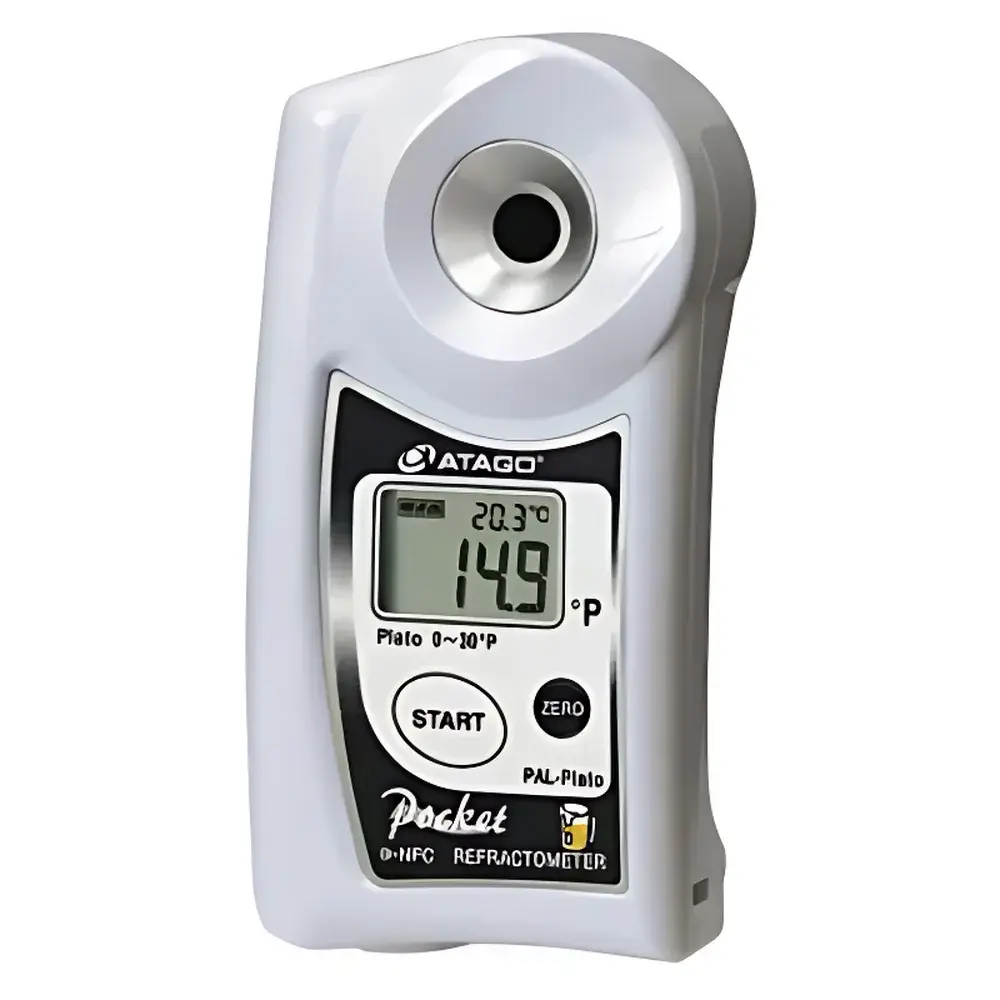

ATAGO PAL-Plato Portable Refractometer
| Brand | ATAGO |
|---|---|
| Origin | Japan |
| Model | PAL-Plato |
| Product Type | Handheld Refractometer |
| Temperature Compensation | Automatic (ATC) |
| Display | Digital LCD |
| Measurement Range | 0.0–30.0 °P |
| Accuracy | ±0.2 °P |
| Resolution | 0.1 °P |
| Operating Temperature | 10–75 °C |
| Sample Volume | 0.3 mL |
| Measurement Time | ~3 seconds |
| Power Supply | 2 × AAA batteries |
| IP Rating | IP65 |
| Dimensions | 5.5 × 3.1 × 10.9 cm |
| Weight | 100 g (main unit only) |
Overview
The ATAGO PAL-Plato Portable Refractometer is a precision optical instrument engineered for rapid, reliable determination of original gravity in wort prior to fermentation—expressed in degrees Plato (°P), the standard unit for extract concentration in brewing science. Based on the principle of critical-angle refractometry, the device measures the refractive index of aqueous sugar solutions and converts it directly to °P using a pre-calibrated polynomial algorithm aligned with the ICUMSA sucrose reference scale and internationally accepted wort-specific conversion models. Its compact, rugged design integrates a high-stability prism assembly, LED illumination source, and CMOS photodetector array to ensure consistent optical path geometry and minimal thermal drift. Unlike hydrometers or pycnometers, the PAL-Plato eliminates subjective meniscus reading errors and requires only 0.3 mL of sample—critical for small-batch or pilot-scale brewing operations where sample conservation is essential.
Key Features
- Automatic Temperature Compensation (ATC) across 10–75 °C, eliminating manual correction and ensuring measurement integrity under variable ambient or sample-temperature conditions
- Digital LCD display with 0.1 °P resolution and intuitive single-button operation—no calibration tools or external software required for routine use
- IP65-rated enclosure for dust-tight and water-jet resistant performance, suitable for humid brewhouse environments, lab benches, or field deployment
- Optimized optical path and high-transmittance prism surface minimize signal noise and enhance repeatability (RSD < 0.15% under controlled conditions)
- Low-power consumption architecture supports >10,000 measurements per set of two AAA alkaline batteries, minimizing operational downtime
- Factory-calibrated against NIST-traceable sucrose standards; user verification possible via distilled water (0.0 °P) and certified 10.0 °P reference solution
Sample Compatibility & Compliance
The PAL-Plato is validated for use with clarified wort, malt extracts, and other non-turbid, low-viscosity aqueous sugar solutions typical in brewing and malting QA/QC workflows. It is not intended for samples containing suspended solids, emulsified oils, or highly viscous syrups without prior filtration or dilution. While not certified to ISO/IEC 17025 as a standalone metrological instrument, its measurement traceability aligns with ASTM D1000-22 (Standard Test Method for Refractive Index of Transparent Liquids) and supports GLP-compliant documentation when integrated into laboratory SOPs. The device meets CE marking requirements for electromagnetic compatibility (EN 61326-1) and safety (EN 61010-1).
Software & Data Management
The PAL-Plato operates as a self-contained, embedded-system instrument with no onboard data logging or USB/Bluetooth connectivity. All measurements are displayed in real time and must be manually recorded. For laboratories requiring audit-ready records, ATAGO recommends pairing the unit with externally validated electronic lab notebooks (ELNs) or LIMS platforms. When used within regulated environments (e.g., contract brewing labs serving FDA-regulated clients), users should establish written procedures covering instrument verification, environmental monitoring during use, and operator training—consistent with FDA 21 CFR Part 11 principles for manual data entry systems.
Applications
- Pre-fermentation wort analysis in craft breweries, macrobreweries, and contract manufacturing facilities
- Quality control of malt extract powders and liquid concentrates in ingredient supply chains
- Process validation during lautering and kettle boiling stages to monitor extract yield and consistency
- Educational use in brewing science curricula and food technology programs for hands-on refractometry instruction
- Field testing at malthouses to assess germination efficiency and kilning endpoint based on soluble extract content
FAQ
Does the PAL-Plato require periodic recalibration?
No routine recalibration is needed if handled per manufacturer guidelines; however, daily verification using distilled water (0.0 °P) and a certified reference standard is recommended before critical measurements.
Can it measure finished beer alcohol content?
No—it measures original extract only. Alcohol calculation requires paired measurements of original and final gravity (e.g., using a separate final-gravity refractometer or hydrometer) and application of established attenuation correction formulas.
Is cleaning the prism safe with ethanol or isopropanol?
Yes—soft lint-free tissue moistened with ≥95% ethanol or isopropanol is approved for prism cleaning; avoid abrasive pads or acetone-based solvents.
What does the “ATC” specification mean in practice?
ATC uses an internal thermistor to dynamically adjust the refractive index-to-°P conversion curve in real time, ensuring accuracy even when sample temperature deviates from 20 °C—the reference condition for Plato scale definition.
How does its accuracy compare to laboratory-grade benchtop refractometers?
While benchtop units offer higher resolution (e.g., 0.01 °P) and advanced features like multi-wavelength analysis, the PAL-Plato delivers metrologically sufficient accuracy (±0.2 °P) for process control and meets industry-accepted tolerances for brewhouse decision-making.



