
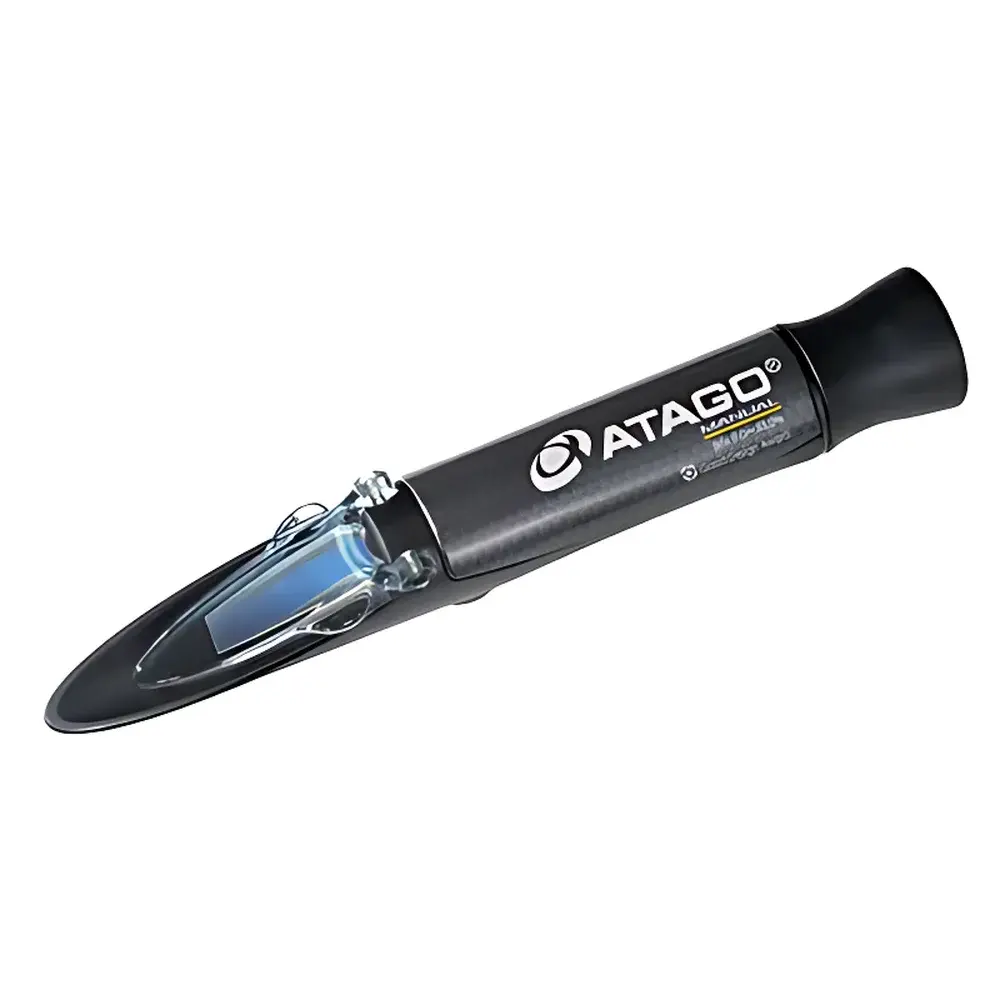
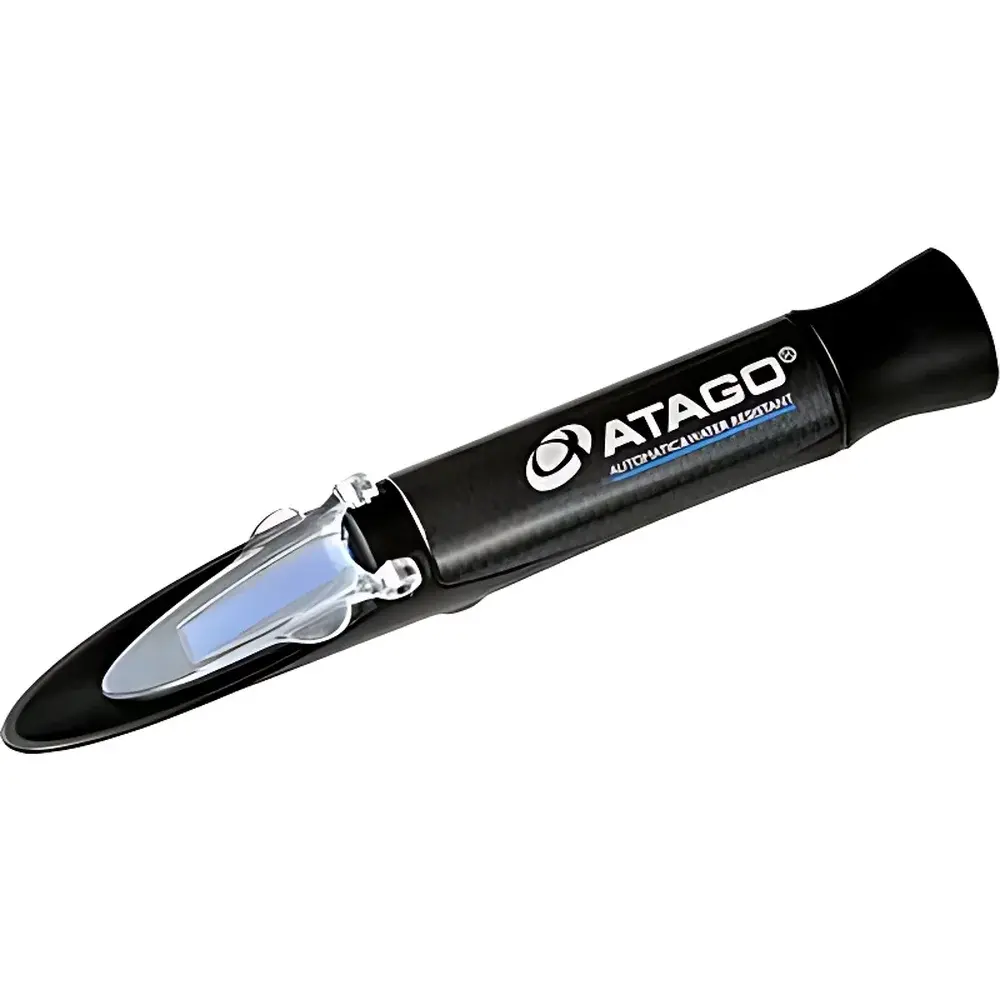
Atago MASTER-53T Handheld Refractometer with Wide Brix Range (0–53%)
| Brand | Atago |
|---|---|
| Origin | Japan |
| Model | MASTER-53T |
| Product Type | Handheld Refractometer |
| Temperature Compensation | Automatic (ATC) |
| Waterproof Rating | IP65 |
| Measurement Range | Brix 0.0–53.0% |
| Minimum Resolution | 0.2% Brix |
| Accuracy | ±0.2% Brix at 20°C |
| Repeatability | ±0.1% Brix at 20°C |
| Dimensions | 3.2 × 3.4 × 16.8 cm |
| Weight | 130 g |
| Sample Volume | 2–3 drops |
| Calibration Standards | Sucrose solutions (10–50% w/w, RE-110010 to RE-110050) |
Overview
The Atago MASTER-53T is a high-precision, field-deployable handheld refractometer engineered for rapid, reliable measurement of soluble solids concentration in aqueous solutions—expressed as Brix (% w/w sucrose equivalent). Based on the principle of critical angle refraction, the instrument determines refractive index via total internal reflection at the prism–sample interface; this optical signal is converted into a calibrated Brix value using an integrated scale optimized for the 0.0–53.0% range. Designed for industrial food processing, agricultural quality control, and laboratory spot-checking, the MASTER-53T incorporates Atago’s proprietary Automatic Temperature Compensation (ATC) system, which dynamically corrects readings across ambient temperatures from 10°C to 30°C without external calibration or manual adjustment. Its robust, ergonomic housing meets IP65 ingress protection standards—ensuring resistance to water jets and dust—making it suitable for wet environments such as production floors, orchards, fermentation tanks, and brine preparation stations.
Key Features
- Wide Brix measurement range: 0.0–53.0%, ideal for high-sugar, high-salt, or viscous samples including pickling brines, fruit pulp, jam concentrates, soy sauce, and fermented beverages.
- True ATC functionality: Compensates for thermal drift using a bimetallic thermal element embedded within the prism assembly—no software or battery dependency required.
- Ultra-low sample requirement: Only 2–3 drops (≈0.05 mL) needed per measurement, minimizing waste and enabling analysis of precious or limited-volume samples.
- 180° full-body cover design: Patented hinged lid ensures uniform sample dispersion across the prism surface, eliminating air bubbles and operator-induced pressure variability—critical for reproducible results with turbid or non-homogeneous liquids.
- IP65-rated enclosure: Fully sealed against dust and low-pressure water jets; compatible with post-measurement rinsing under running tap water and quick-dry wiping.
- Lightweight and portable: Weighing only 130 g with compact dimensions (3.2 × 3.4 × 16.8 cm), the unit fits comfortably in one hand and requires no power source—ideal for mobile QC workflows.
Sample Compatibility & Compliance
The MASTER-53T is validated for use with opaque, semi-viscous, and particulate-laden samples—including plum paste (umeboshi), miso, tomato paste, and salt-cured fish brines—where conventional digital refractometers may yield inconsistent readings due to light scattering. Its optical design minimizes sensitivity to suspended solids through optimized prism geometry and viewing angle. For corrosive media (e.g., acidic fruit juices or saline solutions), Atago recommends the resin-bodied MASTER-53Pα variant; for elevated-temperature applications up to 50°C, the heat-resistant MASTER-53H series is specified. The device complies with ISO 2173:2003 (fruit and vegetable products — determination of soluble solids content — refractometric method) and supports GLP-aligned documentation when used with traceable sucrose calibration standards (RE-110010 to RE-110050). No electrical certification (e.g., CE, UKCA) applies, as the instrument is fully passive and non-powered.
Software & Data Management
As a purely optical, analog-readout instrument, the MASTER-53T does not incorporate digital electronics, memory storage, or connectivity interfaces. All measurements are displayed directly on a high-contrast, etched glass scale viewable through the eyepiece—eliminating battery dependency, firmware updates, or data export requirements. This architecture ensures long-term stability, zero drift over time, and full compliance with environments where electromagnetic interference (EMI) or intrinsic safety restrictions prohibit electronic devices. Users record values manually or integrate readings into existing LIMS/QMS platforms via standardized SOPs. Calibration verification follows ASTM D1218–19 (Standard Test Method for Refractive Index of Hydrocarbon Liquids) protocols using certified sucrose reference solutions traceable to NIST SRMs.
Applications
- Food & Beverage: Monitoring sugar concentration during jam, jelly, and syrup production; verifying brine strength in olive and cucumber fermentation; assessing ripeness of stone fruits and citrus prior to harvest.
- Agriculture: Field-based evaluation of grape must Brix for optimal harvest timing; rapid screening of honey adulteration risk via deviation from expected sucrose equivalence.
- Chemical & Industrial: Quantifying glycol concentration in heat-transfer fluids; controlling sodium chloride content in de-icing solutions; verifying consistency of detergent concentrates.
- Research & Education: Teaching optical principles of refractometry in undergraduate physics and food science labs; validating correlations between Brix and other quality indices (e.g., °Plato, specific gravity).
FAQ
Does the MASTER-53T require batteries or charging?
No. It is a fully mechanical optical instrument with no electronic components.
Can it measure turbid or colored samples accurately?
Yes—its optical path and prism design are optimized for heterogeneous samples such as fruit purees, soy sauce, and brines, provided the sample fully wets the prism surface.
What is the recommended calibration frequency?
Calibrate before each use session or whenever ambient temperature changes exceed 5°C; always verify with a certified sucrose standard matching the expected measurement range.
Is the prism surface scratch-resistant?
The prism is made of optical-grade BK7 glass with a hardened coating—resistant to typical cleaning abrasion but not immune to metal tools or coarse particulates.
How is traceability maintained for quality audits?
By documenting calibration dates, standard lot numbers (e.g., RE-110030), operator ID, and environmental conditions per ISO/IEC 17025 clause 7.7 requirements.




