
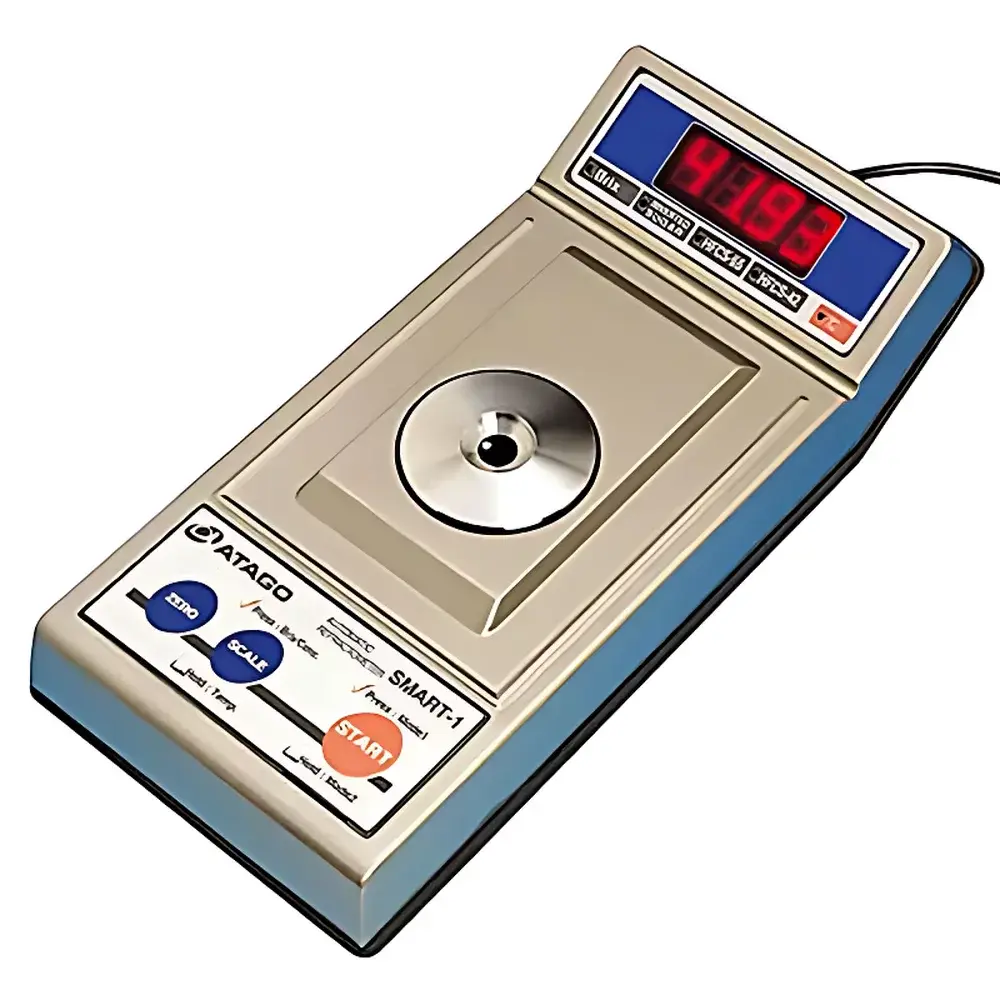
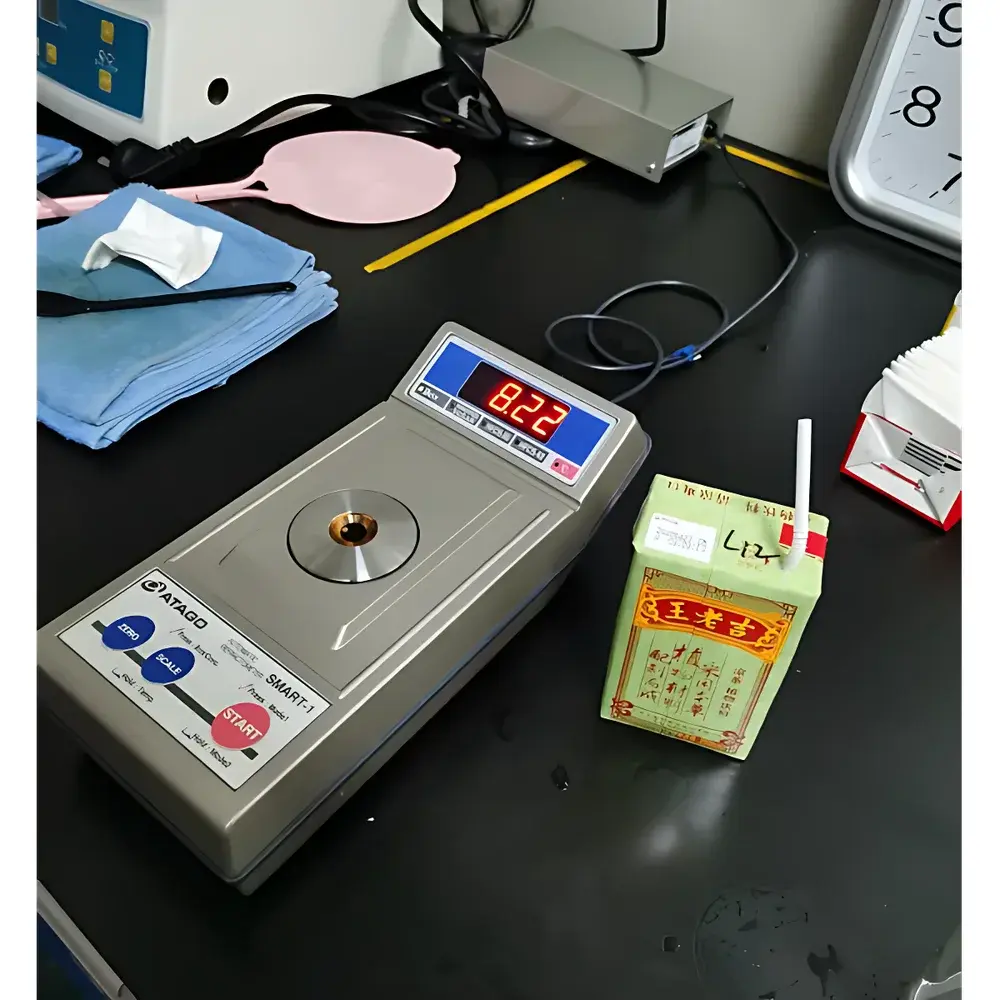
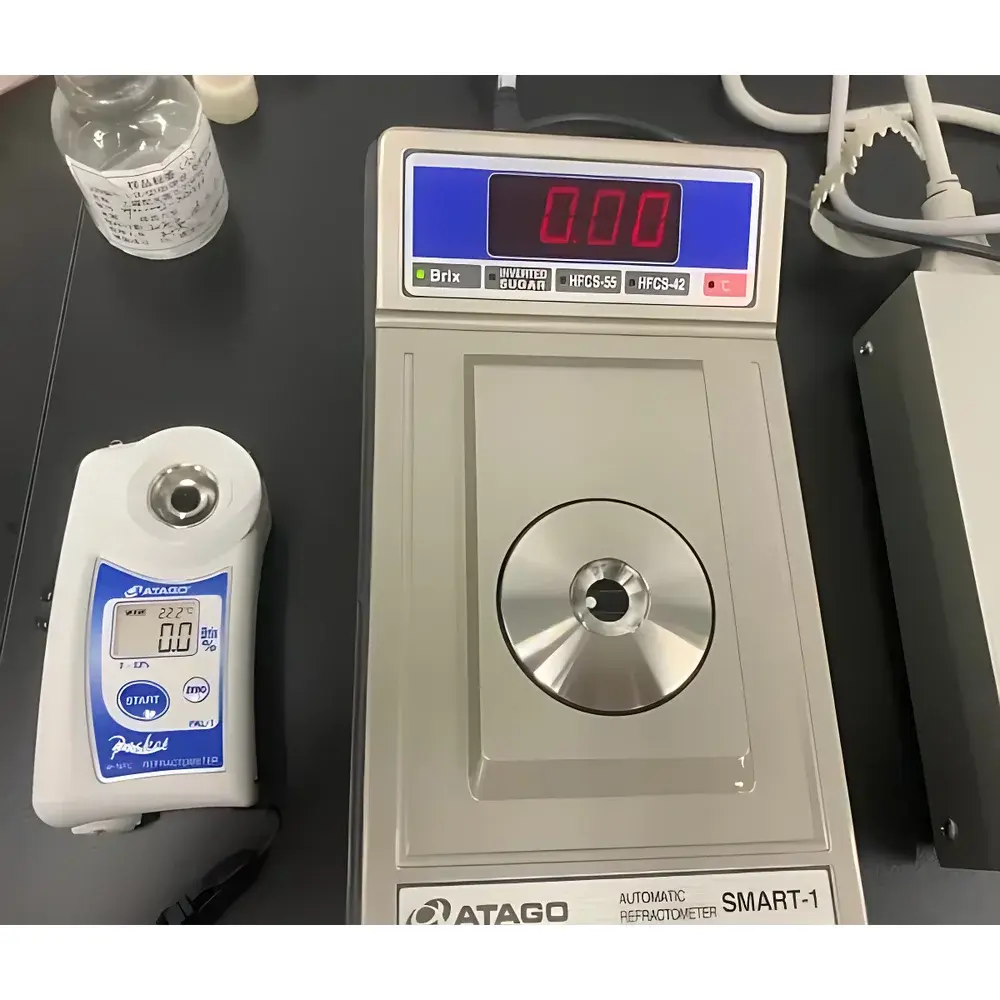
ATAGO SMART-1 Desktop Automatic Refractometer for HFCS, Invert Sugar, and Brix Measurement
| Brand | ATAGO |
|---|---|
| Origin | Japan |
| Model | SMART-1 |
| Measurement Principle | Abbe Refraction |
| Measurement Range | Brix 0.00–95.00%, Invert Sugar 0.00–95.00%, HFCS-42 0.00–95.00%, HFCS-55 0.00–95.00% |
| Resolution | 0.01% for all scales |
| Accuracy | ±0.05% for all scales |
| Repeatability | ±0.01% |
| Temperature Compensation | Automatic (5.00–40.00 °C) |
| Power Supply | AC 100–240 V, 50/60 Hz |
| Power Consumption | 15 VA |
| IP Rating | IP64 (main unit) |
| Interface | RS-232C |
| Dimensions (H×W×D) | 12×27×9 cm |
| Weight | 2.0 kg (main unit), 0.7 kg (AC adapter) |
Overview
The ATAGO SMART-1 is a benchtop automatic refractometer engineered for high-precision, routine concentration analysis of sugar-based solutions in industrial quality control and research environments. It operates on the principle of critical-angle refractometry—measuring the refractive index of a sample at the interface between prism and liquid—and converting it to concentration values using pre-calibrated polynomial algorithms compliant with internationally recognized optical standards (e.g., ISO 2173, AOAC 932.12). Unlike destructive titration or enzymatic assays, the SMART-1 delivers non-invasive, solvent-free measurements in under 3 seconds per sample. Its dedicated calibration modes support four primary scales: Brix (for sucrose-equivalent concentration), invert sugar (hydrolyzed sucrose), and two industry-specific HFCS formulations—HFCS-42 and HFCS-55—enabling direct readout without manual conversion factors. Designed for robustness in production-floor settings, the instrument features a thermally stabilized sapphire prism, sealed optical path, and automatic temperature compensation across 5.00–40.00 °C, eliminating drift caused by ambient fluctuations.
Key Features
- Four pre-installed concentration scales: Brix, invert sugar, HFCS-42, and HFCS-55—all with identical 0.00–95.00% range and 0.01% resolution
- High metrological performance: ±0.05% accuracy and ±0.01% repeatability (standard deviation over 10 consecutive measurements)
- Integrated Peltier-assisted temperature control ensures measurement stability independent of lab HVAC conditions
- IP64-rated main unit housing provides dust-tight and splash-resistant protection for use near mixing tanks, filling lines, or agricultural processing stations
- RS-232C serial interface supports direct data logging to LIMS or Excel via standard terminal emulation (no proprietary drivers required)
- Low-power architecture (15 VA max) compatible with global AC mains (100–240 V, 50/60 Hz), certified to IEC 61010-1 for laboratory electrical safety
Sample Compatibility & Compliance
The SMART-1 accepts aqueous solutions with viscosity ≤500 mPa·s and suspended solids <0.1% w/w. It is routinely deployed for QC of syrups (e.g., corn syrup, maple syrup), fruit concentrates, soft drink bases, fermentation broths, and hydrolyzed starch products. For regulatory alignment, its Brix scale conforms to ASTM D1000 and ISO 5725-2 for precision validation; HFCS modes follow USDA-FNS specifications for sweetener labeling compliance. The instrument meets GLP documentation requirements when paired with RS-232C timestamped output and external audit-trail printers. While not FDA 21 CFR Part 11–certified out-of-the-box, its deterministic measurement logic and unalterable firmware enable qualification for GMP environments under internal SOPs.
Software & Data Management
No embedded operating system or proprietary software is required. Measurement data export occurs via ASCII-formatted RS-232C packets containing: timestamp (YYYY-MM-DD HH:MM:SS), selected scale ID, numeric result, temperature reading, and status flag (e.g., “OK”, “LOW SAMPLE”, “TEMP OUT OF RANGE”). This raw stream integrates natively with LabVIEW, Python (pySerial), or commercial SCADA platforms. Optional thermal printers (e.g., Epson TM-T20II) provide permanent hardcopy records compliant with ISO/IEC 17025 clause 7.8.2 for result traceability. Firmware updates—distributed as signed HEX files via ATAGO’s secure portal—retain full backward compatibility with existing calibration certificates.
Applications
- Food & Beverage: Real-time monitoring of HFCS blending ratios during beverage formulation; incoming inspection of tomato paste, soy sauce, and jam batches
- Agriculture: On-farm fruit maturity assessment using Brix thresholds correlated to harvest readiness (e.g., grape must ≥22.0°Bx for wine fermentation)
- Bioprocessing: Tracking glucose depletion and fructose accumulation during enzymatic isomerization of glucose syrup
- Textile Manufacturing: Quantifying polyvinyl alcohol (PVA) or starch-based sizing concentrations prior to warp application
- Academic Research: Teaching refractometric principles in analytical chemistry labs; validating HPLC sugar quantification methods
FAQ
Is the SMART-1 suitable for measuring viscous or particulate-laden samples?
Yes—samples up to 500 mPa·s viscosity are accommodated; however, suspensions require centrifugation or filtration to prevent prism fouling and ensure optical clarity.
Does the instrument require daily recalibration?
No. Factory calibration remains stable for ≥6 months under normal use; verification with NIST-traceable sucrose standards (e.g., 10.00±0.01% w/w) is recommended before each shift.
Can HFCS-42 and HFCS-55 modes be customized for other fructose:glucose ratios?
No—these scales are fixed polynomial fits validated against reference HFCS standards from the Corn Refiners Association; custom curve loading is not supported.
What maintenance is required beyond prism cleaning?
Annual verification of temperature sensor drift (<±0.1 °C) and prism surface flatness (λ/4 tolerance) by an ATAGO-authorized service center is advised for ISO 17025 accreditation.
Is USB connectivity available?
No—only RS-232C is provided; USB-to-serial adapters (FTDI chipset) are widely compatible and maintain full data integrity.





