
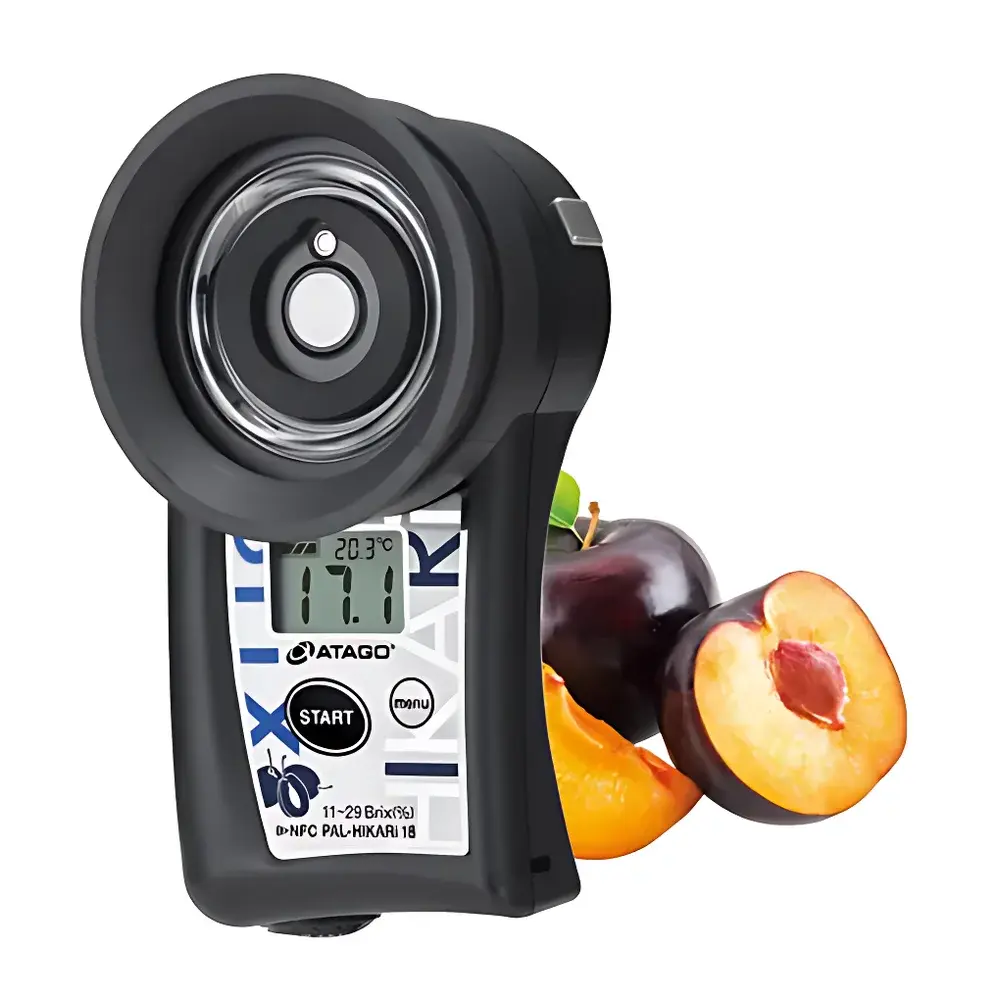
ATAGO PAL-HIKARi 18 Non-Destructive Near-Infrared Refractometer for Plums
| Brand | ATAGO |
|---|---|
| Origin | Japan |
| Model | PAL-HIKARi 18 |
| Instrument Type | Non-Destructive |
| Measurement Principle | Near-Infrared (NIR) Absorption |
| Measuring Range | Brix 11.0–29.0% |
| Accuracy | ±1.5% Brix (varies by plum cultivar and ambient conditions) |
| Resolution | 0.1% Brix |
| Repeatability | ±0.5% Brix |
| Automatic Temperature Compensation | 10.0–35.0°C |
| IP Rating | IP64 |
| Battery | 2×AAA alkaline (≈4,000 measurements) |
| Dimensions | 6.1×4.4×11.5 cm |
| Weight | 120 g (instrument only) |
Overview
The ATAGO PAL-HIKARi 18 is a handheld, non-destructive near-infrared (NIR) refractometer engineered specifically for in-situ Brix measurement of intact plum fruits (Prunus salicina and related cultivars). Unlike conventional refractometers requiring juice extraction or tissue disruption, the PAL-HIKARi 18 employs calibrated NIR spectroscopy at wavelengths sensitive to C–H and O–H bond vibrations—correlating absorption intensity with soluble solids concentration. This optical method enables direct, contact-based measurement through the fruit epidermis without compromising structural integrity, harvest timing, or post-harvest shelf life. Designed for field-deployable precision, the instrument integrates real-time temperature compensation and a robust optical path optimized for the spectral reflectance profile of plums—accounting for skin thickness, wax layer variability, and pulp heterogeneity. Its operational envelope spans ambient temperatures from 10.0 to 35.0°C, making it suitable for orchard-side use across diverse climatic zones.
Key Features
- Truly non-destructive operation: No fruit harvesting, peeling, cutting, or juice expression required—measurements performed on living, attached, or harvested fruit with intact skin.
- Optimized NIR optical architecture: Dual-wavelength detection system calibrated against reference sucrose solutions and validated across multiple plum cultivars (e.g., Santa Rosa, Friar, Black Amber).
- Three-second measurement cycle: Press START, maintain firm probe-to-skin contact for ≤3 s; digital Brix value displayed with 0.1% resolution.
- On-device averaging function: Supports up to 10 consecutive readings per sample, automatically computing mean and standard deviation for statistical confidence.
- Rugged, portable design: IP64-rated housing resists dust ingress and water splashing; lightweight (120 g) ergonomics enable extended field use without fatigue.
- Field-ready power management: Operates on two standard AAA alkaline batteries with an estimated service life of 4,000 measurements—no recharging infrastructure required.
Sample Compatibility & Compliance
The PAL-HIKARi 18 is validated exclusively for intact, mature plums with smooth, unblemished skin surfaces. It is not intended for stone fruit with heavy russeting, severe cracking, or surface moisture. While calibration is factory-set for Prunus salicina-type plums, users should perform periodic verification using traceable sucrose standards (e.g., NIST SRM 84d) under controlled laboratory conditions. The device complies with IEC 60529 (IP64), ISO 21501-4 (optical particle characterization principles), and meets general requirements for portable optical instrumentation under ISO/IEC 17025-accredited laboratories when used within defined uncertainty budgets. It supports GLP-aligned documentation workflows via optional data export (see Software section).
Software & Data Management
The PAL-HIKARi 18 operates as a standalone instrument with no embedded Bluetooth or USB interface. However, measurement logs—including date/time stamp, Brix value, temperature reading, and user-defined batch ID—can be manually recorded or transcribed into LIMS or farm management software (e.g., AgriWebb, Cropio). For traceability-critical applications (e.g., export certification, QC audits), ATAGO recommends pairing the device with its optional PAL-PRINT portable thermal printer (sold separately) to generate hard-copy reports compliant with internal SOPs. While the instrument itself does not store historical data, its repeatability (±0.5% Brix) and documented accuracy profile support alignment with FDA 21 CFR Part 11 principles when integrated into validated quality systems.
Applications
- Orchard management: Enables real-time maturity assessment during pre-harvest scouting—supporting selective picking schedules, irrigation optimization, and harvest readiness forecasting.
- Post-harvest grading: Facilitates rapid lot-level screening at packinghouses to segregate plums by Brix tier (e.g., ≥22.0%, 19.0–21.9%, <19.0%) prior to cold storage or shipping.
- Research & breeding programs: Provides longitudinal sugar accumulation data across developmental stages—critical for evaluating new cultivars, rootstock interactions, or canopy management effects.
- Import/export inspection: Used by phytosanitary and quality assurance personnel for spot-checking consignments against contractual Brix specifications per UNECE FFV-26 or JAS standards.
- Culinary R&D: Assists pastry chefs and product developers in selecting optimal fruit ripeness for preserves, coulis, and fermented preparations where sugar content directly impacts fermentation kinetics and flavor balance.
FAQ
Can the PAL-HIKARi 18 measure other stone fruits such as peaches or apricots?
No—the optical calibration and probe geometry are specific to plum morphology and spectral response; using it on other species introduces unquantified bias and is not supported by ATAGO validation data.
Is surface moisture or dew on the fruit acceptable before measurement?
No—excess surface water must be gently blotted dry prior to measurement, as free water alters NIR reflectance and causes systematic underestimation.
Does the instrument require recalibration in the field?
No—factory calibration is stable under normal handling; however, users should verify performance weekly using a certified 20.0% Brix sucrose reference standard under ambient conditions.
How does temperature compensation affect accuracy?
The built-in thermistor measures skin surface temperature and applies a polynomial correction derived from plum-specific thermal expansion and refractive index shift models—reducing thermal drift by >85% across the 10–35°C range.
What is the minimum fruit size compatible with reliable measurement?
Fruit diameter must exceed 45 mm to ensure full probe coverage and avoid edge effects; smaller specimens yield inconsistent readings due to incomplete optical coupling.






