
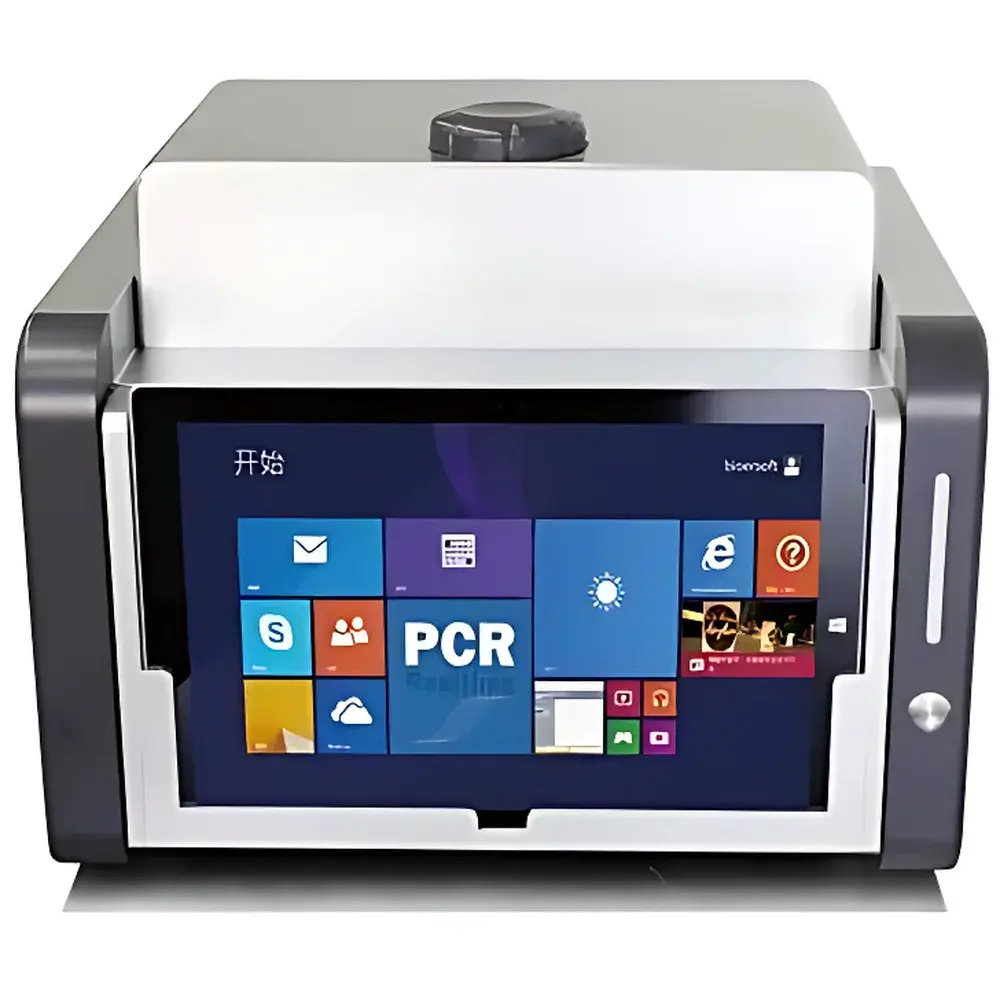
Bioer LineGene K Plus Real-Time Fluorescent Quantitative PCR System
| Brand | Bioer |
|---|---|
| Origin | Zhejiang, China |
| Model | FQD-48A |
| Instrument Type | Real-Time Fluorescent Quantitative PCR System |
| Sample Throughput | 48-well |
| Maximum Heating Rate | 5°C/s |
| Temperature Accuracy | ≤ ±0.1°C |
| Well-to-Well Temperature Uniformity | ≤ ±0.3°C |
| Excitation Source | High-Intensity LED |
| Detection Method | Bottom-Optical Fluorescence Detection |
| Thermal Control Architecture | Triple-Zone Independent Peltier Control with Dual-Side Ferrotec Modules |
| Thermal Lid | Motorized Auto-Lift Lid with SOAK Function |
| Compatible Consumables | 0.2 mL Single Tubes (Flat/Capless & Dome/Capped), 0.2 mL 8-Tube Strips (Flat/Capless & Dome/Capped) |
| Interfaces | RS232, USB 2.0, Bluetooth 4.0 |
| Operating System Support | Windows 7/8.1/10 (64-bit) |
| Dimensions (L×W×H) | 410 × 386 × 352 mm |
| Net Weight | 28 kg |
| Power Input | AC 100–240 V, 50/60 Hz, 600 W |
Overview
The Bioer LineGene K Plus Real-Time Fluorescent Quantitative PCR System is an engineered platform for precise nucleic acid quantification based on the principle of sequence-specific amplification coupled with real-time fluorescence detection. It employs a bottom-optical detection architecture—protected by patented optical design—to minimize cross-well signal crosstalk and maximize sensitivity in low-volume reactions. The system utilizes high-intensity, long-life LED excitation sources across multiple emission bands, eliminating lamp degradation concerns and ensuring stable photometric performance over extended operational lifetimes. Its thermal control system integrates dual-side Ferrotec Peltier modules with triple-zone independent temperature regulation, enabling rapid thermal ramping (up to 5°C/s), exceptional well-to-well uniformity (≤ ±0.3°C), and accurate thermal setpoint maintenance (≤ ±0.1°C). Designed for both research and clinical laboratory environments, the LineGene K Plus complies with core instrumentation requirements for ISO/IEC 17025-accredited testing laboratories and supports workflows aligned with CLIA, CAP, and GLP/GMP documentation standards.
Key Features
- Patented bottom-optical fluorescence detection geometry minimizes inter-well optical interference and enhances detection sensitivity for low-abundance targets.
- Dual-side Ferrotec Peltier heating/cooling architecture increases thermal contact area and improves heat transfer efficiency—enabling rapid ramp rates up to 5°C/s.
- Triple-zone independent thermal control allows flexible gradient programming (spanning up to 30°C) across the 48-well block for assay optimization and primer validation.
- Motorized auto-lift thermal lid eliminates manual intervention, ensures consistent pressure sealing, and prevents sample evaporation during prolonged cycling.
- SOAK function maintains user-defined low-temperature storage (e.g., 4°C or 10°C) prior to run initiation—critical for cold-sensitive master mixes and enzyme stability.
- Multi-platform remote operation support via RS232, USB 2.0, and Bluetooth 4.0 interfaces enables integration with desktop PCs, laptops, and tablet devices running Windows 7/8.1/10 (64-bit).
Sample Compatibility & Compliance
The LineGene K Plus accommodates standard 0.2 mL PCR consumables—including single tubes (flat and dome caps) and 8-tube strips—ensuring compatibility with widely adopted labware formats and eliminating proprietary cartridge dependencies. Its optical path is calibrated for common fluorescent chemistries: SYBR Green I, hydrolysis probes (TaqMan), molecular beacons, and scorpions. The system supports full compliance with analytical method validation frameworks per USP , ISO 13485 (for IVD-related use), and FDA 21 CFR Part 11 when deployed with audit-trail-enabled software configurations. All thermal and optical performance specifications are verified using NIST-traceable reference materials and validated against ASTM E2593-15 (Standard Guide for Validation of Real-Time PCR Methods).
Software & Data Management
The embedded LineGene Analysis Software provides comprehensive data acquisition, visualization, and interpretation tools. It supports quantitative analysis modes including absolute quantification (via standard curve), relative quantification (ΔΔCt), qualitative detection, high-resolution melting (HRM), SNP genotyping, and isothermal amplification monitoring. All analyses generate exportable reports in PDF, CSV, and XML formats—with customizable templates for institutional branding and regulatory submission. Audit trail functionality records user actions, parameter changes, and result modifications with timestamps and operator IDs—meeting GLP/GMP traceability requirements. Raw fluorescence data (.lgs files) are stored in open-format archives for third-party reanalysis using R/Bioconductor packages or Python-based qPCR analysis libraries.
Applications
The LineGene K Plus serves as a foundational instrument across translational and diagnostic domains. In clinical virology, it enables quantitative monitoring of HBV, HCV, HIV-1, CMV, EBV, and SARS-CoV-2 viral loads. In oncology, it supports expression profiling of hTERT and other telomerase-associated transcripts, as well as detection of fusion genes and mutation hotspots. Forensic applications include STR profiling and mitochondrial DNA quantification. In food safety and environmental microbiology, validated assays exist for Salmonella, Enterobacter sakazakii, total bacterial load in dairy products, and Mycobacterium tuberculosis. Its HRM capability facilitates rapid screening of methylation status, splice variants, and epigenetic biomarkers without probe hybridization steps.
FAQ
What consumables are compatible with the LineGene K Plus?
It accepts standard 0.2 mL PCR single tubes (flat and dome caps) and 0.2 mL 8-tube strips—no proprietary consumables required.
Does the system support FDA 21 CFR Part 11 compliance?
Yes—when configured with enabled audit trails, electronic signatures, and secure user authentication, it meets core requirements for regulated environments.
Can the instrument perform high-resolution melting (HRM) analysis?
Yes—its precise temperature ramping control (0.01°C increments) and high-sampling-rate fluorescence detection enable robust HRM profiling for SNP discrimination and methylation analysis.
Is remote operation supported?
Yes—via USB, RS232, or Bluetooth 4.0; software is compatible with Windows 7/8.1/10 (64-bit) on desktops, laptops, and tablets.
What is the thermal uniformity across the 48-well block?
Well-to-well temperature variation is ≤ ±0.3°C at 95°C, 60°C, and 72°C—verified per ASTM E2593-15 protocols.



