
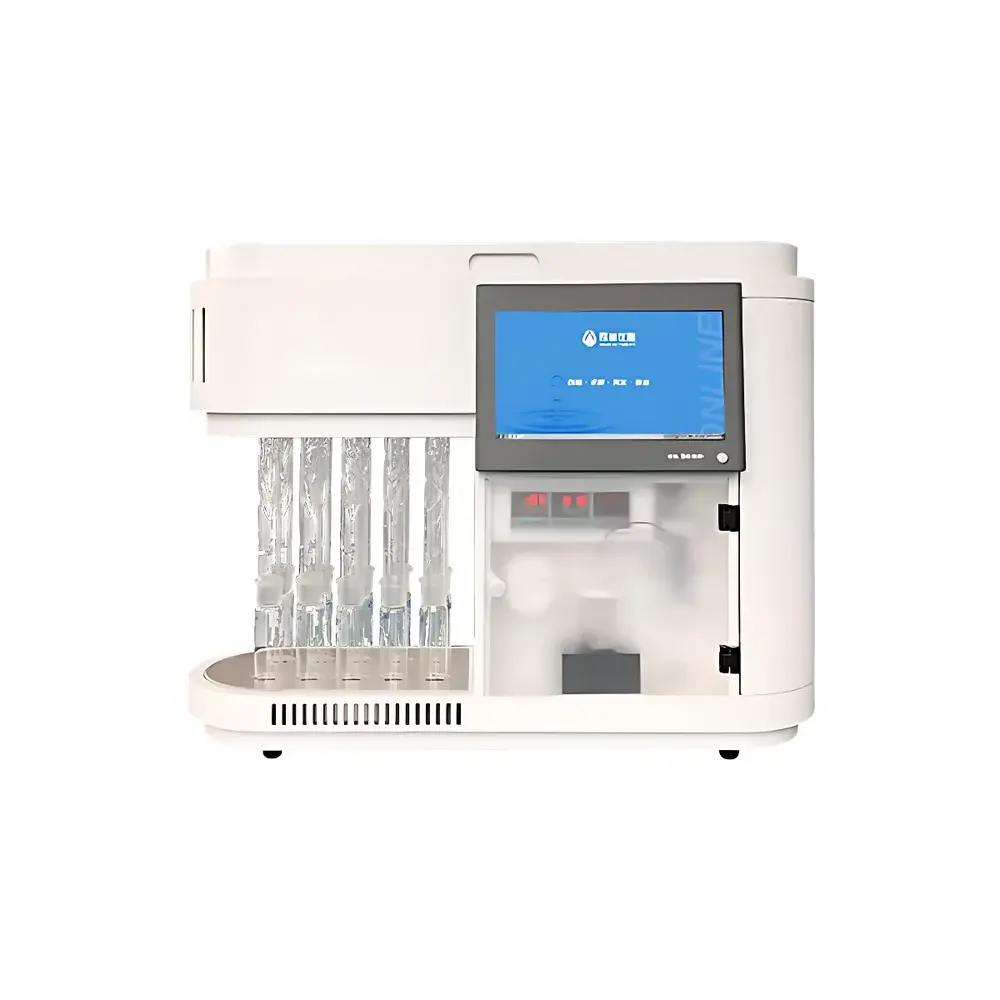
Online Instrument OL3015 Automated COD Analyzer
| Brand | Online Instrument |
|---|---|
| Origin | Shanghai, China |
| Manufacturer Type | Manufacturer |
| Product Category | Domestic |
| Model | OL3015 |
| Instrument Type | Laboratory-Grade |
| Measurement Principle | 2-Hour Closed-Vessel Digestion Followed by Potentiometric/Titrmetric Endpoint Detection |
| Wavelength | Not Applicable (Titration-Based) |
| Accuracy | ≤5% |
| Repeatability | RSD ≤3% |
| LOD | 4 mg/L COD |
| Sample Capacity | 15-position digestion + 15-position sample rack (expandable to 50-position autosampler) |
| Digestion Positions | 15 |
| Titration Channels | 2 |
| Chloride Correction | Integrated Automatic Chloride Compensation Module |
| Temperature Control | Programmable Heating (15–350 °C) with Air/Water Cooling |
| Cleaning Protocol | Fully Automated Rinse Cycles for Digestion Vessels, Titration Cells, and Fluidic Lines |
| Data Export | Excel/PDF Reports |
| LIMS Integration | Supported (Standard ASTM D1252 & ISO 6060 Compliant Workflow) |
Overview
The Online Instrument OL3015 Automated COD Analyzer is a laboratory-grade chemical oxygen demand (COD) measurement system engineered for precision, reproducibility, and regulatory compliance in environmental water quality laboratories. It implements the standardized 2-hour closed-vessel digestion method per ASTM D1252 (Method B) and ISO 6060, followed by automated titrimetric quantification using potassium permanganate or dichromate-based redox chemistry. Unlike spectrophotometric COD analyzers, the OL3015 relies on endpoint-determined titration—ensuring traceability to classical wet-chemistry reference methods and eliminating interferences from turbidity or colored matrices. Its fully enclosed fluidic architecture prevents operator exposure to hazardous reagents (e.g., concentrated H₂SO₄, Ag₂SO₄, HgSO₄), high-temperature digestion vapors, and residual chlorine compounds—making it suitable for routine use under GLP and ISO/IEC 17025-accredited environments.
Key Features
- Fully automated workflow: Sequential execution of sample aspiration (10.0 mL ±0.02 mL), reagent addition (digestion acid, catalyst, oxidant), programmable heating (15–350 °C), controlled cooling (air/water hybrid), endpoint titration, and post-analysis cleaning.
- Intelligent endpoint detection: Dual-electrode potentiometric titration with real-time slope analysis ensures robust recognition of stoichiometric equivalence points—even in low-COD or chloride-rich samples.
- Integrated chloride interference correction: Onboard AgNO₃ precipitation module with automatic stoichiometric compensation per ISO 6060 Annex A, eliminating manual blank subtraction and reducing analyst variability.
- Modular sample handling: Standard 15-position sample/digestion carousel; optionally upgradeable to a 50-position robotic autosampler with barcode scanning and sample ID tracking.
- Self-contained cleaning protocol: Three-stage rinse sequence (deionized water → dilute acid → final rinse) for digestion vessels, titration cells, and all fluidic pathways; cycle count programmable per method.
- Thermal management system: PID-controlled heating blocks with independent temperature zoning, coupled with forced-air and optional recirculating water cooling for rapid thermal equilibration between runs.
Sample Compatibility & Compliance
The OL3015 accommodates raw and pretreated aqueous matrices including surface water, municipal wastewater, industrial effluents, and leachates—with demonstrated performance across COD ranges from 4 mg/L (LOD) to 10,000 mg/L (with auto-dilution). All digestion and titration protocols adhere to the procedural rigor required by EPA Method 410.4, ASTM D1252-12 (B), and ISO 6060:2023. The system supports audit-ready electronic records compliant with FDA 21 CFR Part 11 when deployed with validated LIMS integration, including user authentication, electronic signatures, and immutable audit trails for all critical parameters (temperature profiles, titrant consumption, endpoint stability, cleaning logs).
Software & Data Management
The embedded Windows-based control software provides intuitive touchscreen operation with method templates preconfigured for standard and high-chloride applications. All analytical data—including raw titration curves, digestion thermograms, reagent lot tracking, and calibration history—are timestamped and stored locally with optional cloud synchronization. Export formats include CSV, Excel (.xlsx), and PDF reports conforming to ISO/IEC 17025 documentation requirements. LIMS connectivity is implemented via ASTM E1384-compliant HL7 or direct SQL interface, enabling bidirectional sample assignment, result push, and instrument status polling without middleware.
Applications
This analyzer serves as a primary COD quantification platform in municipal wastewater treatment plants (WWTPs), environmental testing laboratories (ETLs), industrial process monitoring units, and academic research facilities conducting water quality benchmarking. It is routinely deployed for compliance reporting under national discharge permits (e.g., China’s GB 8978-1996, EU Urban Wastewater Treatment Directive 91/271/EEC), method validation studies, and long-term trend analysis of organic loading in receiving waters. Its closed-system design also meets occupational safety requirements under OSHA 29 CFR 1910.1200 (Hazard Communication Standard) and REACH Annex XIV substance handling protocols.
FAQ
Does the OL3015 comply with international COD standard methods?
Yes—it implements ASTM D1252 Method B and ISO 6060:2023 with full procedural fidelity, including digestion time, temperature ramping, and titrant delivery specifications.
Can the system handle high-chloride wastewater without manual intervention?
Yes—the integrated chloride compensation module automatically adjusts oxidant dosage and applies stoichiometric correction prior to final calculation.
Is remote diagnostics and method update capability supported?
Yes—via secure HTTPS-enabled web interface; firmware updates, method library revisions, and real-time sensor diagnostics are accessible through authenticated remote sessions.
What maintenance intervals are recommended for routine operation?
Daily: Visual inspection of tubing integrity and waste reservoir level. Weekly: Electrode calibration verification and pump tube replacement. Quarterly: Digestion block thermal calibration and titration valve seal inspection.
How is data integrity ensured during power interruption?
All active assays retain state in non-volatile memory; upon recovery, the system resumes digestion or titration at the last validated checkpoint without data loss or reagent waste.







