
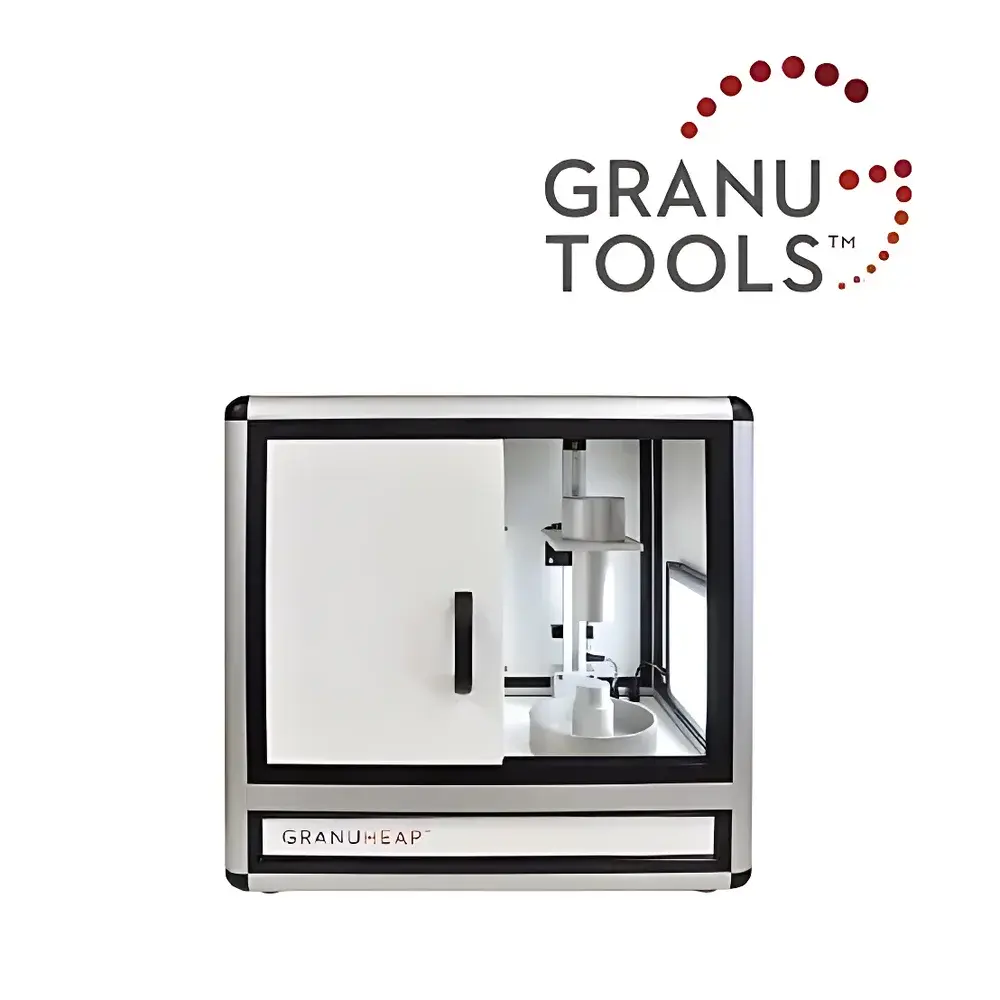
Granutools Granuheap Powder Heap Angle Analyzer
| Brand | Granutools |
|---|---|
| Origin | Belgium |
| Model | Granuheap |
| Instrument Type | Powder Heap Angle Analyzer |
| Measurable Parameter | Angle of Repose |
| Maximum Sample Vessel Capacity | 8 mL |
| Minimum Sample Volume | 4–8 mL |
| Automation Level | Fully Automated |
| Measurement Principle | Image-based heap geometry analysis with rotational multi-angle imaging |
Overview
The Granutools Granuheap Powder Heap Angle Analyzer is a fully automated, image-based instrument engineered for the precise and reproducible quantification of powder heap geometry—specifically the angle of repose—as a fundamental indicator of bulk powder flowability. Unlike traditional manual protractor-based methods, Granuheap employs a controlled dynamic deposition process: powder is dispensed from a vertically ascending cylindrical hopper onto a rotating circular stainless-steel tray. As the tray rotates incrementally (typically in 10°–30° steps), high-resolution side-view images of the resulting heap are captured under consistent illumination. A proprietary edge-detection algorithm identifies the powder–air interface in each frame, then fits an isosceles triangle to the projected heap silhouette. The apex angle of this triangle defines the measured angle of repose for that orientation. The final reported value is the arithmetic mean across all acquired orientations—typically ≥12 positions—ensuring statistical robustness and mitigating directional bias inherent in single-angle measurements. This methodology directly reflects the interplay between gravitational force, particle cohesion, and interfacial friction, making it particularly sensitive to subtle changes in surface energy, moisture content, particle size distribution, and fines content.
Key Features
- Fully automated measurement cycle—from hopper ascent to multi-angle imaging, edge detection, geometric fitting, and statistical reporting—requiring no operator intervention post-sample loading.
- Rotational multi-angle acquisition (standard 12–24 positions per test) delivers intrinsically higher repeatability (RSD < 1.2% for well-flowing powders; < 2.5% for cohesive materials) compared to static single-view systems.
- Sealed, compact benchtop architecture (W × D × H: 320 × 360 × 410 mm) enables safe integration within fume hoods, gloveboxes, or ISO-classified cleanrooms—critical for handling potent APIs or sterile formulations.
- Dual sample vessel options: standard 8 mL capacity for routine QC; optional 4 mL low-volume kit compliant with ICH Q5C and USP guidelines for limited-batch pharmaceutical development and precious material testing.
- Integrated calibration verification suite—including traceable geometric reference standards and procedural checklists—supports GLP/GMP audit readiness and instrument qualification (IQ/OQ/PQ).
Sample Compatibility & Compliance
Granuheap accommodates free-flowing, slightly cohesive, and moderately adhesive powders—including crystalline APIs, excipients (e.g., microcrystalline cellulose, lactose monohydrate), metal alloys, catalysts, and ceramic precursors—without requiring compaction, vibration, or tapping. Its non-invasive, gravity-driven deposition preserves native particle arrangement and avoids shear-induced densification artifacts. The system complies with ASTM D6393–22 (“Standard Test Method for Flowability of Powders Using the Angle of Repose”) and aligns with ISO 4490:2017 (Metallic powders — Determination of flow rate using the Hall flowmeter). Data integrity meets FDA 21 CFR Part 11 requirements via electronic signatures, audit trails, and user-access-controlled software permissions.
Software & Data Management
The GranuTools Analyze™ software (v4.2+) provides real-time visualization of heap contours, raw image archives, and full metadata logging (timestamp, operator ID, environmental conditions, vessel ID). All quantitative outputs—including mean angle of repose, standard deviation, static cohesivity index (SCI), and interfacial deviation maps—are exportable in CSV, PDF, and XML formats. Batch comparison tools enable trend analysis across formulation variants or manufacturing lots. Data storage adheres to ALCOA+ principles (Attributable, Legible, Contemporaneous, Original, Accurate, Complete, Consistent, Enduring, Available), supporting regulatory submissions and internal quality reviews.
Applications
- Rapid pre-formulation screening of API–excipient compatibility based on flow classification (e.g., “excellent” vs. “poor” per Carr’s Index correlation).
- QC release testing of incoming raw materials against predefined repose-angle specifications (e.g., ≤35° for direct compression blends).
- Process troubleshooting: detecting moisture uptake during milling or drying, or identifying segregation effects after blending.
- Supporting QbD initiatives by establishing design space boundaries for powder handling unit operations (hopper discharge, tablet press feeders, capsule fillers).
- Academic research into powder rheology fundamentals—particularly cohesion–flow relationships in low-stress regimes where shear cell methods lack sensitivity.
FAQ
What sample volume is required for a valid measurement?
A minimum of 4 mL is sufficient when using the low-volume kit; 6–8 mL is recommended for standard vessels to ensure heap stability and image contrast.
Can Granuheap measure powders with very low flowability (e.g., >55° repose angle)?
Yes—the algorithm accommodates irregular, flattened, or asymmetric heaps typical of highly cohesive materials, and reports both mean angle and cohesivity index as complementary metrics.
Is method transfer possible between different Granuheap units?
Yes—inter-instrument RSD remains < 1.8% when using identical SOPs, calibrated vessels, and environmental controls (20–25°C, 30–50% RH).
Does the system require external vibration isolation or compressed air?
No—Granuheap operates passively with no moving parts beyond the stepper-motor-driven tray and hopper lift mechanism; benchtop placement is sufficient.
How is data security ensured during long-term deployment in regulated environments?
Role-based access control, encrypted local database storage, automatic backup scheduling, and full 21 CFR Part 11-compliant audit trail generation are enabled by default.



