
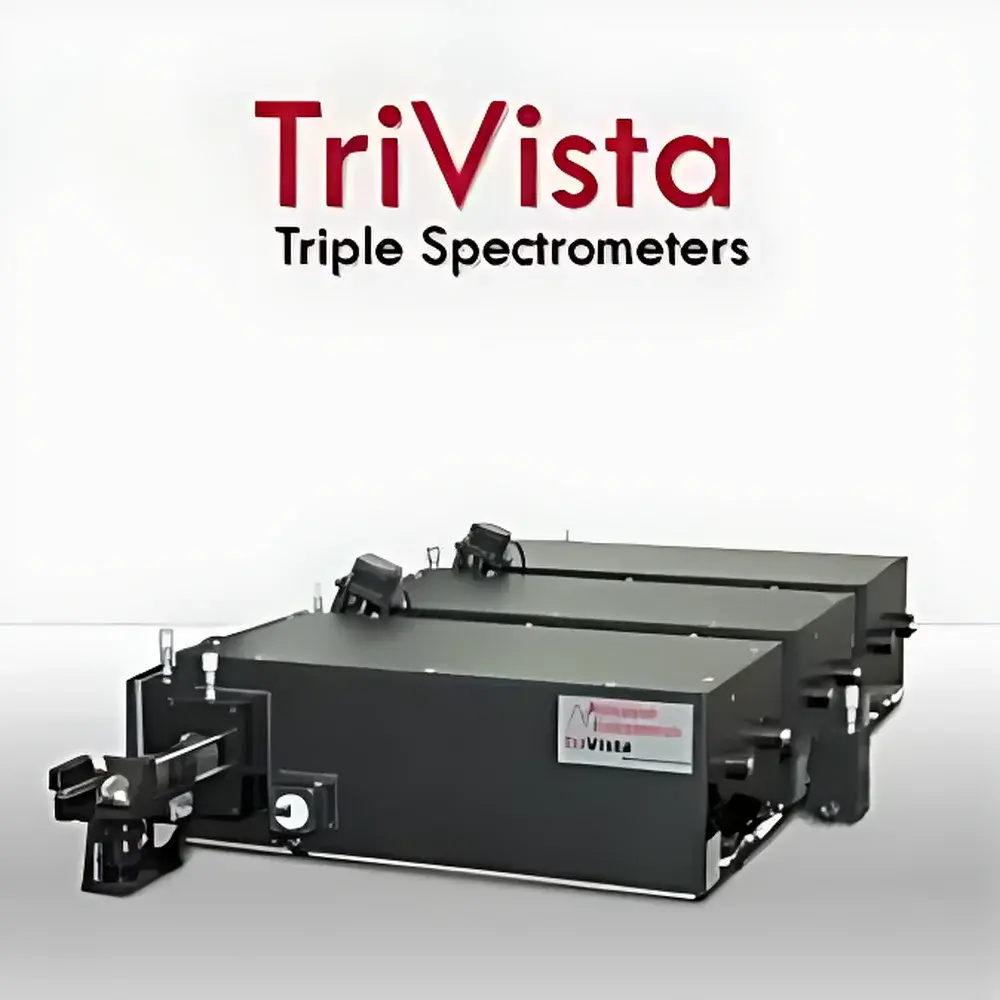
Princeton Instruments TriVista Triple-Grating Spectrometer
| Brand | Princeton Instruments (Teledyne) |
|---|---|
| Origin | USA |
| Model Variants | TR555, TR557, TR777, DM55, DM77 |
| Spectral Range | 200 nm – 2.2 µm |
| Resolution (Additive Mode) | up to 0.13 cm⁻¹ (TR777) |
| Resolution (Subtractive Mode) | up to 0.4 cm⁻¹ |
| Stray Light Rejection | <1×10⁻⁶ (enabling Raman measurements within 5 cm⁻¹ of Rayleigh line) |
| Focal Length Options | 500 mm, 750 mm, 1000 mm, 1500 mm, 1750 mm, 2250 mm |
| Aperture Ratio | f/6.5 – f/9.7 |
| Grating Compatibility | Up to 1800 grooves/mm |
| Operating Modes | Additive (high-resolution), Subtractive (ultra-low stray light), Independent Dual/Triple Stage |
Overview
The Princeton Instruments TriVista Triple-Grating Spectrometer is a research-grade, modular Czerny–Turner imaging spectrometer engineered for ultra-high spectral resolution and exceptional stray light suppression in demanding photonics and molecular spectroscopy applications. Based on the high-fidelity optical architecture of the Acton SpectraPro platform, the TriVista integrates three independently configurable grating stages—each with precision motorized grating rotation, wavelength calibration via internal reference lamps, and vacuum-compatible optical paths—enabling operation across the deep UV (200 nm) to near-infrared (2.2 µm) spectral range. Its core optical design eliminates coma and astigmatism across the full focal plane, supporting both high-throughput spectral acquisition and diffraction-limited spatial imaging without realignment. Unlike conventional cascaded systems, TriVista implements true synchronous grating motion control with sub-arcsecond positional repeatability, ensuring phase-coherent dispersion summation in additive mode or destructive interference cancellation in subtractive mode. This dual-mode capability makes it uniquely suited for experiments where simultaneous optimization of resolution (10⁶) is non-negotiable—particularly in low-signal Raman, resonance Raman, and tip-enhanced Raman spectroscopy (TERS).
Key Features
- Triple-grating architecture with fully independent or synchronized stage control via Princeton Instruments’ LightField software
- Additive mode operation delivering spectral resolution down to 0.13 cm⁻¹ (TR777, 1800 g/mm grating at 500 nm)
- Subtractive mode achieving stray light rejection better than 1×10⁻⁶—enabling reliable detection of Raman signals within 5 cm⁻¹ of the Rayleigh line
- Multi-port configuration: up to three input slits and four output ports (including side, front, and rear exits), supporting concurrent UV-Raman and photoluminescence setups
- Vacuum-purgeable optical bench (optional) for deep-UV stability and oxygen absorption mitigation below 200 nm
- Integrated NIST-traceable wavelength calibration using Hg/Ar/Ne spectral lines with automated drift correction
- Compatibility with all Princeton Instruments scientific CCD, EMCCD, and ICCD detectors—including back-illuminated, deep-depletion sensors optimized for UV–NIR quantum efficiency
Sample Compatibility & Compliance
The TriVista accommodates diverse sample geometries and excitation configurations through its modular slit, fiber-coupled, and free-space input options. It supports standard 1/4″ and 1/2″ kinematic mounts for lasers (e.g., 325 nm HeCd, 532 nm DPSS, 785 nm diode), optical parametric oscillators (OPOs), and supercontinuum sources. For regulated environments, the system complies with ISO/IEC 17025 requirements for calibration traceability, and LightField software supports 21 CFR Part 11-compliant audit trails, electronic signatures, and secure user-role management—meeting GLP and GMP documentation standards for pharmaceutical and materials QA/QC labs. All optical coatings meet MIL-C-48497A specifications for environmental durability, and mechanical housing conforms to IP52 dust resistance ratings.
Software & Data Management
Control and data acquisition are unified under Princeton Instruments’ LightField v9.x platform—a Windows-based application developed in collaboration with metrology laboratories to support ISO 14253-1 uncertainty propagation modeling. LightField provides real-time spectral alignment feedback, multi-stage grating synchronization logic, and automated mode-switching protocols (e.g., transitioning from subtractive Raman to additive PL acquisition in <2 s). Raw spectral data are saved in vendor-neutral HDF5 format with embedded metadata (wavelength axis, grating groove density, slit width, integration time, detector temperature), enabling direct import into MATLAB, Python (via h5py), Igor Pro, and ORIGIN. Batch processing pipelines support dark-current subtraction, cosmic-ray removal, and Savitzky–Golay smoothing with configurable polynomial order and window size—all validated against NIST SRM 2036 reference spectra.
Applications
- Tip-Enhanced Raman Spectroscopy (TERS): Subtractive-mode operation isolates weak plasmon-enhanced Raman signals from substrate fluorescence and laser scatter, critical for nanoscale chemical mapping of 2D materials and catalytic surfaces
- Resonance Raman Spectroscopy: High-resolution additive-mode acquisition resolves vibronic progressions in heme proteins, carotenoids, and transition-metal complexes under selective electronic excitation
- Surface-Enhanced Raman Spectroscopy (SERS): Enables quantitative analysis of monolayer adsorbates on Au/Ag nanostructures with signal-to-noise ratios exceeding 10⁴:1
- X-ray Absorption Near-Edge Structure (XANES): When coupled with synchrotron beamlines via fiber-optic coupling, TriVista’s UV–VIS arm provides complementary ligand-field analysis of L-edge transitions
- Stimulated Raman Scattering (SRS) Pump-Probe: Multi-port architecture allows simultaneous monitoring of Stokes/anti-Stokes bands during ultrafast pump-probe experiments with temporal jitter <100 fs
FAQ
What distinguishes additive vs. subtractive mode in TriVista operation?
Additive mode aligns dispersion vectors of all three gratings constructively to maximize linear dispersion and spectral resolution; subtractive mode introduces controlled path-length differences to destructively interfere stray light while preserving signal integrity.
Can TriVista be integrated with time-resolved detection systems?
Yes—LightField supports hardware-triggered acquisition synchronized to pulsed lasers (e.g., Ti:Sapphire, OPOs) with jitter <5 ns, and is compatible with delay-stage controllers for pump-probe experiments.
Is vacuum purging required for UV operation below 200 nm?
While not mandatory, nitrogen purging or vacuum operation is strongly recommended to suppress ozone formation and atmospheric O₂ absorption features that degrade SNR in the VUV region.
How does TriVista ensure long-term wavelength calibration stability?
Each grating stage includes an internal Hg/Ar lamp with automated shutter and intensity normalization; calibration routines execute before each acquisition sequence and correct for thermal drift using embedded thermistor feedback.
Are custom grating configurations supported?
Princeton Instruments offers factory-installed gratings from 300–3600 g/mm, including blazed holographic, ruled echelle, and VPH transmission types—fully characterized and certified per ISO 10110-7 standards.




