
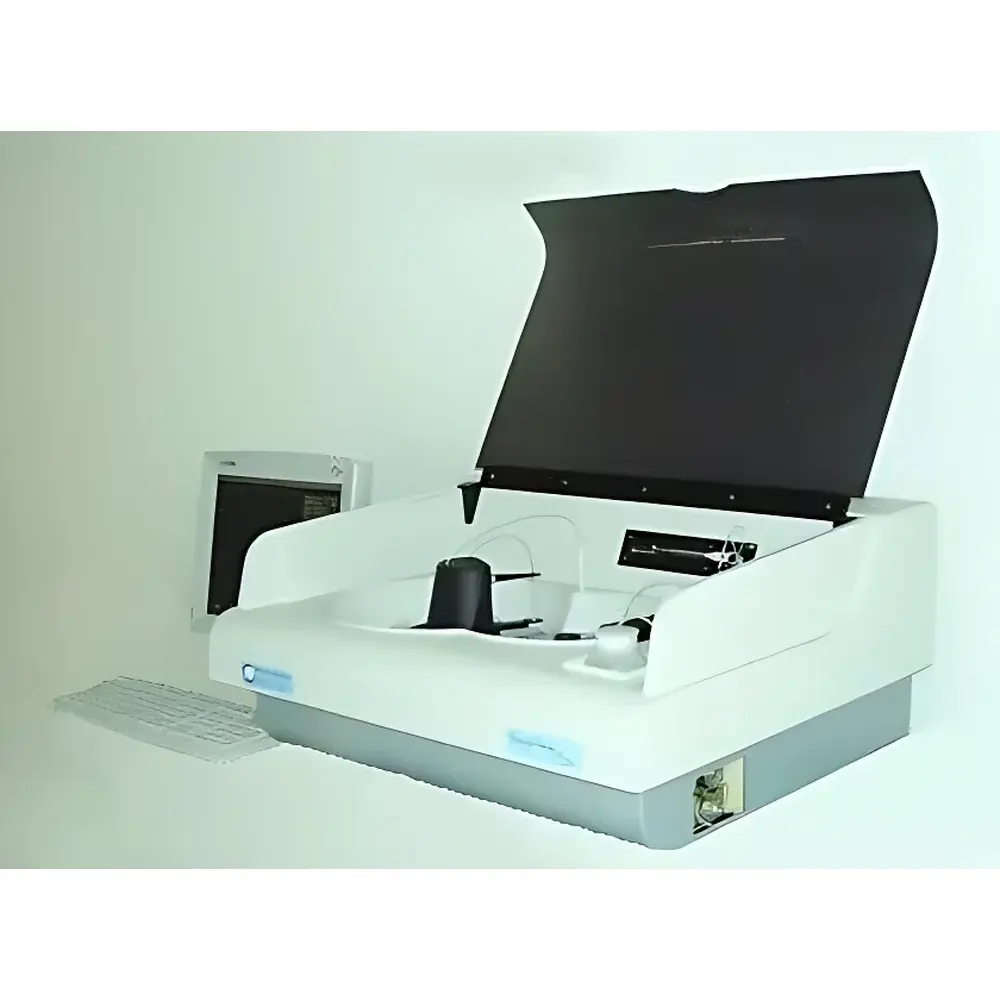
SYSTEA EASYCHEM PLUS Automated Discrete Analyzer
| Brand | SYSTEA |
|---|---|
| Origin | Italy |
| Model | EASYCHEM PLUS |
| Product Type | Discrete Analyzer |
| Wavelength Range | 340–880 nm |
| Sample Capacity | 60 positions (18-sample carousel + auxiliary racks) |
| Reagent Positions | 18 |
| Flow Cell Path Length | 10 mm |
| Light Source | 6 V / 10 W Halogen Lamp with UV-Visible Spectral Output |
| Detection Principle | Photometric Colorimetry (Static Reaction in Flow-Through Cuvette) |
| Compliance | Designed for ASTM D129, ISO 6878, ISO 15681, USP <621>, EPA Methods 353.2, 365.2, 4500-NH₃ F, 4500-NO₂⁻ B, 4500-P E, and GLP/GMP-aligned workflows |
Overview
The SYSTEA EASYCHEM PLUS is an advanced automated discrete analyzer engineered for high-precision, low-maintenance wet-chemical analysis of environmental, agricultural, and industrial samples. Unlike continuous flow or flow injection systems, the EASYCHEM PLUS employs a true static photometric detection architecture: each sample undergoes controlled reagent addition, timed incubation, and color development within a fixed 10-mm-pathlength quartz flow cell—eliminating fluid dynamics artifacts such as band broadening, baseline drift, carryover, and bubble interference. This discrete methodology replicates validated manual colorimetric protocols under programmable, sensor-monitored conditions, delivering metrological traceability aligned with ISO/IEC 17025 requirements. The system integrates a high-stability halogen light source covering 340–880 nm, enabling quantification across a broad spectrum of analytes—including total nitrogen, total phosphorus, nitrate, nitrite, ammonia, orthophosphate, silicate, chloride, sulfate, alkalinity, hardness, phenols, cyanide, sulfide, anionic surfactants, DOC, COD, and urea—without hardware modification.
Key Features
- True discrete analysis architecture: No peristaltic pumps, no tubing wear, no baseline stabilization delay—analysis begins immediately after software initiation.
- Robust robotic arm handling: Precision liquid handling with ≤1 µL dispensing resolution; full emulation of manual pipetting, mixing, heating (optional module), and cuvette positioning.
- Real-time process supervision: Integrated optical, pressure, and level sensors monitor reagent integrity, sample aspiration, reaction kinetics, and post-analysis cleaning cycles—with configurable alarm thresholds and event logging.
- Ultra-low reagent consumption: Typical assay volumes range from 5–50 µL per test, reducing chemical procurement costs and hazardous waste generation by >85% versus conventional CFA/FIA platforms.
- Self-validating shutdown protocol: Automatic multi-stage rinsing with conductivity and absorbance verification ensures residual-free status prior to standby mode.
- Method flexibility: On-board serial dilution capability for standards and out-of-range samples; user-defined calibration curves (linear, quadratic, spline) with forced zero or blank correction.
Sample Compatibility & Compliance
The EASYCHEM PLUS accepts aqueous matrices including raw and treated wastewater, surface/groundwater, soil extracts (e.g., Mehlich-3, CaCl₂), plant digests, fermentation broths, and food processing effluents. Sample vessels conform to standard 12–16 mm OD vials (including EPA-compliant 40-mL amber bottles). The system supports dual-rack configuration: primary 18-position carousel plus expandable auxiliary racks totaling 60 sample positions. All photometric measurements comply with ISO 7027 (turbidity), ISO 6878 (phosphorus), ISO 15681-1/-2 (phosphate and nitrate), and ASTM D129 (sulfur), with optional validation packages available for FDA 21 CFR Part 11 compliance—including electronic signatures, audit trail, and data integrity controls for regulated laboratories.
Software & Data Management
EASYCHEM Control Software is built on a Windows-based framework with role-based access control (administrator, analyst, reviewer). It provides method editor with drag-and-drop step sequencing, real-time chromatogram-like reaction progress visualization, automatic QC flagging per CLSI EP28-A3c guidelines, and integrated LIMS export via ASTM E1384-compliant XML or direct ODBC connection. All raw absorbance data, timestamps, sensor logs, and maintenance events are stored in encrypted SQLite databases with daily auto-backup and SHA-256 hash verification. Calibration reports include uncertainty budgets calculated per GUM (JCGM 100:2008), and QC charts (X-bar/R, Levey-Jennings) are auto-generated with Westgard multirule evaluation.
Applications
The EASYCHEM PLUS serves as a reference-grade platform in accredited environmental testing labs (ISO/IEC 17025), municipal water quality monitoring centers, agrochemical R&D facilities, and university analytical chemistry departments. Typical use cases include compliance testing for EU Water Framework Directive parameters (e.g., TP, TN, NH₄⁺), nutrient profiling in hydroponic systems, speciation analysis of nitrogen compounds in activated sludge, and rapid screening of surfactants in textile effluents. Its static reaction geometry enables reliable measurement of unstable intermediates (e.g., diazotized nitrites) and low-concentration analytes (<0.01 mg/L) where kinetic variability in flow systems compromises accuracy.
FAQ
How does EASYCHEM PLUS differ fundamentally from continuous flow analyzers?
It eliminates fluid propulsion entirely—replacing segmented flow with discrete, individually processed reactions in a stationary cuvette, thereby removing baseline instability, dispersion-related imprecision, and cross-contamination risks inherent to pumped systems.
Is method validation support provided for regulatory submissions?
Yes—SYSTEA supplies IQ/OQ documentation templates, performance qualification protocols aligned with ISO 8466-1, and optional third-party PQ services certified to ISO/IEC 17025 scope.
What maintenance is required beyond routine cleaning?
No consumable pumps, valves, or tubing; only quarterly optical alignment verification and annual lamp replacement—average uptime exceeds 99.2% over 12-month field deployments.
Can the system integrate with existing laboratory informatics infrastructure?
Fully compatible with major LIMS vendors via ASTM E1384, HL7, or custom API; supports direct instrument-to-LIMS result push with embedded metadata (operator ID, method version, QC status).
Does it support temperature-controlled reactions?
Optional Peltier-heated reaction block (±0.2 °C stability) and ambient-temperature incubation zones enable precise thermal management for enzymatic or slow-kinetic assays.




