
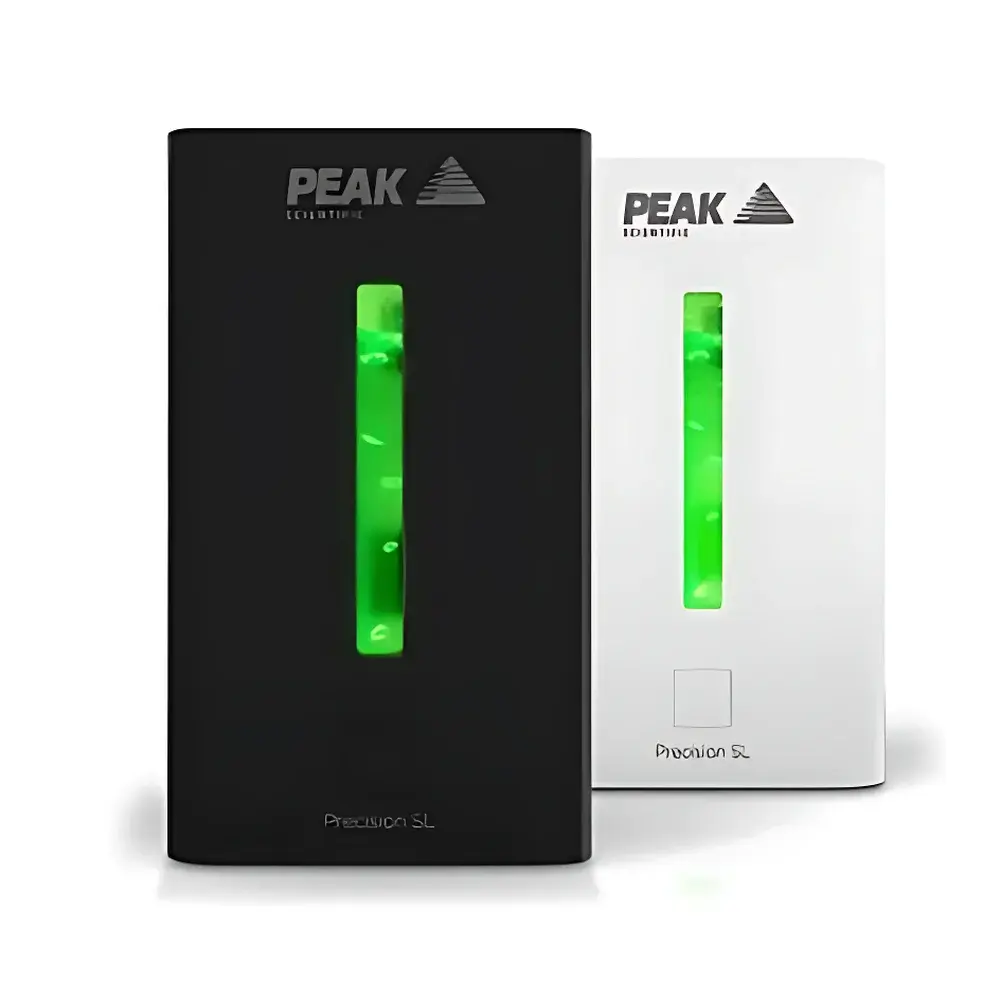
PEAK Precision SL 200 Hydrogen Generator
| Brand | PEAK |
|---|---|
| Origin | United Kingdom |
| Manufacturer Type | Original Equipment Manufacturer (OEM) |
| Import Status | Imported |
| Model | Precision SL 200 |
| Hydrogen Generation Principle | Pure Water Electrolysis |
| Output Flow Rate | 200 cm³/min |
| Output Pressure | 100 psi (6.9 bar) |
| Hydrogen Purity | 99.9995% |
| Power Consumption | 220 W |
| Dimensions | Compact footprint equivalent to a 14-inch laptop (~35.6 × 25.4 × 15.2 cm) |
| Dryer Cartridge Replacement Time | < 60 seconds |
| Warranty | 1 year standard |
Overview
The PEAK Precision SL 200 Hydrogen Generator is an engineered solution for laboratories requiring a continuous, on-demand supply of ultra-high-purity hydrogen gas (99.9995%) for gas chromatography with flame ionization detection (GC-FID). Unlike traditional high-pressure cylinder systems, this generator employs membrane-separated pure water electrolysis—eliminating the need for chemical reagents, KOH solutions, or external gas purification stages. The core electrochemical cell operates at low voltage and controlled current density, ensuring stable H₂ output across variable demand while minimizing thermal drift and electrode degradation. Designed specifically for integration into analytical workflows where space, safety, and regulatory compliance are critical, the SL 200 delivers consistent flow (up to 200 cm³/min) at regulated pressure (100 psi), meeting the stringent gas quality requirements of modern GC-FID systems per ASTM D3612 and ISO 8573-1 Class 1 compressed air/gas purity benchmarks.
Key Features
- On-demand hydrogen generation via deionized water electrolysis—no hazardous chemicals, no consumable catalysts, no gas cylinders
- Integrated pressure regulation and real-time flow monitoring with digital display for operator verification
- Compact benchtop form factor (35.6 × 25.4 × 15.2 cm) optimized for crowded lab environments; footprint comparable to a 14-inch laptop
- Fail-safe architecture including automatic shutdown on low water level, overpressure, temperature anomaly, or membrane integrity failure
- Modular desiccant cartridge system enabling full dryer replacement in under 60 seconds without tools or system venting
- Low power draw (220 W nominal) compatible with standard 100–240 V AC, 50/60 Hz laboratory circuits
- Dual-color housing option (black or white) for aesthetic integration into instrument racks or cleanroom-compatible lab furniture
Sample Compatibility & Compliance
The Precision SL 200 is validated for use with all major GC-FID platforms—including Agilent, Thermo Fisher Scientific, Shimadzu, and PerkinElmer—without modification to detector gas inlet configurations. It complies with IEC 61010-1:2010 for electrical safety in laboratory equipment and meets EN 60079-0:2018 requirements for non-explosive zone operation when installed per manufacturer instructions. Hydrogen purity (99.9995%, <0.5 ppm O₂, <0.1 ppm H₂O, <0.1 ppm total hydrocarbons) satisfies USP , EP 2.5.27, and FDA guidance for carrier and fuel gases in regulated analytical testing. No internal gas storage volume exceeds 50 cm³—well below the 100 cm³ threshold defined in NFPA 55 for “low-hazard” hydrogen generation devices, eliminating the need for dedicated gas cabinets or ventilation interlocks in most institutional settings.
Software & Data Management
While the SL 200 operates as a standalone analog-controlled unit (no embedded firmware or network interface), its operational parameters support full traceability in GLP/GMP environments. All status indicators—including water level, pressure, flow, and fault codes—are visible via front-panel LED display and mapped to discrete dry-contact outputs for connection to building management systems (BMS) or lab-wide SCADA networks. Optional analog 0–10 V or 4–20 mA signals can be configured for remote pressure/flow logging. Maintenance logs—including desiccant change timestamps and water refill records—can be maintained manually in accordance with 21 CFR Part 11 Annex 11 principles using laboratory electronic notebooks (e.g., LabArchives, Benchling) with audit trail enabled.
Applications
- Primary hydrogen fuel source for GC-FID in environmental analysis (EPA Method 8260, 8270), pharmaceutical residual solvent testing (ICH Q2(R2)), and petrochemical hydrocarbon profiling
- Backup or redundancy gas supply in multi-instrument labs where cylinder logistics introduce scheduling bottlenecks
- Research applications requiring stable H₂ flow for catalytic reaction monitoring or hyphenated techniques such as GC-MS with hydrogen-based ionization sources
- Teaching laboratories seeking safe, transparent gas generation for student-operated instrumentation without cylinder handling training overhead
- Mobile or field-deployable GC units where weight, footprint, and explosion risk mitigation are prioritized
FAQ
What type of water must be used to operate the Precision SL 200?
Deionized water with resistivity ≥ 18.2 MΩ·cm and total organic carbon (TOC) < 5 ppb is required. Tap water, distilled water, or reverse-osmosis-only water will cause rapid membrane fouling and void warranty.
Does the SL 200 require periodic calibration?
No. Flow and pressure sensors are factory-calibrated and sealed; only routine visual inspection and desiccant replacement per 6-month intervals (or per usage log) are required.
Can the SL 200 be used for hydrogen carrier gas in GC, not just FID fuel?
Yes—though not optimized for high-flow carrier applications (>5 mL/min), it supports low-flow hydrogen carrier configurations common in microbore or capillary GC methods where purity and stability outweigh volumetric demand.
Is remote monitoring or alarm integration possible?
Yes. Dry-contact fault outputs and optional analog signal modules enable integration with third-party lab monitoring systems without proprietary software dependencies.
How often does the desiccant cartridge need replacement?
Under typical GC-FID usage (8 hrs/day, 5 days/week), replacement is recommended every 6 months; frequency increases with ambient humidity >60% RH or continuous operation cycles.



