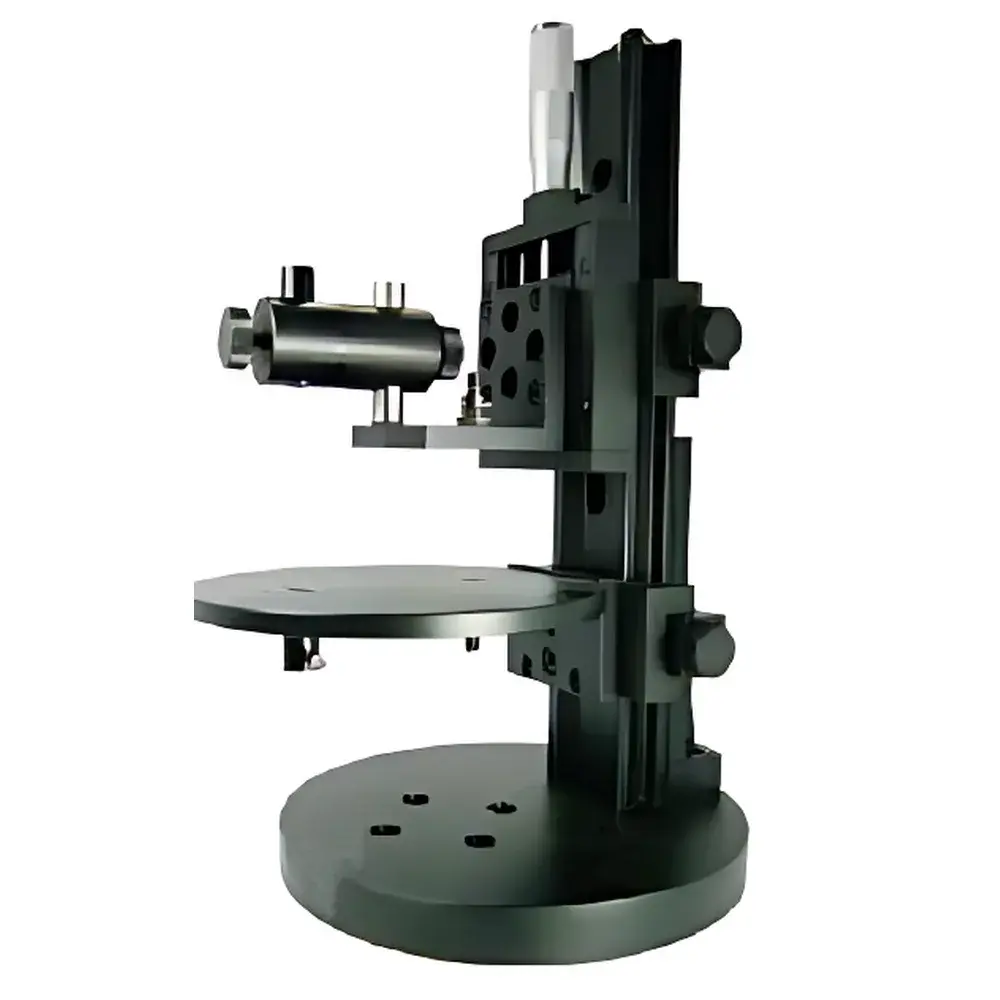
SPL SPL-STAGE-TR Transmitted and Reflected Light Sample Stage
| Brand | SPL |
|---|---|
| Origin | Zhejiang, China |
| Manufacturer Type | Authorized Distributor |
| Country of Origin | China |
| Model | SPL-STAGE-TR |
| Component Category | Optical Mounting Accessory |
| Adjustable Height Range | 210 mm (customizable) |
| Linear Translation Stage Travel | 25 mm (customizable) |
| Probe Mounting Compatibility | Ø6.35 mm (customizable) |
| Base Diameter | Ø180 mm |
| Integrated Collimating Lenses | 2 × COL-UV (200–2000 nm) |
| Construction Material | Anodized Black Aluminum |
Overview
The SPL SPL-STAGE-TR Transmitted and Reflected Light Sample Stage is a precision-engineered optical mounting platform designed for dual-mode spectral characterization in laboratory and industrial metrology environments. Built upon a robust coaxial optical alignment architecture, it enables simultaneous or sequential configuration for either transmission or reflection spectroscopy—without mechanical reassembly. Its operational principle relies on collimated beam delivery and collection geometry: two integrated COL-UV collimating lenses (200–2000 nm) ensure uniform illumination and signal capture across UV-VIS-NIR bands, while the stage’s kinematic design maintains beam path stability under variable sample thickness and surface orientation. This stage is not a light source but a passive, alignment-critical interface between spectrometers, fiber-optic probes, and heterogeneous solid samples—including semiconductors, metallic alloys, dielectric thin films, polymer substrates, and gemological materials.
Key Features
- Modular dual-mode operation: Configurable for transmission (using two fiber jumpers) or reflection (paired with a bifurcated or single-reflection probe) without hardware substitution
- Coaxial height adjustment system: Coarse positioning over 210 mm vertical range, supplemented by fine-tuning via a calibrated 25 mm travel linear translation stage with micrometer-driven resolution
- Integrated optical train: Two factory-aligned COL-UV collimating lenses (fused silica optics, AR-coated for 200–2000 nm) mounted in rigid kinematic holders to minimize beam walk-off and angular drift
- Universal mechanical adaptability: Ø180 mm black-anodized aluminum base with tapped mounting holes (M4/M6 standard pattern); optional custom hole spacing and probe collar diameters (e.g., Ø8 mm, Ø12.7 mm) available upon specification
- Stable thermal and mechanical performance: 6061-T6 aluminum construction with matte black anodization reduces stray light and improves dimensional stability across ambient lab temperature ranges (15–30 °C)
Sample Compatibility & Compliance
The SPL-STAGE-TR accommodates planar and low-curvature samples up to 100 mm × 100 mm footprint and 50 mm maximum thickness. It supports standardized optical measurement protocols aligned with ASTM E308 (computing colorimetric data from spectral reflectance), ISO 13655 (spectral measurement of printing substrates), and JIS K 7103 (transmittance testing of plastics). While the stage itself carries no intrinsic certification, its mechanical repeatability (< ±2 µm positional uncertainty after lock-down) and lens alignment tolerance (< ±0.1° beam deviation) enable traceable measurements when used with NIST-traceable spectrometers and calibrated reference standards (e.g., Spectralon® diffuse reflectance tiles, Schott NG filters). No electrical safety or EMC certifications apply, as the device contains no active electronics.
Software & Data Management
As a passive optical interface, the SPL-STAGE-TR requires no embedded firmware or driver software. It is fully compatible with third-party spectral acquisition platforms including Ocean Insight OceanView, Avantes AvaSoft, StellarNet SpectraWiz, and Hamamatsu SpectraSmart. When integrated into automated test sequences (e.g., via LabVIEW or Python-based PyVISA control), the stage’s mechanical adjustability supports programmable height stepping for multi-layer film analysis or depth-resolved reflectance profiling. Audit trails, calibration metadata embedding, and instrument configuration logging are managed at the spectrometer-software level—not by the stage—and remain compliant with GLP/GMP documentation requirements when paired with systems supporting 21 CFR Part 11 electronic signature functionality.
Applications
- Thin-film thickness quantification via interference fringe analysis in transmission mode
- Specular vs. diffuse reflectance separation on polished metal and semiconductor wafers
- Color consistency validation for automotive paint, display cover glass, and injection-molded polymers
- Optical density mapping of photomasks and lithographic reticles
- Gemstone identification using spectral absorption fingerprinting (e.g., distinguishing natural vs. synthetic sapphire)
- In-line QC screening of anti-reflective coatings on AR/VR optical components
FAQ
Is the SPL-STAGE-TR compatible with non-SPL spectrometers and fiber probes?
Yes—it is mechanically and optically agnostic; compatibility depends only on physical probe diameter (standard Ø6.35 mm) and collimated beam geometry.
Can the COL-UV lenses be replaced with other wavelength-optimized collimators?
Yes—lens mounts use industry-standard SM1 (1.035″-40) threading; alternative collimators (e.g., NIR-optimized, UV-enhanced, or telecentric) may be substituted per application requirements.
What is the maximum sample weight the stage can support without deflection?
The base and translation stage are rated for static loads up to 2.5 kg with < 5 µm sag under center-loading conditions; heavier samples require auxiliary support fixtures.
Does SPL provide calibration certificates for this stage?
No—calibration applies to optical power, wavelength, and radiometric response, which are properties of the spectrometer and light source—not the mechanical stage. However, SPL supplies dimensional drawings and alignment verification reports upon request.
Is vacuum or inert-atmosphere operation supported?
The standard anodized aluminum construction is suitable for dry nitrogen purged enclosures; for high-vacuum applications (<10⁻⁴ mbar), optional stainless steel base variants and vacuum-compatible lubricants for the translation stage are available under custom order.