
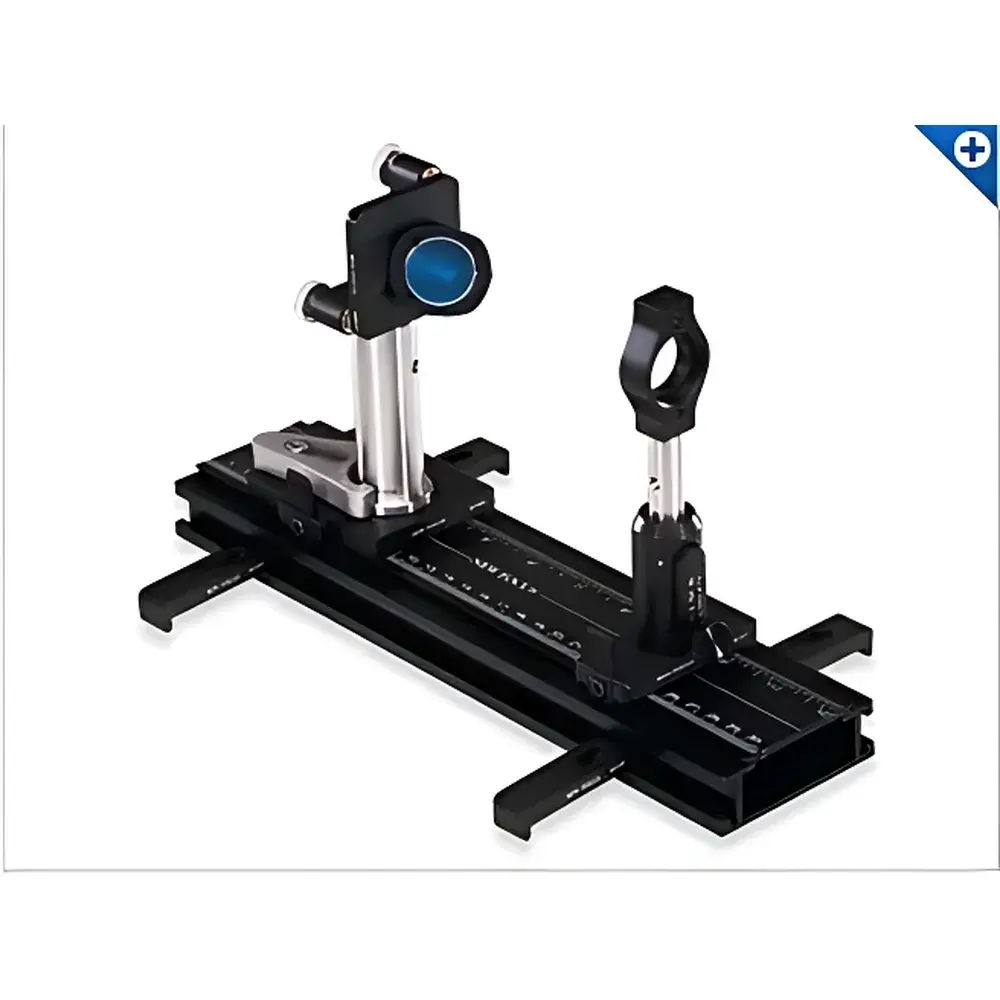
New Focus 9743-M Quasi-Kinematic Quick-Release Optical Rail Carrier
| Brand | New Focus |
|---|---|
| Origin | USA |
| Manufacturer Type | Authorized Distributor |
| Origin Category | Imported |
| Model | 9743-M |
| Component Category | Optical Mounting Hardware |
| Rail Compatibility | 9731 & 9732 Series |
| Length | 25.4 mm |
| Width | 66.0 mm |
| Height | 28.7 mm |
| Mounting Thread | M4 |
| Counterbored Holes | Two M4 |
| Tapped Holes | Two M4 |
| Rail Width Family | 3.0 in (76.2 mm) |
Overview
The New Focus 9743-M Quasi-Kinematic Quick-Release Optical Rail Carrier is a precision-engineered mounting component designed for high-stability, repeatable alignment in modular optical bench systems. It operates on the principle of quasi-kinematic constraint—minimizing parasitic motion during clamping by balancing mechanical preload with controlled degrees of freedom. Unlike conventional slide carriers that rely on friction or over-constrained bolt patterns, the 9743-M employs a spring-loaded lever mechanism to engage a cam-actuated locking interface against the rail’s precision-machined side surfaces. This design ensures sub-microradian angular stability and sub-micrometer positional repeatability without inducing thermal drift or mounting-induced stress into sensitive optical assemblies. The carrier is specifically engineered for integration with New Focus’ 9731 (metric-scaled) and 9732 (dual-scale) extruded aluminum optical rails, forming part of a fully interoperable, table-clamp-based optomechanical architecture widely deployed in university teaching labs, industrial interferometry setups, and R&D photonics test benches.
Key Features
- Quasi-kinematic locking mechanism eliminates binding and hysteresis during repeated positioning cycles
- Spring-loaded quick-release lever enables single-handed carrier engagement/disengagement under load
- Permanent M4 setscrew provides secondary mechanical lockout for long-term alignment retention
- Dual M4 counterbored holes (top surface) and dual M4 tapped holes (side surface) support versatile mounting of kinematic mounts, translation stages, and lens holders
- Optimized stiffness-to-weight ratio achieved via symmetric box-beam rail interface geometry
- Integrated dual-scale graduations (metric and imperial) laser-etched directly onto compatible rails for rapid coarse alignment verification
Sample Compatibility & Compliance
The 9743-M carrier is mechanically and dimensionally compliant with ISO 10110–7 (optical element mounting interfaces) and ANSI/OEOSC OP1.002–2021 (standardized optomechanical mounting dimensions). Its M4 thread specification conforms to ISO 1502 metric thread tolerances (6H), ensuring interchangeability with third-party accessories from Thorlabs, Newport, and Edmund Optics. No electrical or optical certification (e.g., CE, RoHS) applies, as the component is passive and non-powered. However, its aluminum 6061-T6 construction meets ASTM B221 tensile strength and dimensional stability requirements for laboratory-grade structural components. When used in FDA-regulated optical metrology workflows (e.g., ophthalmic device calibration), the carrier supports GLP-compliant documentation through traceable batch labeling and material certifications available upon request.
Software & Data Management
As a purely mechanical mounting component, the 9743-M requires no firmware, drivers, or software integration. Alignment data generated using this carrier—such as beam path coordinates or stage position logs—is captured externally via compatible motion controllers (e.g., New Focus ESP300, Thorlabs KDC101) or imaging-based metrology platforms (e.g., Qioptiq OptiCentric, Zygo Verifire). The carrier’s dual-scale engravings facilitate manual correlation between physical rail positions and digital coordinate systems in MATLAB-, Python-, or LabVIEW-based optical alignment scripts. For audit-trail compliance in regulated environments, users may log carrier serial numbers and installation torque values (recommended M4 tightening torque: 1.2 N·m ±0.1 N·m) within electronic lab notebooks aligned with 21 CFR Part 11 requirements.
Applications
- Alignment and stabilization of fiber-coupled laser sources in free-space coupling stations
- Modular beam expansion and collimation trains requiring rapid reconfiguration without realignment
- Kinematic mounting of retroreflectors and corner cubes in Michelson and Mach–Zehnder interferometers
- Positioning of photodetectors, wavefront sensors, and CCD cameras in optical testing rigs
- Teaching laboratory setups where student-accessible, tool-free adjustment reduces setup time and improves pedagogical throughput
- Integration into automated optical inspection systems where carrier repeatability supports sub-pixel image registration across multiple measurement cycles
FAQ
What rail profiles is the 9743-M compatible with?
The 9743-M is mechanically designed exclusively for New Focus 9731 (single-scale) and 9732 (dual-scale) optical rails, both featuring a nominal 3.0-inch (76.2 mm) rail width and standardized side-wall geometry.
Can the carrier be used on vibration-isolated optical tables?
Yes—the low-profile design and rigid M4 locking interface minimize resonant coupling; when paired with New Focus table clamps (e.g., 9721 series), it maintains alignment stability under broadband vibrations below 5 Hz.
Is thermal expansion compensated in the quasi-kinematic design?
While not actively compensated, the aluminum 6061-T6 construction (CTE ≈ 23.6 × 10⁻⁶ /°C) and symmetric loading path reduce differential expansion effects across the carrier-rail interface, preserving alignment within ±1.5 µrad over 0–40 °C ambient range.
Are replacement levers or springs available as spare parts?
Yes—New Focus offers OEM spare kits (P/N 9743-M-SPARE) containing lever assembly, compression spring, and pivot pin, all traceable to original manufacturing lot data.
Does the carrier meet cleanroom compatibility standards?
The anodized 6061-T6 surface meets ISO Class 5 particulate limits when cleaned per IEST-STD-CC1246D; however, lubrication-free operation means no outgassing risk in vacuum-compatible configurations up to 10⁻⁶ Torr.



