
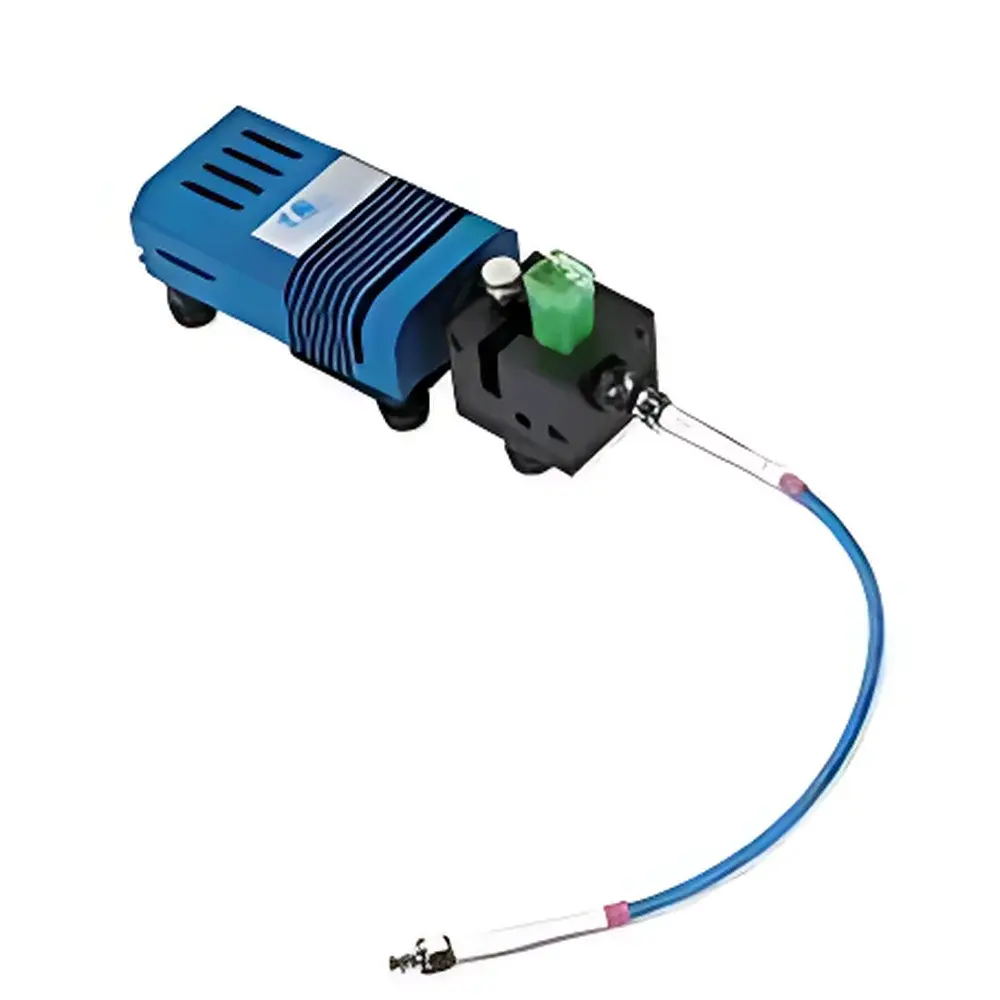
ISS-2 Integrated Sampling System
| Brand | Ocean Optics |
|---|---|
| Origin | USA |
| Model | ISS-2 |
| Light Source Type | Tungsten-Halogen Lamp |
| Illumination Geometry | Internal (In-Cuvette) |
| Optical Path Length | 1 cm |
| Collimating Lens | 5 mm Ø, f/2, BK7 glass, f = 10 mm, SMA 905 connector |
| Filter Holder | Accepts filters up to 6.35 mm (1/4") thick |
| Base Material | Aluminum |
| Spectral Range | 360 nm – 2000 nm |
| Dimensions (L×W×H) | 155.0 × 50.0 × 53.3 mm |
| Input Power | 12 VDC / 800 mA (operating range: 7–20 VDC / 0.5–2 A) |
| Lamp Power | 5 V / 1.3 A |
| Output Power | 6.5 W |
| Lamp Lifetime | 900 h |
| Warm-up Time to Stability | ~30 min |
| Voltage Regulation Accuracy | ±0.2% |
| Cooling | Integrated axial fan beneath lamp assembly |
| Positioning Mechanism | Spring-loaded spherical screw for precise 1 cm cuvette alignment |
Overview
The ISS-2 Integrated Sampling System is a compact, purpose-engineered optical platform designed for reproducible relative absorbance measurements in the visible and near-infrared (VIS-NIR) spectral region (360–2000 nm). It integrates a stabilized tungsten-halogen broadband light source with a precision-machined 1 cm pathlength cuvette holder and collimation optics into a single aluminum chassis. Unlike modular or free-space illumination setups, the ISS-2 establishes a fixed, repeatable optical geometry optimized for coupling with Ocean Insight (formerly Ocean Optics) spectrometers via SMA 905 fiber connectors. Its internal illumination architecture eliminates external alignment dependencies, minimizing beam walk-off and intensity drift during long-term kinetic or temperature-dependent experiments. The system operates on low-voltage DC power and incorporates active thermal management—critical for maintaining spectral stability over extended acquisition periods. As a turnkey component in benchtop absorption spectroscopy workflows, the ISS-2 supports method development compliant with ASTM E131, ISO 13477, and USP for photometric validation.
Key Features
- Precision 1 cm fixed-pathlength cuvette chamber with spring-loaded spherical screw positioning—ensures sub-10 µm repeatability in vertical and lateral alignment across successive sample insertions.
- High-stability tungsten-halogen lamp (5 V / 1.3 A) delivering 6.5 W optical output, rated for 900 hours of continuous operation under nominal voltage regulation (±0.2%).
- Integrated collimation optics: 5 mm diameter, f/2 BK7 lens (f = 10 mm) with AR coating optimized for 360–2000 nm; mounted in rigid kinematic housing to preserve focus over thermal cycles.
- Dedicated 1/4″ (6.35 mm) filter slot positioned pre-collimator—enables spectral band selection without modifying fiber coupling or introducing stray light.
- Onboard cooling: Low-noise axial fan located directly beneath lamp base, engineered to maintain junction temperature below 85°C at ambient ≤30°C—preventing thermal lensing and output spectral shift.
- Universal DC input (7–20 VDC, 0.5–2 A), compatible with laboratory bench supplies, battery packs, or OEM integration; includes fused 12 VDC/800 mA adapter and IEC C7 cable.
Sample Compatibility & Compliance
The ISS-2 accommodates standard 10 mm square quartz, fused silica, or high-transmission polymer cuvettes (e.g., Hellma Suprasil, Starna UV-Vis). Its internal illumination design ensures uniform irradiance distribution across the full 1 cm path, validated per ASTM E275 for absorbance linearity (R² > 0.9998 from 0.05–2.5 AU). The aluminum housing meets RoHS Directive 2011/65/EU and carries CE marking for electromagnetic compatibility (EN 61326-1) and safety (EN 61010-1). When paired with Ocean Insight spectrometers supporting NIST-traceable calibration and equipped with firmware v2.8+, the full measurement chain satisfies FDA 21 CFR Part 11 requirements for electronic records when used with audit-trail-enabled software such as OceanView or OceanHDX.
Software & Data Management
The ISS-2 requires no dedicated driver—it functions as a passive optical interface. All control and data acquisition are managed through Ocean Insight’s software ecosystem. OceanView v2.2+ provides real-time lamp stabilization monitoring (voltage, warm-up progress), automated background subtraction, and multi-cuvette batch processing with CSV/XLSX export. For regulated environments, OceanHDx supports 21 CFR Part 11-compliant user roles, electronic signatures, and immutable audit trails. Raw spectral data adhere to ANDI/MSD format standards, enabling interoperability with LIMS platforms (e.g., LabVantage, Thermo Fisher SampleManager) and chemometric tools (MATLAB, Python scikit-learn).
Applications
- Quantitative UV-Vis-NIR absorbance assays in pharmaceutical QC (e.g., concentration verification of API solutions per USP ).
- Kinetic enzyme studies requiring stable baseline illumination over 30+ minute time courses.
- Material characterization of thin-film coatings, nanoparticle suspensions, and dye-doped polymers.
- Educational labs: Teaching Beer-Lambert law fundamentals with hands-on cuvette handling and spectral overlay analysis.
- OEM integration into portable analyzers where space-constrained, vibration-resistant optical paths are essential.
FAQ
Can the ISS-2 be used with non-Ocean Insight spectrometers?
Yes—any spectrometer accepting SMA 905 fiber input and operating within 360–2000 nm can interface with the ISS-2; however, spectral calibration and lamp stability diagnostics require Ocean Insight software.
Is the tungsten-halogen lamp field-replaceable?
Yes—the lamp module is user-serviceable using standard Torx T5 tools; replacement part number is ISS-LAMP-TH-5V (available directly from Ocean Insight authorized distributors).
Does the ISS-2 support temperature-controlled cuvettes?
No—the base does not include Peltier or fluid-jacketed ports; it is designed for ambient-temperature measurements only. For thermostatted applications, external jacketed cuvettes must be coupled via custom fiber adapters.
What is the typical spectral irradiance uniformity across the 1 cm path?
Measured at 550 nm, spatial non-uniformity is ≤±1.2% across the illuminated cross-section (10 mm × 10 mm), verified using NIST-traceable CCD-based profiling.
How does the ISS-2 handle stray light in high-absorbance measurements?
The internal baffle geometry, BK7 lens AR coating, and recessed filter slot collectively suppress stray light to <0.01% at 2.0 AU—meeting ISO 9050 Class B specifications for photometric accuracy.





