
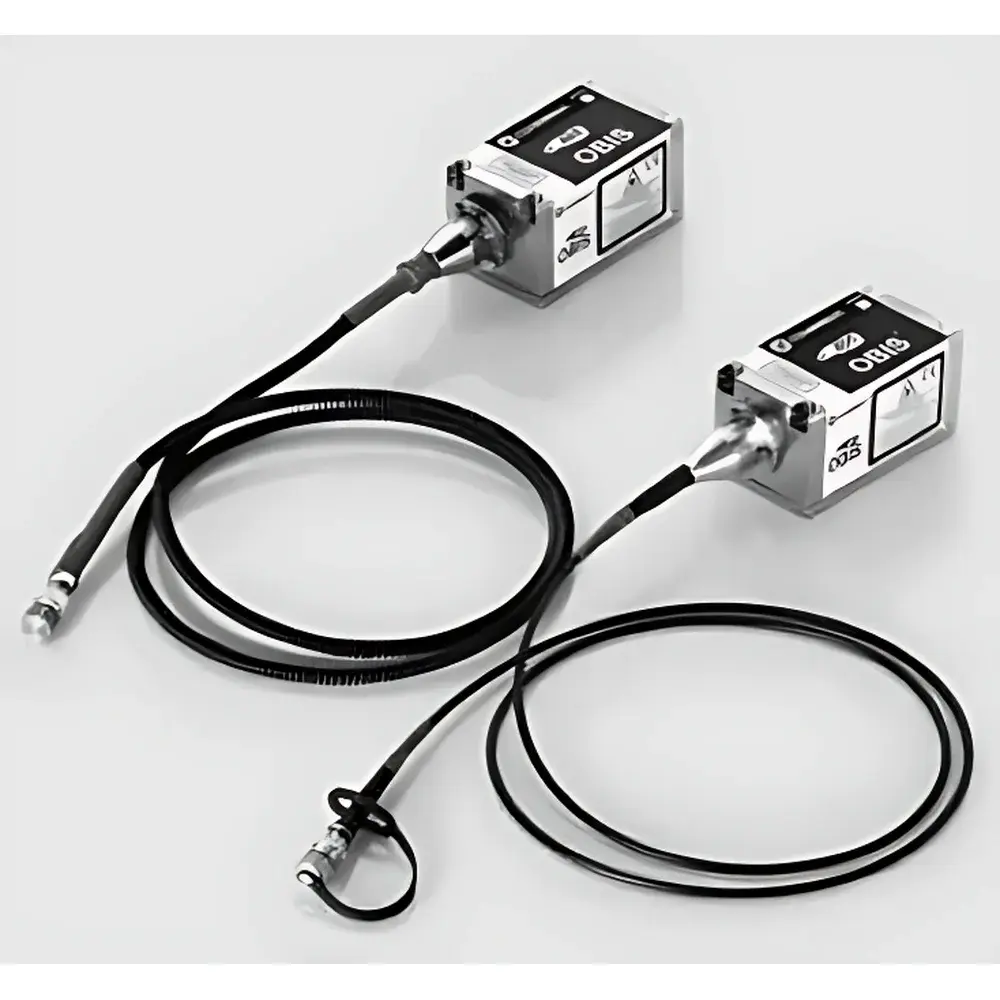
Coherent OBIS FP Series 405 nm Fiber-Coupled Solid-State Laser
| Brand | Coherent |
|---|---|
| Origin | USA |
| Manufacturer Type | Authorized Distributor |
| Origin Category | Imported |
| Model | OBIS FP Series |
| Wavelength | 405 nm |
| Output Type | Fiber-Coupled (Single-Mode, FC/PC or FC/APC connector) |
| Laser Medium | Diode-Pumped Solid-State (DPSS) |
| Operating Mode | Continuous Wave (CW) |
| Compliance | CE, RoHS, FDA 21 CFR Part 1040.10 |
| Cooling | Conduction-cooled |
| Control Interface | Analog 0–5 V / TTL modulation, USB 2.0 (optional), RS-232 (optional) |
Overview
The Coherent OBIS FP Series 405 nm Fiber-Coupled Solid-State Laser is a compact, OEM-integrated laser source engineered for high-stability continuous-wave (CW) output at the biologically critical 405 nm wavelength. Based on diode-pumped solid-state (DPSS) architecture, it delivers diffraction-limited beam quality via single-mode polarization-maintaining (PM) fiber coupling—enabling precise spatial mode control and seamless integration into optical trains where alignment stability and modal purity are essential. Unlike gas or dye lasers, this solid-state design eliminates consumables, offers rapid turn-on response (<100 ms), and maintains long-term power stability (<±0.5% over 8 hours, typical) under laboratory or industrial environmental conditions. Its 405 nm emission falls within the near-UV/blue spectral region, enabling efficient excitation of common fluorophores (e.g., DAPI, Hoechst 33342, Alexa Fluor 405), photoactivation of caged compounds, and compatibility with high-resolution fluorescence microscopy modalities including confocal, TIRF, and structured illumination.
Key Features
- Stable CW output at 405 nm with <±1% RMS power noise (10 Hz–10 MHz bandwidth)
- Fiber-coupled delivery via PM single-mode fiber (core diameter: 5.6 µm, NA: 0.12), supporting FC/PC or FC/APC termination
- Integrated thermal management with conduction cooling—no forced air or water required
- Digital and analog control options: TTL modulation (up to 100 kHz), 0–5 V analog intensity control, optional USB 2.0 or RS-232 interface for remote configuration
- Compliance with international laser safety standards (IEC 60825-1:2014, Class 3B); built-in interlock circuitry and key switch for system-level safety integration
- OEM-optimized form factor (92 × 52 × 32 mm) with low EMI emissions suitable for embedded instrumentation
Sample Compatibility & Compliance
The OBIS FP 405 nm laser is routinely deployed in regulated life science environments requiring traceable performance and audit-ready documentation. It supports GLP/GMP-aligned workflows through deterministic output repeatability and factory calibration certificates traceable to NIST standards. The system complies with ISO 13485–aligned manufacturing controls and meets electromagnetic compatibility requirements per EN 61326-1 (industrial environment). For applications involving human tissue or clinical diagnostics, the laser conforms to IEC 60601-2-22 (medical laser equipment safety) when integrated into certified host platforms. Its fiber-coupled architecture minimizes alignment drift during thermal cycling—a critical requirement for automated microscopy platforms and microfluidic cytometers operating across ambient temperature ranges of 15–30 °C.
Software & Data Management
Coherent provides the OBIS LaserStudio™ software suite (Windows-based) for full parameter configuration, real-time monitoring, and firmware updates. The application supports logging of operational metrics—including output power, case temperature, and driver current—with timestamped CSV export for QA/QC record retention. When interfaced via USB or RS-232, the laser enables synchronized triggering with external devices (e.g., cameras, shutters, stage controllers) using programmable delay and pulse width settings. For enterprise integration, the OBIS FP supports SCPI command syntax and can be embedded into LabVIEW, MATLAB, or Python-based control frameworks via standard serial or virtual COM port drivers. Audit trail functionality—including user login, parameter change history, and session timestamps—is available upon enabling secure mode per FDA 21 CFR Part 11 compliance guidelines.
Applications
- Confocal and super-resolution fluorescence microscopy (STED, PALM/STORM) requiring stable, diffraction-limited 405 nm excitation
- Flow cytometry systems utilizing violet-side scatter (VSSC) and multi-color immunophenotyping panels
- Photochemical crosslinking in chromatin immunoprecipitation (ChIP) and proximity labeling assays (e.g., BioID, APEX)
- Optogenetic activation of engineered opsins (e.g., ChR2 variants with enhanced 405 nm sensitivity)
- Microfabrication and photolithography setups requiring UV-grade coherence and low pointing instability (<5 µrad)
- Calibration sources for spectroradiometers and CCD/CMOS quantum efficiency characterization
FAQ
Is the OBIS FP 405 nm laser compatible with third-party fiber optic patch cables?
Yes—provided the patch cable uses a matching connector type (FC/PC or FC/APC) and maintains polarization-maintaining specifications (e.g., Panda or Bow-tie PM fiber with extinction ratio >20 dB).
What is the maximum allowable back-reflection into the fiber output?
Back-reflection exceeding –20 dB relative to output power may induce instability or damage; use of an in-line optical isolator (≥30 dB isolation at 405 nm) is recommended for interferometric or cavity-enhanced configurations.
Can output power be modulated at frequencies above 100 kHz?
Analog modulation bandwidth is limited to 100 kHz; for higher-frequency modulation (>500 kHz), external acousto-optic or electro-optic modulators must be used downstream of the fiber output.
Does Coherent provide calibration certificates with NIST traceability?
Yes—each unit ships with a factory calibration report documenting output power, center wavelength, and beam divergence, all traceable to NIST SRM 2211 and calibrated using ISO/IEC 17025–accredited instrumentation.
Is remote firmware update supported over USB without physical access to the laser head?
Yes—LaserStudio™ enables secure firmware upgrades via USB connection without disassembly or service intervention, with rollback capability and checksum verification.



