
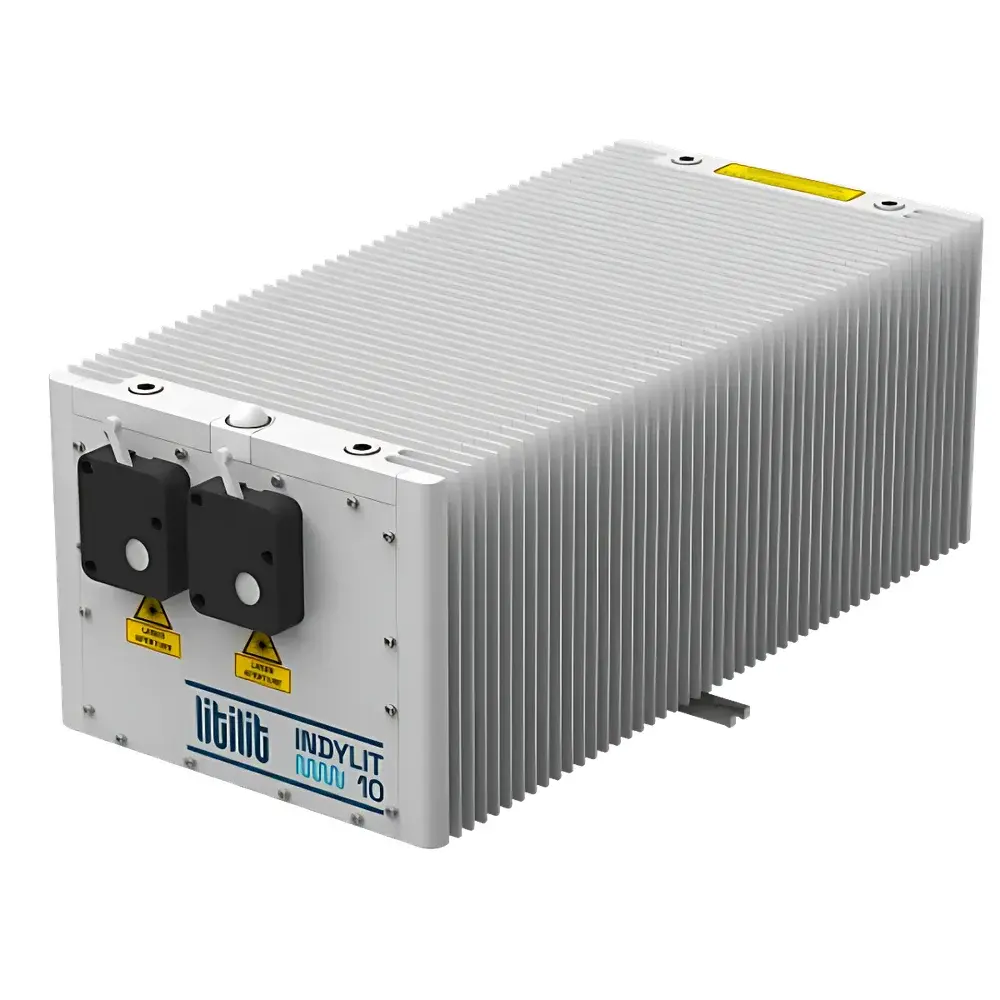
Litilit Indylit 10 High-Energy Air-Cooled Industrial Femtosecond Laser System
| Brand | Litilit |
|---|---|
| Origin | Lithuania |
| Model | Indylit 10 |
| Output Wavelength | 1030 ± 2 nm (fundamental), 515 ± 1 nm (SHG) |
| Spectral Bandwidth (FWHM) | < 4 nm (1030 nm), < 3 nm (515 nm) |
| Average Power | > 10 W @ 100 kHz / > 12 W @ 1 MHz (1030 nm) |
| Pulse Energy | > 100 µJ (1030 nm), > 50 µJ (515 nm) |
| Pulse Duration | < 400 fs (adjustable from 400 fs to 4 ps) |
| Repetition Rate | 100 kHz – 1.6 MHz (burst mode down to 30 kHz) |
| Beam Quality (M²) | < 1.2 |
| Beam Roundness | > 0.90 (1030 nm), > 0.85 (515 nm) |
| Beam Diameter (1/e²) | 2.6 ± 0.2 mm (1030 nm), 2.2 ± 0.2 mm (515 nm) |
| Polarization | Linear, > 200:1 extinction ratio |
| Pre-pulse Contrast | > 1:1000 |
| Post-pulse Contrast | > 1:100 |
| Beam Divergence (full angle) | < 1 mrad |
| Beam Pointing Stability (RMS) | < 20 µrad |
| Power Stability (RMS, 1 s) | < 1% (1030 nm), < 2% (515 nm) |
| Pulse Energy Stability (RMS, 10 s) | < 1% (1030 nm), < 2% (515 nm) |
| Warm-up Time (cold start) | < 30 min |
| Warm-up Time (hot start) | < 3 min |
| Cooling | Passive air-cooled laser head, active fan-cooled control unit |
| Dimensions (L×W×H) | Laser Head: 498 × 248 × 194 mm³ |
| Control Unit | 490 × 370 × 140 mm³ |
| AC/DC Converter | 250 × 125 × 60 mm³ |
| Input Voltage | 100–240 V AC, 47–63 Hz → 24 V DC (25 A) |
| Max Power Consumption | 700 W |
| Avg. Power Draw (steady state) | 300 W |
| Operating Temperature | 18–30 °C |
| Storage/Transport Temp | −20 to +70 °C |
| Interfaces | CAN, USB |
| Pulse Picking | Integrated TTL-gated pulse selector (1–12 pulses/burst) |
| Switching time between outputs | < 1 s |
Overview
The Litilit Indylit 10 is a high-energy, industrial-grade femtosecond laser system engineered for precision microprocessing in demanding production environments. Based on Litilit’s patented all-fiber, self-starting oscillator-amplifier architecture, the Indylit 10 delivers ultrashort pulses (< 400 fs) with exceptional temporal fidelity, high pulse-to-pulse stability, and intrinsic resistance to mechanical vibration and thermal drift. Unlike conventional water-cooled ultrafast lasers, its passive air-cooled laser head eliminates dependency on external chillers or complex fluid loops—significantly reducing footprint, operational overhead, and failure points. The system operates at a fundamental wavelength of 1030 ± 2 nm, with an integrated, electronically switchable second-harmonic generation (SHG) module enabling seamless transition to 515 ± 1 nm output. This dual-wavelength capability expands material interaction flexibility across transparent dielectrics, wide-bandgap semiconductors, and highly reflective metals—critical for applications such as selective ablation, cold ablation, and sub-surface modification where nonlinear absorption thresholds and heat-affected zone (HAZ) minimization are paramount.
Key Features
- Passive air cooling of the laser head: No chiller required; enables robust deployment in factory-floor environments with variable ambient conditions.
- Adjustable pulse duration: Tunable from <400 fs up to 4 ps via internal dispersion compensation—optimized for specific material coupling and ablation efficiency.
- High pulse energy & clean temporal profile: >100 µJ pulse energy at 100 kHz (1030 nm), with pre-pulse contrast >1:1000 and post-pulse contrast >1:100—ensuring minimal parasitic energy deposition.
- Integrated burst-mode operation: Programmable pulse trains (1–12 pulses per burst) with sub-millisecond switching between fundamental and SHG outputs.
- Exceptional beam stability: Beam pointing drift <20 µrad RMS over 8 hours; thermal coefficient <20 µrad/°C—enabling long-duration, high-repeatability machining without realignment.
- Turnkey industrial interface: Dual-control architecture via CAN bus (for OEM integration) and USB (for lab configuration); supports analog modulation (0–1 V) for fast power attenuation (<1 µs rise time).
- Maintenance-free design: Solid-state fiber architecture with no consumables, no alignment-sensitive free-space optics, and no periodic servicing requirements—aligned with ISO 9001-certified manufacturing and GLP-compliant operation protocols.
Sample Compatibility & Compliance
The Indylit 10 is validated for processing a broad spectrum of industrially relevant materials—including fused silica, sapphire, lithium niobate, silicon carbide, copper, stainless steel, polyimide, PET, and lithium-ion battery electrode foils. Its high peak intensity (>1013 W/cm² at focus) enables multiphoton absorption in transparent media, while its low thermal load preserves micron-scale feature integrity in heat-sensitive substrates. The system complies with IEC 60825-1:2014 (laser safety), EN 61000-6-3:2011 (EMC emission), and EN 61000-6-2:2016 (EMC immunity). All firmware and GUI operations support audit-trail logging compatible with FDA 21 CFR Part 11 requirements when deployed in regulated manufacturing settings (e.g., medical device micromachining or semiconductor packaging). Optional NIST-traceable calibration reports are available upon request.
Software & Data Management
The Indylit Control Suite provides a unified GUI for parameter configuration, real-time monitoring, and diagnostics—including live power tracking, pulse energy histogramming, and beam pointing trend analysis. All operational parameters (repetition rate, pulse width, SHG enable/disable, burst count, attenuation level) are accessible via CAN register mapping for seamless integration into PLC-controlled motion platforms (e.g., Aerotech, PI, or Zaber stages). Data export supports CSV and HDF5 formats, enabling traceability for SPC (Statistical Process Control) workflows. Firmware updates are delivered via signed binary packages with SHA-256 verification, ensuring integrity during remote maintenance. Internal non-volatile memory retains user-defined presets across power cycles, supporting reproducible job recall in high-mix production lines.
Applications
- High-precision micromachining of brittle and composite materials: drilling, cutting, and surface structuring of display glass (OLED/LCD), MEMS wafers, and ceramic substrates.
- Ophthalmic device fabrication: corneal flap creation, intraocular lens scribing, and hydrogel-based contact lens patterning—leveraging low HAZ and minimal collateral damage.
- Semiconductor and advanced packaging: via drilling in Si, GaN, and SiC; trench isolation in power devices; and selective removal of passivation layers without substrate damage.
- Battery manufacturing: electrode trimming, separator ablation, and current collector patterning for solid-state and pouch-cell architectures.
- Permanent laser marking: high-contrast, oxide-free marking on stainless steel, titanium, and anodized aluminum—meeting ISO/IEC 15415 and AIM DPM Grade A requirements.
- Scientific instrumentation seeding: serving as a reliable, turnkey oscillator source for OPCPA systems, THz generation, and pump-probe spectroscopy setups.
FAQ
Is the Indylit 10 suitable for cleanroom environments?
Yes—the fully enclosed, fan-filtered control unit and sealed laser head meet ISO Class 5 particulate limits when installed with standard cleanroom HVAC airflow protocols.
Can the pulse repetition rate be synchronized to an external clock?
Yes—via the CAN interface, users can lock the internal oscillator to an external 10 MHz reference signal with jitter <100 fs RMS.
What is the expected lifetime of the laser under continuous operation?
Based on accelerated life testing per Telcordia GR-468-CORE, the core fiber amplifier exhibits >50,000 hours MTBF at rated operating conditions.
Does the system support vacuum-compatible integration?
The laser head is not vacuum-rated; however, beam delivery can be coupled into UHV chambers via collimated free-space or hollow-core photonic crystal fiber interfaces (custom options available).
How is beam pointing stability verified during qualification?
Beam pointing is measured using a quadrant photodiode and digital lock-in amplifier over 8-hour sessions at constant ambient temperature (±0.5 °C), per ISO 11554 Annex B guidelines.




