
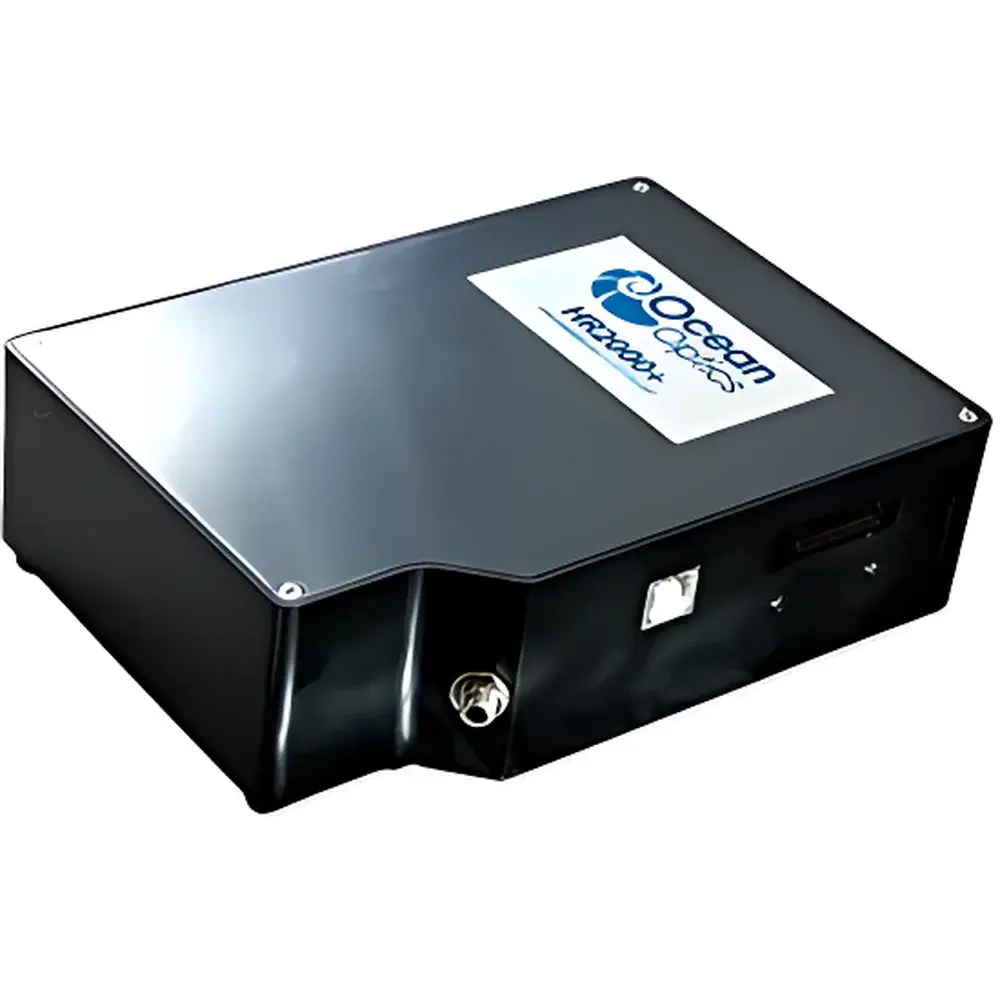
Ocean Optics HR2000+ High-Resolution UV-Vis-NIR Spectrometer
| Brand | Ocean Optics |
|---|---|
| Origin | USA |
| Model | HR2000+ |
| Wavelength Range | 200–1100 nm |
| Slit Width | 5 µm |
| Optical Resolution (FWHM) | ~0.035–0.12 nm (configurable) |
| Detector | 2048-pixel CCD array |
| A/D Converter | 2 MHz |
| Interface | USB 2.0 or RS-232 |
| Full Spectra Acquisition Rate | Up to 1000 spectra/s |
| Onboard Programmable Microcontroller | Yes |
| Digital I/O | 10 programmable pins |
| Analog Input/Output | 1 each |
| Trigger Support | External TTL, analog, or software |
Overview
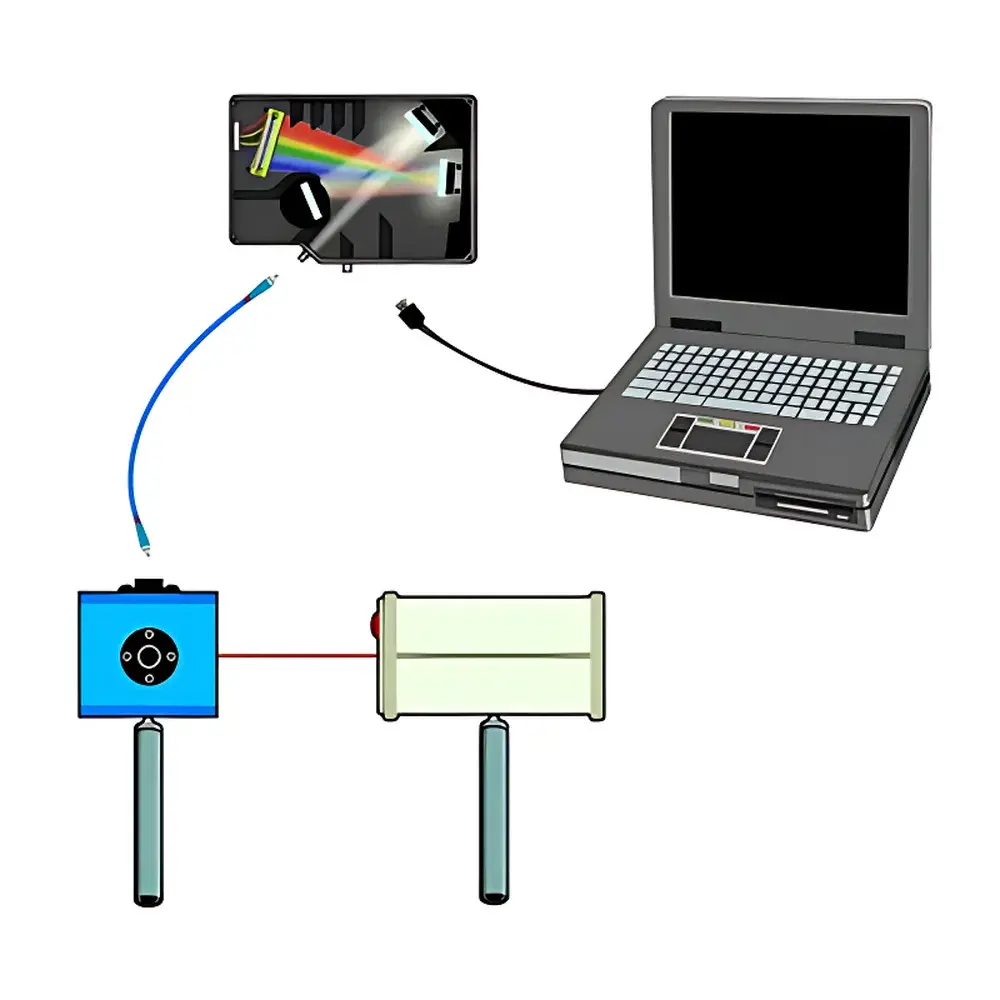
The Ocean Optics HR2000+ High-Resolution UV-Vis-NIR Spectrometer is a modular, research-grade optical spectrometer engineered for precision spectral characterization across the ultraviolet, visible, and near-infrared regions (200–1100 nm). It operates on the principle of Czerny-Turner optical dispersion, utilizing a symmetric crossed-beam design with a 25.4 mm collimating/focusing mirror diameter and 101.6 mm focal length. Its core architecture integrates a high-resolution optical bench, a 2048-pixel linear CCD detector, a 2 MHz analog-to-digital converter, and an embedded programmable microcontroller — enabling real-time spectral acquisition, onboard signal conditioning, and synchronized external device control. The system is optimized for applications demanding high spectral fidelity, including laser line profiling, plasma emission analysis, and dynamic process monitoring in industrial manufacturing environments.
Key Features
- Configurable optical resolution down to ~0.035 nm FWHM (dependent on grating selection, slit width, and wavelength range)
- Standard 5 µm entrance slit; optional slit widths available for trade-off between resolution and throughput
- High-speed spectral acquisition: up to 1000 full-spectrum reads per second via USB 2.0 interface
- Onboard 32-bit microcontroller supporting real-time integration time control, external triggering, and peripheral coordination
- 10 programmable digital I/O lines, one analog input, one analog output, and a built-in waveform generator for hardware-level synchronization
- Modular optical bench: user-selectable gratings (e.g., 1200, 1800, or 2400 grooves/mm), coatings, detector windows, and fiber coupling options
- Compliance-ready firmware architecture: supports timestamped data logging, metadata tagging, and audit-trail-capable operation when integrated with validated SpectraSuite software environments
Sample Compatibility & Compliance
The HR2000+ is compatible with diverse sampling geometries via fiber-optic interfacing, including cosine correctors for diffuse irradiance measurement, integrating spheres for absolute radiance calibration, and custom probe assemblies for in situ plasma or laser-induced breakdown spectroscopy (LIBS) applications. For high-power laser characterization (e.g., CW or pulsed Nd:YAG, CO₂, or diode lasers), attenuation is achieved using NIST-traceable neutral density filters, calibrated integrating spheres, or cosine receptor optics — preventing CCD saturation while preserving photometric linearity. The system adheres to foundational metrological standards underpinning spectroscopic instrumentation, including ISO/IEC 17025 requirements for calibration traceability and ASTM E334–22 guidelines for spectral bandwidth verification. When deployed in regulated environments (e.g., pharmaceutical process analytical technology or aerospace weld validation), configuration control, electronic signature support, and 21 CFR Part 11-compliant data handling are achievable through validated SpectraSuite deployment protocols.
Software & Data Management
SpectraSuite — Ocean Optics’ cross-platform spectral acquisition and analysis software — provides native support for HR2000+ hardware control, real-time spectral visualization, peak detection (including centroid, weighted center, and FWHM calculation), and batch export in CSV, ASCII, or HDF5 formats. Advanced users may leverage the SDK (C++, Python, LabVIEW, MATLAB) to embed spectral acquisition into custom automation frameworks. All spectral datasets include embedded metadata: acquisition timestamp (UTC), integration time, detector temperature (via onboard thermistor), grating ID, slit configuration, and user-defined sample identifiers. Audit trails record parameter changes, software version, and operator login events — essential for GLP/GMP-aligned workflows. Data integrity is preserved via checksummed binary storage and optional encryption at rest when configured within enterprise IT policies.
Applications
- Laser spectral diagnostics: precise determination of central wavelength, mode structure, sideband separation, and temporal stability in semiconductor, fiber, and solid-state lasers
- Laser-induced plasma spectroscopy (LIPS): elemental identification and relative quantification in laser welding plumes (e.g., Cu, Fe, Cr, Ni emissions in stainless steel or copper alloys)
- Real-time process monitoring: closed-loop feedback for laser power modulation and travel speed adjustment based on plume temperature (via Boltzmann plot analysis) and species ratio trends
- UV-Vis absorption/reflectance kinetics: reaction monitoring in photochemical synthesis or photocatalytic degradation studies (263–523 nm range demonstrated)
- Calibration transfer and instrument intercomparison: reference-grade stability enables cross-laboratory spectral harmonization under ISO 13406-2 and ASTM E275
FAQ
What is the minimum resolvable wavelength difference for the HR2000+?
The theoretical optical resolution depends on grating density, slit width, and focal length. With a 2400 grooves/mm grating and 5 µm slit, resolution approaches ~0.035 nm FWHM in the visible range; typical configurations yield 0.07–0.12 nm depending on setup.
Can the HR2000+ measure pulsed lasers?
Yes — its microsecond-level integration time control and external TTL trigger input enable synchronization with nanosecond-to-millisecond pulse sources, provided optical attenuation prevents detector saturation.
Is NIST-traceable calibration available?
Ocean Optics offers factory calibration services traceable to NIST Standard Reference Materials (e.g., HG/Ar, Ne, and Xe emission lamps; tungsten halogen continuum sources), with certificate of calibration including uncertainty budgets.
How is thermal drift managed during extended measurements?
The CCD detector includes an onboard thermistor; SpectraSuite supports temperature-compensated wavelength calibration and dark-current subtraction routines, improving spectral stability over multi-hour acquisitions.
Can multiple HR2000+ units be synchronized?
Yes — via shared external clock signals or master/slave triggering through the 30-pin connector, enabling multi-channel spectral capture for spatially resolved or polarization-diverse measurements.





