
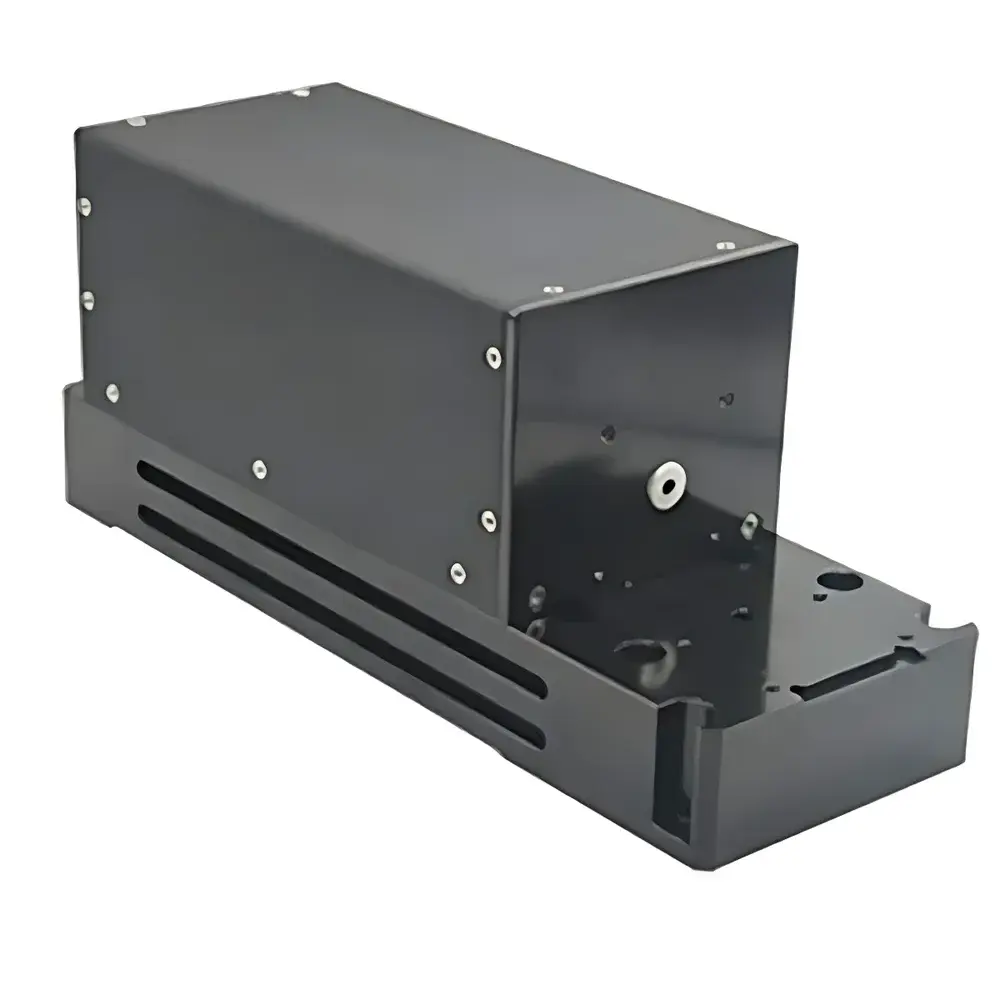
RealLight MCO Series Energy-Tunable Spatial-Output Microchip Laser
| Brand | RealLight |
|---|---|
| Origin | Beijing, China |
| Model | MCO Spatial-Output |
| Wavelengths (nm) | 1064 / 532 / 355 / 266 |
| Repetition Rate | 1–200 Hz |
| Max. Pulse Energy (spatial output) | 60 µJ @ 1064 nm, 30 µJ @ 532 nm, 25 µJ @ 355 nm, 15 µJ @ 266 nm |
| Pulse Width | ≤1 ns |
| Beam Divergence (full angle, 1/e²) | ≤2 mrad (horizontal & vertical) |
| Polarization Ratio | ≥100:1 |
| Beam Mode | TEM₀₀ |
| Energy Stability (RMS) | ≤3% |
| Energy Tuning Step Accuracy | ≤2% |
| Trigger Jitter (optical trigger) | <100 ps |
| Power Supply | 24 V DC |
| Input Voltage Range (adapter included) | 90–260 V AC |
| Peak Power Consumption | <20 W |
| Average Power Consumption | <10 W |
| Dimensions (W×H×L) | 82 × 102.8 × 240 mm |
| Operating Temperature | 15–35 °C |
| Storage Temperature | 0–60 °C |
| Control Interface | RS-232 |
| Modulation Input | TTL 0–5 V, SMB connector |
| Enclosure | Fully sealed, industrial-grade housing |
Overview
The RealLight MCO Series Energy-Tunable Spatial-Output Microchip Laser is a compact, solid-state pulsed laser system engineered for precision applications requiring sub-nanosecond temporal resolution and stable spatial beam delivery. Based on monolithic Nd:YAG or Nd:YVO₄ gain media with intracavity harmonic generation, the MCO platform delivers fundamental (1064 nm) and frequency-converted output (532 nm, 355 nm, 266 nm) in a rigid, alignment-free microchip architecture. Its core measurement principle relies on Q-switched lasing dynamics within a short cavity (<5 mm), enabling high peak power, excellent beam quality (TEM₀₀), and low timing jitter—critical for time-resolved spectroscopy, LIBS, and single-shot imaging techniques. Unlike fiber-coupled or OEM modules, the MCO features free-space collimated output with divergence <2 mrad (1/e²), eliminating coupling losses and enabling direct integration into optical benches, microscope paths, or LIDAR receiver optics without realignment.
Key Features
- Sub-nanosecond pulse width (≤1 ns FWHM) with high temporal fidelity and optical trigger jitter <100 ps—enabling synchronization with ultrafast detectors and streak cameras.
- Digitally tunable pulse energy via integrated electro-optic attenuation module; software-controlled adjustment from minimum threshold to maximum rated output with ≤2% step accuracy.
- Repetition rate programmable from 1 Hz to 200 Hz, supporting both continuous and burst-mode operation (16–200 Hz burst capability).
- Hermetically sealed, conduction-cooled mechanical housing (82 × 102.8 × 240 mm) designed for long-term stability in laboratory and light-industrial environments (15–35 °C operating range).
- RS-232 interface and bundled PC-based control software provide full remote configuration of repetition rate, energy setpoint, trigger mode, and status monitoring—including real-time energy feedback and error logging.
- Compliant with IEC 60825-1:2014 Class 4 laser safety requirements when operated at maximum output; includes interlock circuitry and emission indicator per EN 60825-1.
Sample Compatibility & Compliance
The MCO Series is compatible with standard optical mounts (e.g., kinematic mirror mounts, translation stages) and integrates seamlessly into vacuum-compatible or ambient-air optical setups. Its spatially defined Gaussian beam (M² < 1.1) supports diffraction-limited focusing for micromachining, ablation, and nonlinear excitation. The system meets electromagnetic compatibility standards per CISPR 11 Group 1, Class B, and conforms to RoHS 2015/863/EU directives. For regulated environments—including GLP-compliant analytical labs and medical device R&D—the firmware supports audit-trail-enabled operation logs and user-access-level authentication (via optional software license). While not FDA-cleared as a medical device, its 266 nm and 355 nm variants are widely deployed in USP compliant fluorescence lifetime measurement systems and ASTM E2926-22 LIBS validation protocols.
Software & Data Management
The included RealLight Laser Control Suite (v3.2+) runs on Windows 10/11 (64-bit) and provides deterministic command-response latency (<5 ms) over RS-232. Key functions include pulse energy calibration curves per wavelength, automated energy stabilization routines using internal photodiode feedback, and export of timestamped energy traces (CSV/TXT). All configuration changes are logged with UTC timestamps, operator ID, and parameter deltas—supporting 21 CFR Part 11 compliance when paired with validated IT infrastructure and electronic signature modules. Remote monitoring via TCP/IP bridge (optional add-on) enables integration into LabVIEW, Python (PySerial), or MATLAB environments using documented ASCII command protocol.
Applications
- Laser-Induced Breakdown Spectroscopy (LIBS): High peak irradiance (>1 GW/cm² achievable with <50 µm focus) ensures robust plasma initiation across conductive and dielectric samples.
- Raman Spectroscopy: Low timing jitter and narrow spectral bandwidth (<0.1 nm FWHM at 532 nm) minimize background fluorescence interference in time-gated detection schemes.
- Laser Capture Microdissection (LCM): Sub-µm spatial resolution enabled by diffraction-limited TEM₀₀ output and minimal pointing instability (<5 µrad RMS over 8 hours).
- UV Photolithography & Thin-Film Ablation: 266 nm output supports maskless patterning of polymer resists and transparent conductive oxides with minimal thermal damage zone.
- Time-of-Flight LIDAR Development: Synchronized optical triggering allows precise distance calibration against reference targets with picosecond-level uncertainty propagation.
- Semiconductor Defect Inspection: Multi-wavelength capability enables comparative photoluminescence mapping across bandgap-sensitive layers (e.g., Si, GaN, perovskites).
FAQ
Is the MCO laser suitable for vacuum chamber integration?
Yes—the fully sealed, non-outgassing aluminum housing and absence of internal fans or lubricants make it compatible with moderate vacuum environments (<10⁻³ mbar); optional CF flange mounting kits available upon request.
Can pulse energy be stabilized in real time during extended measurements?
Yes—internal photodiode feedback loop enables closed-loop energy regulation with <±1.5% deviation over 4-hour continuous operation at 100 Hz.
What safety certifications does the system carry?
CE marked per 2014/35/EU (Low Voltage Directive) and 2014/30/EU (EMC Directive); laser classification per IEC 60825-1:2014; full test reports available under NDA.
Is OEM integration support provided?
Yes—RealLight offers mechanical drawings (STEP/IGES), electrical interface schematics, and SDK documentation for embedded controller integration; custom firmware builds available for volume orders.
How is wavelength selection implemented across the MCO series?
Each model is factory-configured for a fixed wavelength; multi-wavelength operation requires separate units or external harmonic separation optics—not internal switching.





