
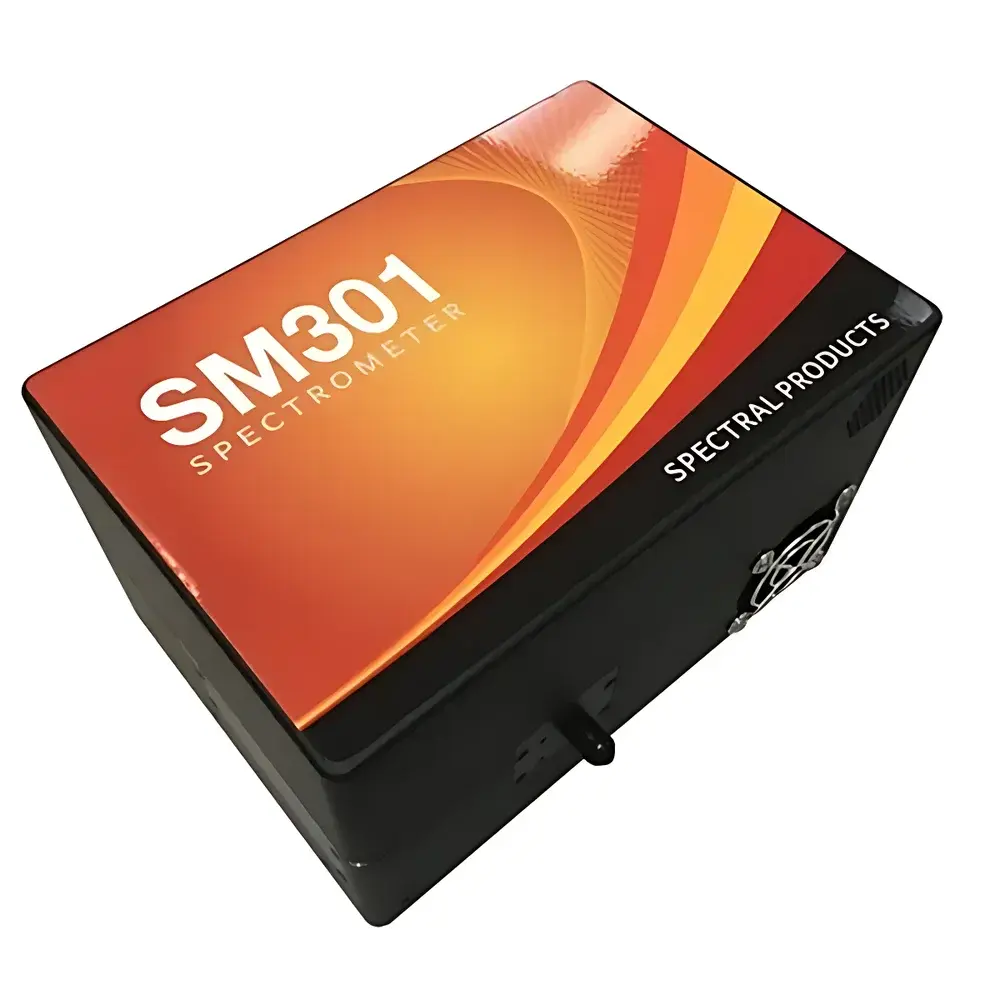
Spectral Products SM301/SM301-EX Dispersive Portable Mid-Infrared Spectrometer
| Brand | Spectral Products |
|---|---|
| Origin | USA |
| Model | SM301 / SM301-EX |
| Instrument Type | Portable |
| Spectral Range | 1.0–3.0 µm (PbS) or 1.5–5.0 µm (PbSe) |
| Spectral Resolution | 10–30 nm (dependent on slit width and grating) |
| Detector | 256-element PbS or PbSe linear array |
| Pixel Size | 45 µm × 450 µm |
| Pixel Clock | up to 2 MHz |
| Data Output Rate | up to 4 MHz |
| Integration Time | 0.01–200 ms (onboard) |
| Slit Options | 10, 25, 50, 100 µm (default: 25 µm) |
| f/# | 3.5 |
| Cooling | TE-cooled to –15 °C ARO (down to –20 °C ARO optional) |
| Dark Noise | ~20 RMS counts (16-bit, balanced) |
| SNR | 4000:1 |
| Stray Light | < 0.1% |
| Interface | USB 1.1/2.0, 16-bit |
| Software | SM32Pro & SMProMX (Windows XP–10, 32/64-bit), DLL & SDK included |
| Dimensions | 173 × 120 × 98.1 mm |
| Weight | 2.5 kg |
| Optical Coupling | SMA 905 or FC connector |
| Trigger Modes | Free-running or external TTL |
Overview
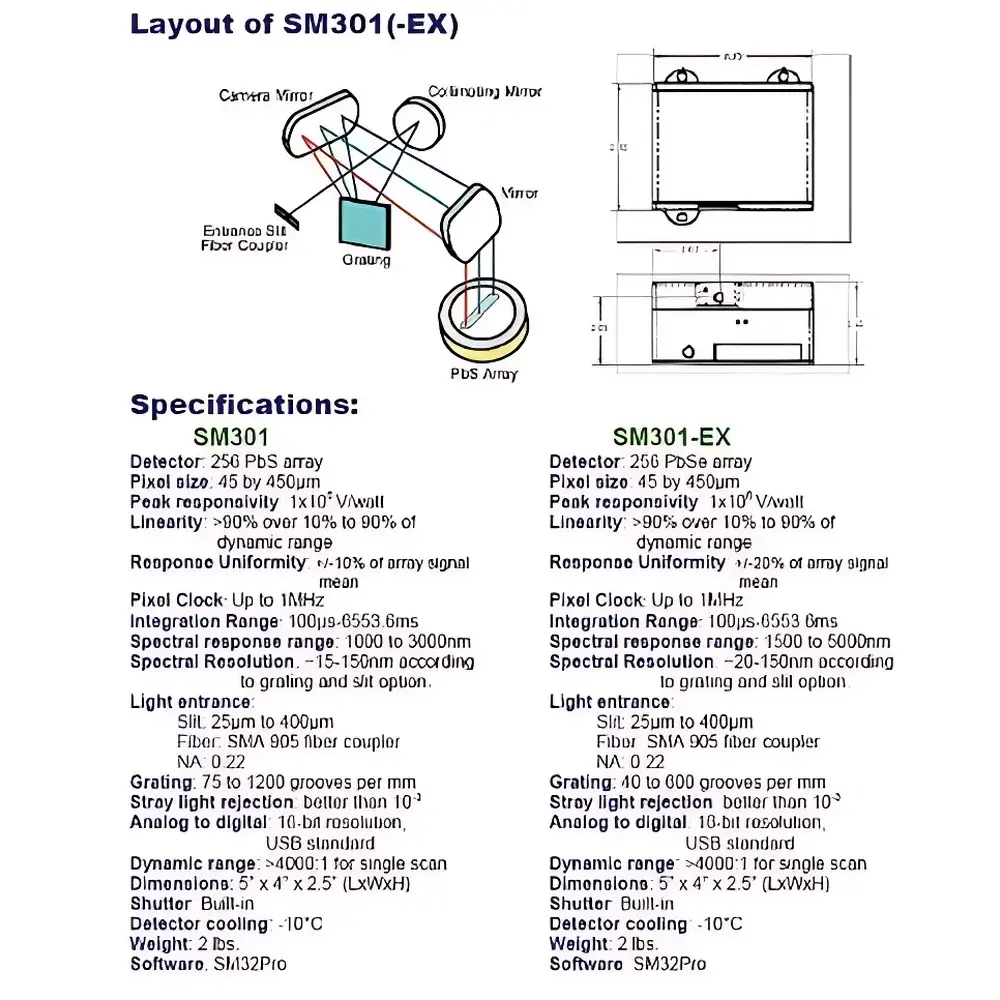
The Spectral Products SM301 and SM301-EX are compact, TE-cooled dispersive mid-infrared spectrometers engineered for high-fidelity spectral acquisition in demanding field and laboratory environments. Based on the Czerny-Turner optical architecture with optimized cross-beam alignment, these instruments employ a 256-element linear PbS (SM301) or PbSe (SM301-EX) photodetector array to deliver simultaneous multi-channel detection across the 1.0–3.0 µm (PbS) or 1.5–5.0 µm (PbSe) spectral bands. Unlike scanning monochromator-based systems, the SM301/SM301-EX leverages multiplexed array readout—enabling full-spectrum capture in a single integration cycle—thereby eliminating mechanical wavelength scanning artifacts and significantly improving measurement throughput and signal reproducibility. The integrated thermoelectric cooler maintains detector stability at –15 °C ARO (ambient-referenced offset), reducing dark current drift and enabling long-term baseline consistency essential for quantitative NIR/MIR analysis. All optical train components—including collimating/focusing mirrors, holographic or ruled diffraction gratings, and precision-machined slits—are housed within a rigid aluminum chassis designed for mechanical robustness and thermal inertia.
Key Features
- TE-cooled PbS or PbSe linear array detector (256 pixels, 45 µm × 450 µm active area) for low-dark-current operation and enhanced thermal stability
- Configurable spectral resolution (10–30 nm) via interchangeable slit widths (10, 25, 50, 100 µm) and application-optimized gratings
- Dual optical input paths: direct slit coupling for maximum radiometric fidelity or SMA 905/FC fiber interface for remote or in-situ sampling
- Onboard mechanical shutter synchronized with detector readout for precise dark-reference acquisition and auto-dark-correction cycles
- High-speed data acquisition with up to 4 MHz output rate and programmable integration times from 0.01 ms to 200 ms
- F/# 3.5 optical design ensuring efficient light throughput while maintaining stray light suppression (< 0.1%)
- USB 2.0 interface with 16-bit digitization and native support for Windows OS (XP through Win10, 32/64-bit)
- Built-in firmware-level trigger modes: free-running acquisition or external TTL synchronization for time-resolved or process-integrated measurements
Sample Compatibility & Compliance
The SM301/SM301-EX supports transmission, reflectance, absorbance, and emission measurements across gaseous, liquid, and solid-phase samples—particularly suited for hydrocarbon analysis, polymer characterization, moisture quantification, and combustion gas monitoring. Its spectral coverage aligns with fundamental vibrational overtones and combination bands critical for industrial QC (e.g., ASTM E1655 for NIR spectroscopy) and environmental compliance testing (e.g., EPA Method 25A for methane detection). While not pre-certified as a medical device, the instrument’s stable thermal management, calibrated linearity (>90%), and pixel uniformity (±10% peak-to-peak) meet foundational requirements for GLP-compliant spectral data generation. Full audit trail capability is enabled via SMProMX software when paired with user-defined metadata logging and timestamped raw-data export (CSV, binary).
Software & Data Management
The spectrometer ships with SM32Pro (for basic acquisition and calibration) and SMProMX (advanced spectral processing suite), both supporting real-time plotting, spectral averaging, baseline correction, peak identification, and user-defined mathematical operations. A comprehensive SDK—including C/C++, .NET, and LabVIEW-compatible DLLs—enables integration into custom automation frameworks, SCADA systems, or LIMS environments. Raw spectral data are stored in vendor-neutral formats (ASCII CSV and binary) with embedded metadata (wavelength array, integration time, temperature, shutter state). The software enforces traceable data handling: each acquisition record includes hardware timestamps, detector temperature logs, and automatic dark/reference flagging—facilitating 21 CFR Part 11 readiness when deployed with appropriate organizational controls (e.g., electronic signatures, access logs).
Applications
- Real-time hydrocarbon composition analysis in refinery streams and fuel blending
- In-line moisture monitoring in pharmaceutical tablet granulation and drying processes
- Non-destructive quality control of polymer films, coatings, and composites
- Field-deployable emissions profiling for natural gas infrastructure leak detection
- Research-grade spectroscopy of semiconductor materials and quantum dot photoluminescence
- Environmental sensing of atmospheric CO, CO₂, CH₄, and NOₓ via open-path or multipass cell configurations
FAQ
What is the difference between the SM301 and SM301-EX models?
The SM301 uses a PbS detector optimized for 1.0–3.0 µm; the SM301-EX employs a PbSe detector covering 1.5–5.0 µm, offering extended sensitivity in the longer-wave MIR region.
Can the SM301/SM301-EX operate without a computer?
No—the instrument requires host PC control for configuration, data acquisition, and power regulation via USB; it does not feature standalone memory or display.
Is spectral calibration traceable to NIST standards?
Yes—each unit is factory-calibrated using NIST-traceable tungsten-halogen and rare-earth oxide sources; calibration files (.cal) are user-loadable and editable.
How is dark current compensated during measurement?
The onboard mechanical shutter automatically acquires dark frames synchronized to integration timing; dark subtraction is applied in real time or post-acquisition via software.
What optical interfaces are supported for fiber coupling?
Standard SMA 905 connectors are provided; FC adapters are available as optional accessories for compatibility with telecom-grade fiber systems.





