
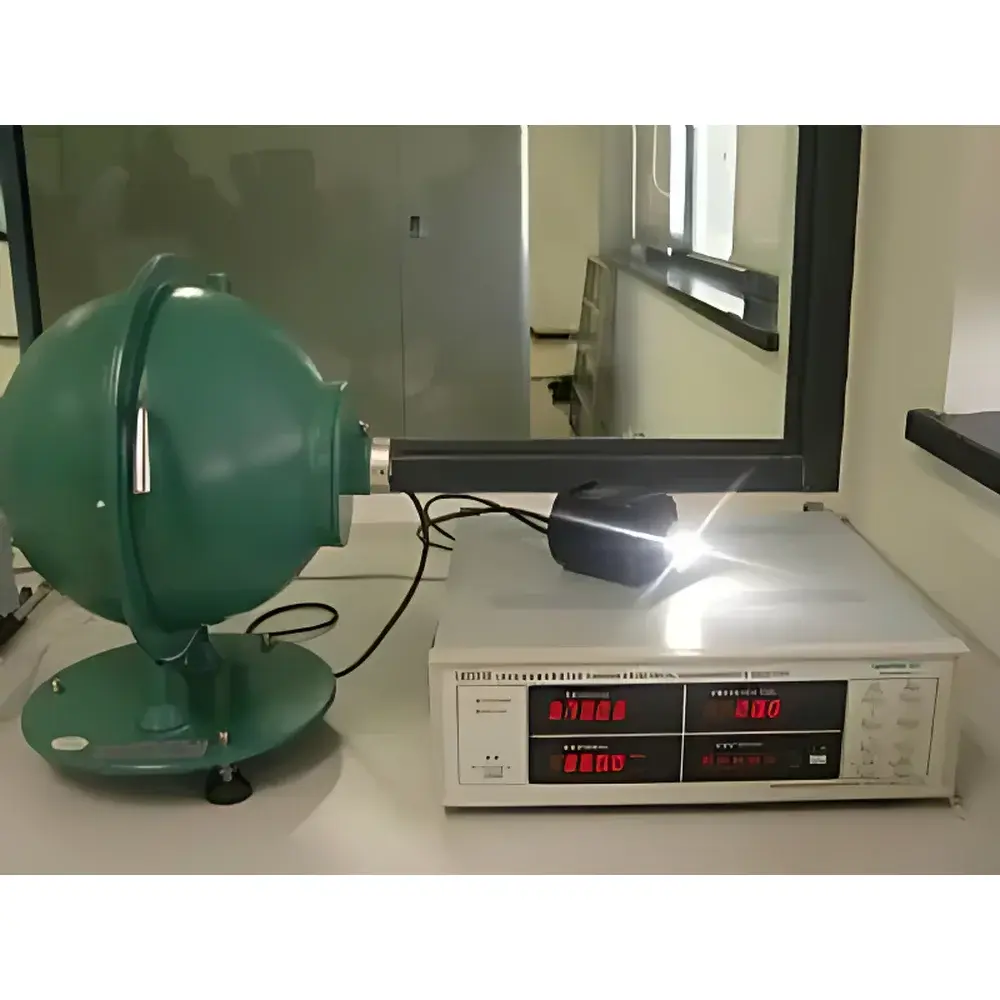
SPL SPL Mid-Size & Large-Source Photometric and Radiometric Testing System
| Brand | SPL |
|---|---|
| Origin | USA |
| Manufacturer Type | Authorized Distributor |
| Product Origin | Imported |
| Model | SPL Mid-Size & Large-Source Photometric and Radiometric Testing System |
| Pricing | Available Upon Request |
Overview
The SPL Mid-Size & Large-Source Photometric and Radiometric Testing System is a turnkey optical metrology platform engineered for high-accuracy, traceable characterization of medium-to-large-area light sources—including fluorescent lamps, incandescent bulbs, HID (High-Intensity Discharge) lamps, and projection lighting systems. Built around a thermoelectrically cooled (TE-cooled) high-sensitivity CCD spectrometer, the system implements absolute photometric and radiometric measurement principles based on spectral integration and calibrated detector responsivity. Its core architecture adheres to fundamental photometric definitions per CIE Publication No. 127 and ISO/CIE 130-1, ensuring compliance with international standards for luminous flux, illuminance, luminous intensity distribution, and chromaticity evaluation. All optical calibration data are NIST-traceable, providing documented uncertainty budgets aligned with ISO/IEC 17025 requirements for accredited laboratories.
Key Features
- TE-cooled back-illuminated CCD spectrometer with optimized quantum efficiency across 380–780 nm (visible) and extended range options up to 1100 nm (NIR)
- NIST-traceable spectral irradiance and spectral radiant flux calibration certificates included with each system
- Integrated auxiliary absorption-corrected reference source for real-time correction of self-absorption effects in high-power or geometrically complex lamps
- Support for both 2π (hemispherical) and 4π (full-sphere) total luminous flux measurements via configurable integrating sphere configurations (diameters: 0.3 m, 0.6 m, 1.0 m, and 1.5 m options)
- Real-time spectral acquisition at ≥10 spectra/sec with on-screen dynamic plotting and live parameter computation (CCT, CRI, TM-30 Rf/Rg, Duv, dominant wavelength, peak wavelength, spectral bandwidth, color purity, etc.)
- On-site recalibration and verification capability—no return-to-factory requirement—via embedded reference LED modules and software-guided validation routines
- High dynamic range (>1:10⁶) enabling accurate measurement of both low-luminance ambient lighting and high-intensity discharge sources without hardware reconfiguration
Sample Compatibility & Compliance
The system accommodates light sources ranging from compact linear fluorescent tubes to large-format LED arrays, automotive headlamps, and theatrical moving lights (up to 1.2 m in maximum dimension). Fixture mounting is facilitated by motorized XYZ stages with tilt/rotation adjustment, supporting IESNA LM-79-19 and EN 13032-1 compliant measurement geometries. Electrical parameter acquisition (voltage, current, power factor, harmonic distortion) is synchronized with optical capture using integrated Class A power analyzers meeting IEC 61000-4-7 requirements. All photometric outputs comply with CIE S 025/E:2015, ANSI C78.377, and ENERGY STAR Lamps V2.1 specifications. System documentation supports GLP/GMP audit readiness, including full electronic record retention, user access control, and FDA 21 CFR Part 11–compliant electronic signatures when paired with optional validation packages.
Software & Data Management
SPL LightLab™ v5.2 software provides a unified interface for instrument control, spectral acquisition, photometric computation, and report generation. It features automated workflow templates for LM-79, LM-80, and IES file export (IESNA LM-63 format), as well as customizable CSV/Excel and PDF reporting with embedded uncertainty analysis. Raw spectral data are stored in HDF5 format with metadata tagging (wavelength calibration coefficients, integration time, temperature logs, calibration date). Audit trails log all user actions, parameter changes, and calibration events. Optional cloud synchronization enables secure remote data review and multi-site comparison—fully compliant with ISO/IEC 27001 data handling protocols.
Applications
- LED module and luminaire development labs requiring traceable efficacy (lm/W) and chromaticity stability validation
- Third-party testing laboratories performing ENERGY STAR, DLC, and CE marking certification
- Automotive lighting OEMs validating headlamp beam pattern uniformity and spectral safety per UNECE Regulation 112
- Display backlighting R&D teams evaluating narrow-band phosphor performance and blue-pump leakage
- Research institutions conducting circadian lighting studies requiring precise melanopic EDI and α-opic irradiance calculations
- Government metrology institutes performing inter-laboratory comparisons under APMP or BIPM frameworks
FAQ
Does the system support both photometric and radiometric measurements?
Yes—the platform delivers simultaneous photometric (luminous flux, illuminance, luminous intensity) and radiometric (radiant flux, irradiance, radiance) outputs, with selectable CIE 1931 or CIE 2006 V(λ) weighting functions.
Can it measure UV or IR-emitting sources?
Standard configuration covers 380–780 nm; optional extended-range spectrometers (200–1100 nm) are available with quartz optics and deep-UV/NIR-optimized detectors.
Is firmware and software update support included?
Yes—SPL provides lifetime access to firmware updates and biannual major software releases, with version-controlled changelogs and backward-compatible data file handling.
What sphere sizes are supported for total flux measurement?
Configurable integrating spheres include 30 cm, 60 cm, 100 cm, and 150 cm diameters, each validated for <±1.5% spatial uniformity per CIE 84:1989.
How is NIST traceability maintained over time?
Each calibration certificate includes measurement uncertainty budgets, reference standard IDs, and expiration dates; users may schedule annual on-site verification using SPL-certified portable standards.




